


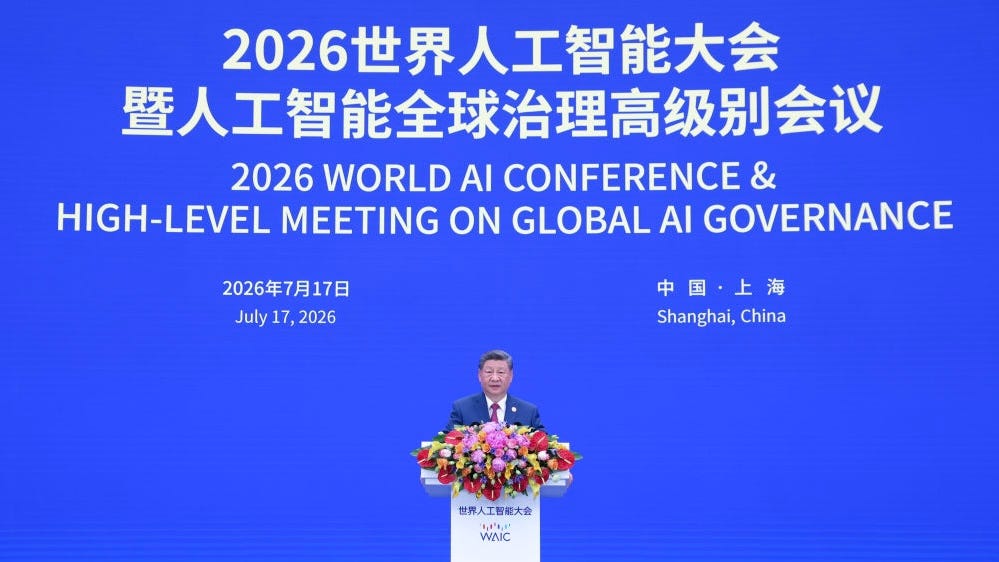
Xi Jinping recently gave the keynote speech (English version) at the 2026 World AI Conference in Shanghai. He emphasized China’s commitment to openness and sharing the benefits of AI with the rest of the world, presenting a stark contrast to the US approach of closed AI development.
But Xi’s speech wasn’t really about AI. It was about China’s broader foreign policy push.
For years, long before the rise of AI, Beijing has been tirelessly persistent in one single foreign policy goal: de-centering the US from the global order and elevating China’s image on the international stage.
AI represents the perfect moment for China’s foreign policy ambitions. AI is the hottest new technology of our time. And for the first time, China is at the forefront, running neck and neck with the US. Contrast this with previous waves of technologies, like the IT revolution, where China was lagging behind and just trying to catch up. (See my earlier piece on China’s technology long game.) Beijing is now seizing on this opportunity with AI to advance its own goals for a less US-centric world order.
America is Apple, China is Android
China’s main message to the world is: “We’re Android, and the US is Apple. The US offers a closed system where power and profits flow back to Washington and American corporations. China offers an open system where everyone, including the Global South, can participate and benefit.” (The reality, of course, is that China’s AI success today was built on America’s earlier openness in AI research and open-source models.)
Google famously invested billions of dollars in its open-source Android mobile operating system, not to make money selling the Android OS itself but to create an alternative to Apple’s iPhone. By empowering other smartphone makers like Samsung and a host of Chinese competitors, Google’s Android OS prevented an Apple monopoly and created space for a more open mobile ecosystem—that it benefited from selling ads through.
China’s “chipping away strategy”
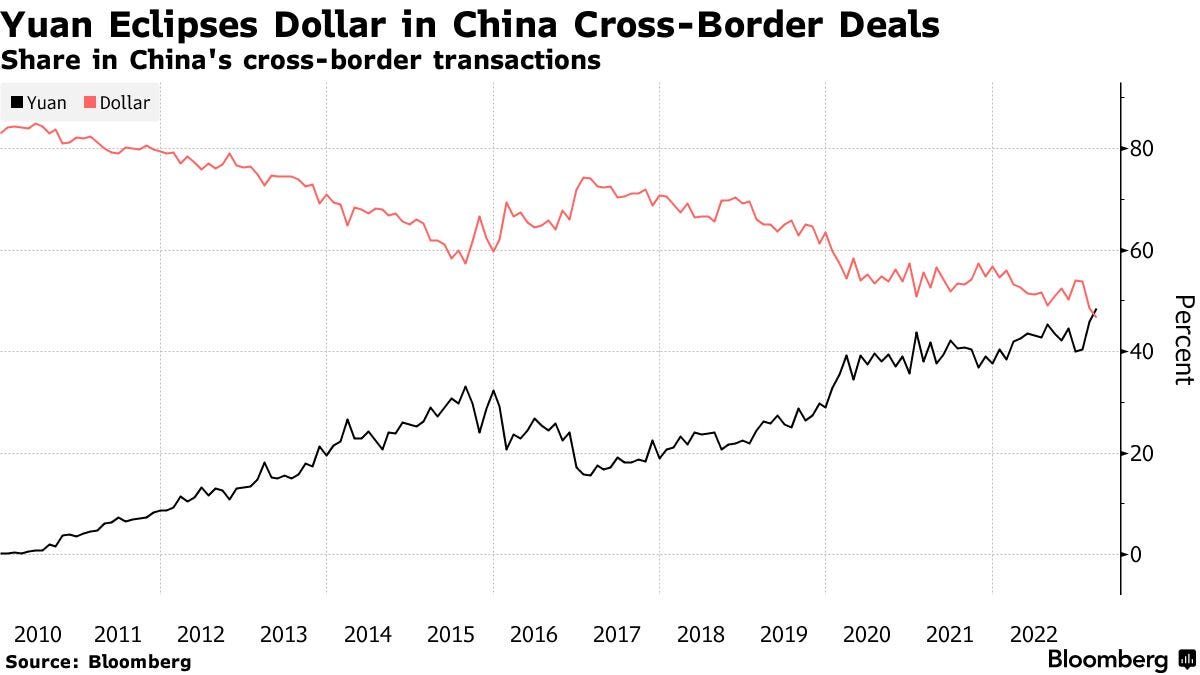
This is the basic idea behind China’s approach to foreign policy, not just for AI but more generally. China doesn’t want a world where key global systems—from technology to finance—are dominated or controlled by the US. China has not so much a foreign policy but an “anti” foreign policy. To this end, China pursues what I call a “chipping away strategy”: steadily eroding global dependence on US-led systems by building and promoting Chinese-led alternatives. The goal is not necessarily Chinese global dominance but a more multipolar world where the US can’t easily shut China out.
You can see this across many domains from China’s efforts to internationalize the RMB and create alternatives to the dollar-based payments system to the formation of new multilateral institutions such as BRICS and the Asian Infrastructure Investment Bank (AIIB) to China’s active role in shaping standards for new technologies such as 5G. The goal is not to replace the US-led system outright but to reduce its grip over the world gradually over time. (Of course, nothing that China does on this beats Trump’s own actions, as I wrote in Foreign Affairs.)
China’s AI diplomacy
AI represents a unique opportunity for China’s foreign policy ambitions. With AI, China is not trying to overturn a long-established paradigm, which is notoriously difficult, but shaping an emerging global architecture from the very beginning.
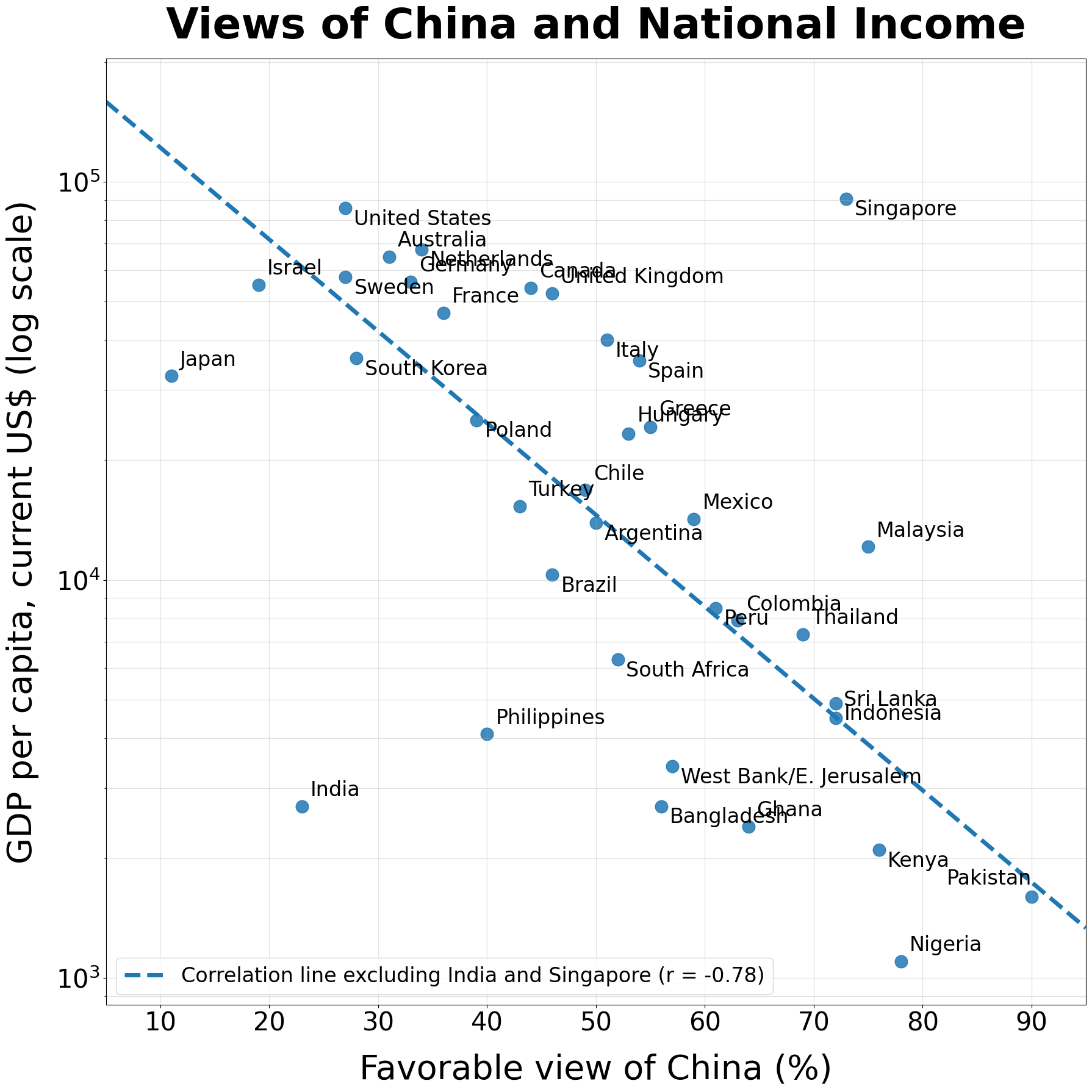
Chinese policymakers are leveraging the power and popularity of Chinese AI models to make a diplomatic point: Chinese open-source AI models keep the world from becoming dependent on a closed American AI oligopoly. Beijing casts China as the open partner and the US as the hegemonic gatekeeper willing to restrict access to technology for its own national interest.
That critique is plainly self-serving. China sees itself as the main target of US export controls and the broader securitization of technology. But the argument likely resonates because many countries already worry about overdependence on American technology platforms—a concern sharpened by recent US restrictions on Anthropic’s Fable model.
China’s AI diplomacy push is now in full swing. China brought together 29 countries to establish the World AI Cooperation Organization (WAICO, 世界人工智能合作组织), an intergovernmental body headquartered in Shanghai that China describes as an open and inclusive platform for global AI governance. AI has been showing up more in China’s bilateral ties with countries like Brazil and Pakistan, including promises to set up joint AI research centers, help build infrastructure, and support technical exchanges. (Interestingly, a lot of China’s bilateral cooperation on AI seems to be led directly by the NDRC.)
At this point, China’s AI diplomacy efforts don’t have much substance. China’s offer of providing “5,000 training opportunities in AI-related specialties” to people from developing countries is pretty meager (are these even funded by China?). A lot of the bilateral agreements are fairly high-level. But even just on a symbolic level, China is making a big splash. China is bolstering its self-image as a technology and development partner to the rest of the world in contrast with the US, which talks about exporting the American tech stack and getting other countries “addicted” to American technology.
China’s open-source AI approach
Central to Beijing’s message is its focus on “openness” 开放. This appears to dovetail nicely with the “open source” 开源 approach of Chinese AI companies. The two are related but not the same, and the difference matters.
Chinese AI companies and open source
Chinese AI companies are pursuing open source as a commercial strategy (and in some cases for principled reasons, like DeepSeek). Giving your models away for free turns out to be a powerful business strategy that offers Chinese AI companies several benefits:
Trust: Users might be skeptical of Chinese models and wonder if they might just be, say, re-routing queries to other models. By releasing model weights, users can see for themselves that these are legit models.
Reach: You can reach far more users with open-weight models, which can be deployed anywhere. Even if you’re compute-constrained (like Moonshot is currently with Kimi K3), your open model can be deployed across the vastly greater compute of other cloud platforms.
Branding: You come across as a team player, sharing technology with the world and making it accessible to everyone.
Control and customizability: You offer users greater control over the AI model and the ability to customize it for their own needs, including fine-tuning on their own data. This allows Chinese AI companies to offer a really unique value proposition compared with their closed US competitors, beyond just cost.
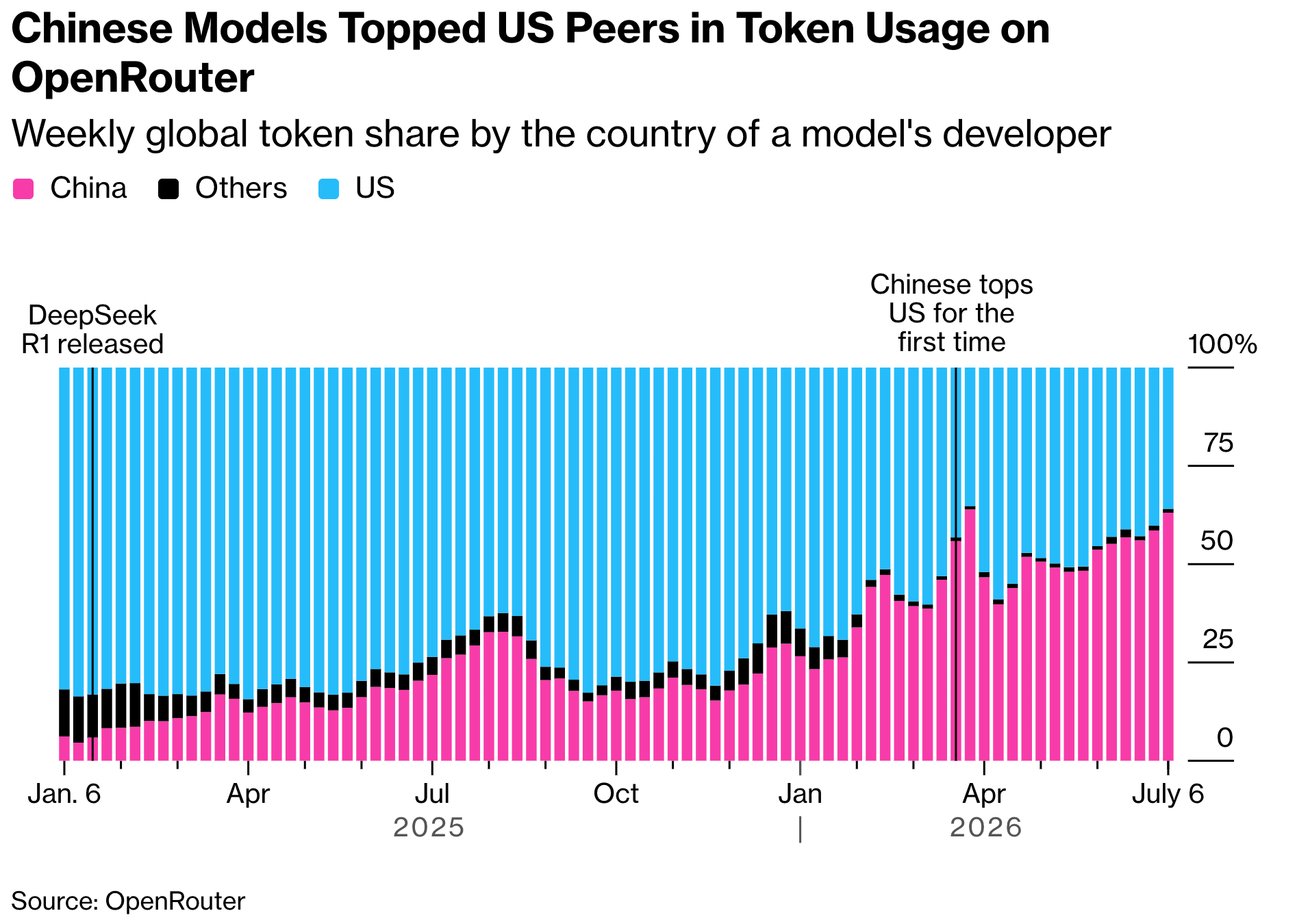
But there are downsides to an open-source approach: namely, it’s harder to make money. (You also don’t get as much direct user data to improve your models.) Chinese AI companies do sell API access to their own models. Some sell additional services, like customization. Chinese Big Tech companies like Alibaba, Tencent, and ByteDance are also using AI to boost their own ecosystem of services. But you’re ultimately cannibalizing your own sales to some extent by giving your models away for free.
Chinese AI companies are facing growing pressure to commercialize their AI services. Companies like DeepSeek, Alibaba, and ByteDance are spending heavily on their own compute infrastructure and even their own custom AI chips. Several Chinese labs recently went IPO, like Zhipu (aka Z.ai) and MiniMax, with Moonshot and potentially DeepSeek soon to follow. Investors want to see real cash flow to justify the increasing spending on models and infrastructure.
To boost revenue, Chinese AI companies have been raising API prices and turning to subscriptions. Moonshot more than tripled its API pricing, from $4 per million output tokens for K2.6 to $15 for K3. Zhipu has also been raising API prices for its latest GLM models. Chinese AI companies have also started promoting subscription plans for coding or agentic work, looking to secure the kind of recurring revenue that has helped turn OpenAI and Anthropic into $1 trillion companies.
Given these pressures to boost revenue, Chinese AI companies will likely shift toward a hybrid strategy, closing their best models but opening the rest. Alibaba was doing this earlier with Qwen3-Max. ByteDance already has a hybrid strategy where it open-sources some models but keeps its main Seedance and Seedream image and video generation models closed. Zhipu CEO Zhang Peng has argued that Chinese AI should “walk on two legs” (两条腿走路) and pursue open and closed AI as complementary approaches.
While the latest wave of Chinese AI models have been open—GLM 5.2, Kimi K3, Qwen3.8—they might have felt a little extra pressure to do so, if only to avoid undercutting Xi’s message of openness at WAIC. But in the longer run, it’s likely that Chinese AI companies will converge to some degree with their American competitors on closed models—as recent pricing trends already show. Yet even as Chinese labs move toward more closed models, they’re likely to remain structurally cheaper than their American rivals, thanks to lower infrastructure, energy, and labor costs—and a stronger emphasis on model efficiency.
Chinese policymakers and open source
At the same time, Beijing seems to be embracing “openness” if not outright “open source” in AI. Historically, Chinese policymakers have explicitly supported open-source software, since at least the 2017 New Generation AI Development Plan and the 14th Five-Year Plan. For Beijing, open source is a really important strategy for getting Chinese tech firms to help each other and multiply their progress across the entire Chinese ecosystem. This is especially crucial for getting over US technology chokepoints on semiconductors.
But for Beijing, the real message on AI is about “openness” rather than “open source” per se. This distinction was made by the head of Alibaba’s AI Governance Center, Fu Hongyu, on the SinoAI Insights podcast:
But I want to emphasize China’s national strategy. It’s not about open source, it’s about our own open development of AI. I think there’s kind of a technical difference between what technical experts been talking about and from the governance or national strategy level. We are talking about we want AI to be open. I think open model weights is just one way of doing that.
And when Xi mentions “open source” in his WAIC speech, he’s really talking about it in the broader context of openness on AI:
第一,坚持开放共赢,驱动创新发展。人工智能是世界经济增长的新引擎和新旧动能转换的加速器,正从“数字世界”走向“物理世界”。要抓住难得的历史性机遇,鼓励开源开放、合作共享,全面促进人工智能科技创新、产业发展、场景应用,协同推进传统产业改造升级、新兴产业培育壮大、未来产业前瞻布局,让人工智能赋能千行百业。
First, we must uphold openness (开放) and win-win cooperation to drive innovation-led development. AI is emerging as a new engine of global economic growth and an accelerator of the transition from old to new growth drivers, extending from the “digital world” into the “physical world.” We must seize this rare historic opportunity by encouraging open-source and openness (开源开放); cooperation and sharing; comprehensively advancing AI innovation, industrial development, and real-world applications; and coordinating the transformation and upgrading of traditional industries, the cultivation and expansion of emerging industries, and the forward-looking development of future industries. In this way, AI can empower every sector of the economy.
China’s AI pendulum swing
China’s policy approach to technology is like a pendulum that swings between Beijing’s primary goals of control and diffusion.
This is part of China’s classic development vs. security dilemma. We’ve seen this with China’s approach to previous technologies like the internet, IT systems, e-commerce, and digital payments. Now we’re seeing it in AI.
Before ChatGPT, China was stepping on the AI accelerator pedal. The 2017 New Generation AI Development Plan was largely about speeding up China’s progress in developing AI as a technology and integrating it across all domains of society. Then with ChatGPT and the rise of generative AI, China tightened controls on AI, treating it more like social media. The Cyberspace Administration of China began requiring AI models to be officially pre-registered and undergo a battery of tests for political content.
The surprising success of DeepSeek R1 last year pushed Beijing back into diffusion mode. Beijing was much more vocal in its support of open-source AI and soon launched the AI+ Initiative aimed at “promoting the broad and deep integration of AI across all industries and areas of the economy and society.” This was soon followed by spin-off plans focused on AI + Manufacturing and AI + Energy. The development-focused National Development and Reform Commission (NDRC) took the lead in coordinating much of China’s AI integration efforts. Much of this was reminiscent of China’s Internet+ diffusion strategy from a previous era.
But now the pendulum may be swinging back toward control as Beijing grows more concerned about AI risks.
Previously more dismissive of concerns over AI-driven job loss, Beijing now seems to be taking these risks more seriously (see Matt Sheehan’s great piece). China is also watching developments in the US very closely, particularly controls on Anthropic’s Mythos and Fable models over cyber risk. As Chinese open-source models approach similar levels of cyber capabilities, this could come back to bite and be used to potentially attack China’s own digital infrastructure.
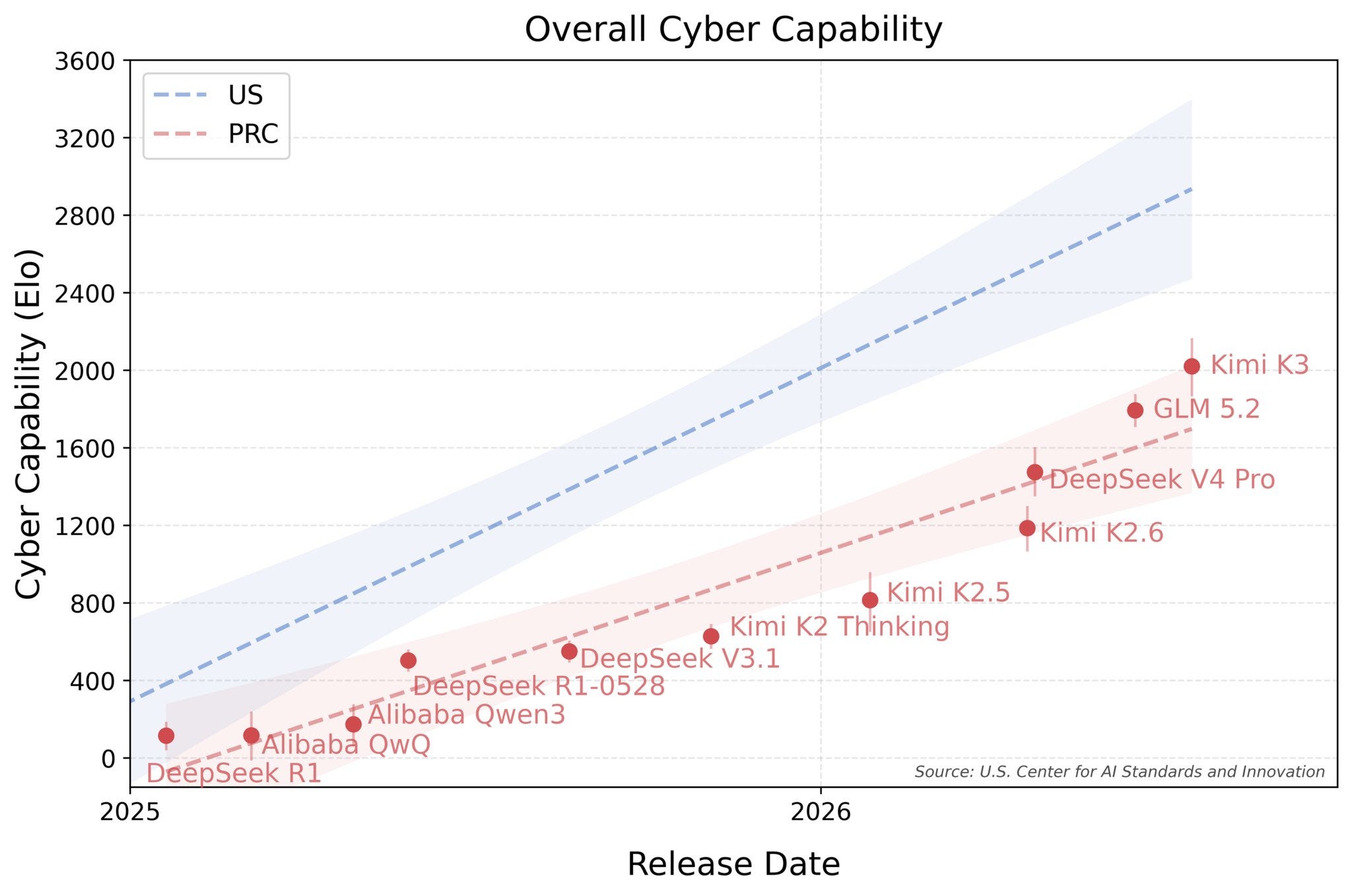
Beijing is also getting more worried about risks inherent to AI itself, such as loss of control and runaway autonomous systems. China’s new AI agent regulatory framework spends a lot of time on risks from AI agents, including “data poisoning, privacy leaks, algorithm tampering, system vulnerabilities, and operational instability.” In his WAIC speech, Xi mentions risks like “loss of control” (失控) and both “inherent and secondary risks” from AI (内生和衍生风险).
This AI safety and risk discussion has always been there in China. But now the difference is it’s percolating up to higher levels of the Party-state system.
For all of its talk of openness, Beijing has been taking new, more restrictive policy actions related to AI. Beijing blocked the sale of Manus, an agentic AI company originally founded in China, to Meta. Beijing has placed travel restrictions on key AI researchers, like at DeepSeek.
Now there’s speculation that China might restrict foreign access to top Chinese AI models. This last issue might be connected to a Supreme People’s Court discussion where several Chinese experts expressed “concerns that Chinese citizens’ personal data or sensitive geographic and economic data embedded in model weights could be reconstructed by foreign actors through reverse engineering.” (当我国具有优势的开源项目出海时,如何防范其中蕴含的我国公民隐私数据或核心地理、经济数据被境外势力通过逆向工程还原)
Going forward, I would not be surprised if China moved to a hybrid approach, restricting access to its top models but still offering strong open-source models. This would allow Beijing to have its cake and eat it too. China could mitigate some of the security and other AI risks while still claiming to support “openness” in global AI development.
Crucially, Xi ends his speech with a special note on China’s flexibility on AI:
“明者因时而变,知者随事而制。”人工智能技术发展越是一日千里,向上向善、造福人类的方向越要正确锚定,监管治理的尺度越要精准把握,防范失控的措施越要及时完善。
“The enlightened change with the times; the wise adapt to evolving circumstances.” The faster AI advances, the more firmly we must anchor its development in the right direction—toward positive ends and the benefit of humanity. We must also calibrate governance and regulation with greater precision and promptly strengthen safeguards against the technology spiraling out of control.
Basically, Xi is saying that AI is evolving so quickly that China will stay flexible in its approach. While this passage follows the section on AI risks, I think this flexibility also applies to open-source AI. China will always present itself as a supporter of open AI development but is giving itself wiggle room on open-source AI. In the end, China faces growing tension between its twin AI goals of control and diffusion. ■
Does China care about AGI?

Across many emerging technologies—quantum, fusion, space, etc.—Chinese and American policymakers share similar views on what’s at stake, even if their approaches to developing these technologies may differ. But on AI, arguably the most consequential technology of all, it’s puzzling how much of a divergence there is between Beijing and Washington. While …
China is running multiple AI races

I’ve just published a new piece with Brookings looking at how China’s AI strategy differs from the US focus on the race to AGI.
China's foreign policy influence over the developing world like African and South American nations is enormous. Why would they not want access to the best and cheapest models. You depict China like some clumsy propaganda machine who are not native to technology. I think China's AI Talent and companies preparing for application layer AI products, sophisticated large language models and physical AI products is going to surprise a lot of people.
That their AI startups and Robotics companies are going IPO before the West is notable. They've made incredible strides in many domains of technology and I think we can expect them to continue to do so. In spite not of not having access to the best AI chips, we have to give them some credit for what they have accomplished since the Advent of generative AI. Nor do I think we should underestimate their Global influence because a lot of the world's young people live in those developing countries that they have focused on.