


In April, an autonomous humanoid robot beat the human world record for the half-marathon, finishing in 50:26. What was truly surprising was who won. It wasn’t a robot made by Unitree, widely regarded as China’s robotics national champion. It was a robot made by Honor, a Chinese smartphone company.
How did a smartphone company make one of the most fastest humanoid robots in the world? (To be sure, Honor is a spinoff from Huawei and retains some of Huawei’s hardcore engineering DNA.)
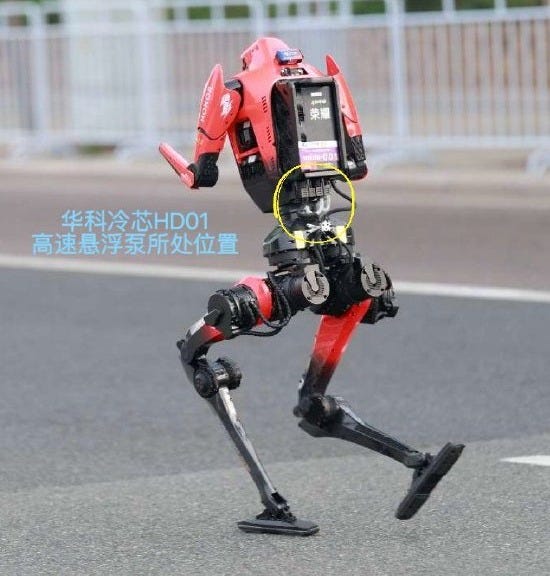
Interviews with the team afterwards revealed that Honor had a special edge: expertise in liquid cooling. To deal with overheating, many other robots in the half-marathon were loaded with ice or sprayed with liquid nitrogen during the race to cool them down.
The Honor team used their company’s experience developing liquid cooling systems for smartphones to create a similar thermal management system for their robots.
They brought together suppliers across China’s smartphone industry, such as Lens Technology and Lingyi, to build a network of pumps and “capillaries” that could move 4 liters of liquid per minute throughout the robot’s body down to the electric motors.
Honor’s shift into robotics might be surprising, but it’s not uncommon in China’s current tech industry.
Overlapping Ecosystems

Chinese tech firms aren’t staying in their lanes. They’re jumping across industries and sectors, moving from smartphones to EVs or EVs to robotics.
Previously, I’ve written about China’s overlapping tech-industrial ecosystems where overlapping supply chains and capabilities help to accelerate the development of new industries.
China’s world-class EV industry is built partly on China’s prior strengths in smartphone manufacturing and consumer electronics. EVs, drones, and robotics share many of the same core components, like batteries, sensors, and electronic controllers.
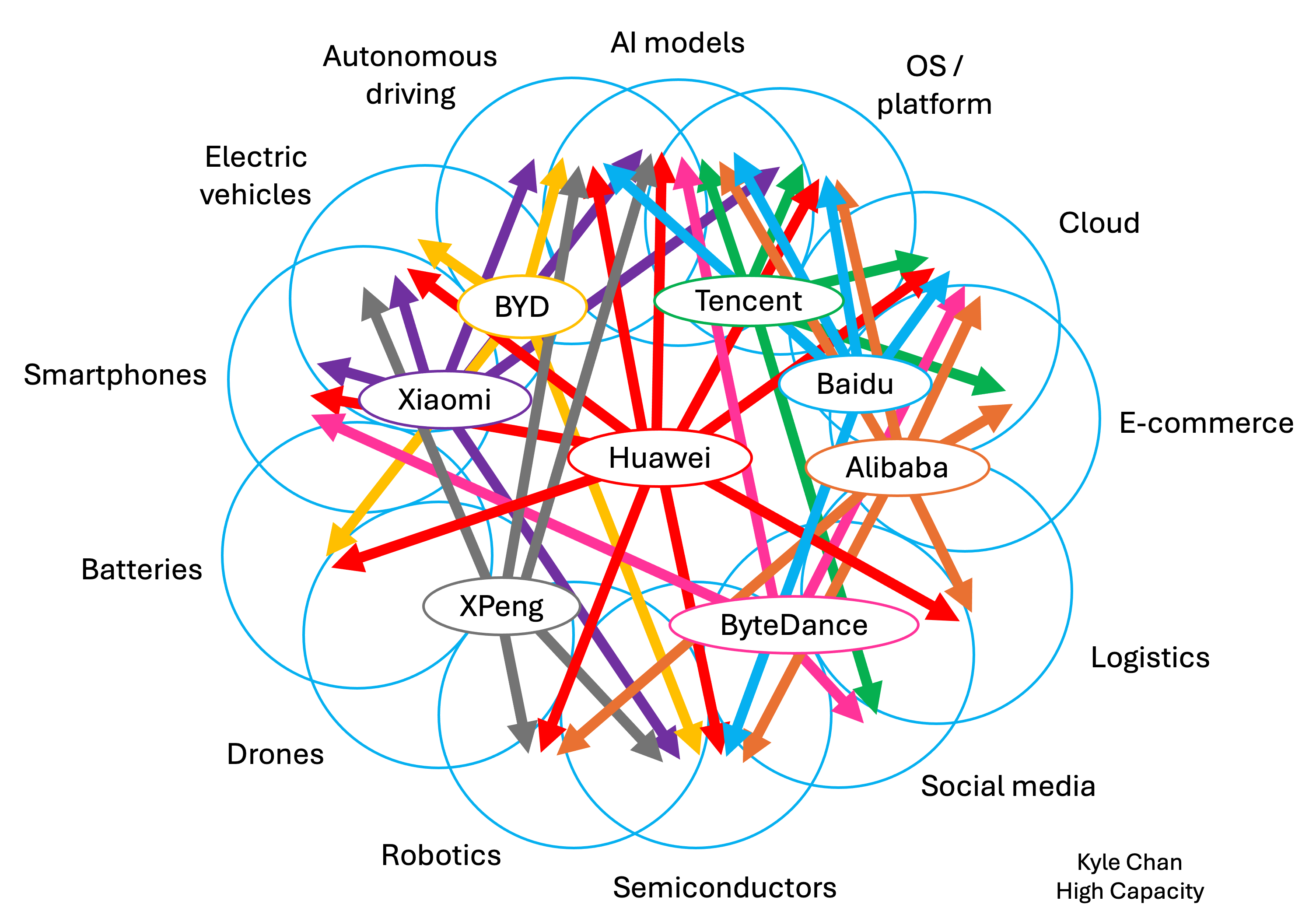
China’s tech Swiss Army knives
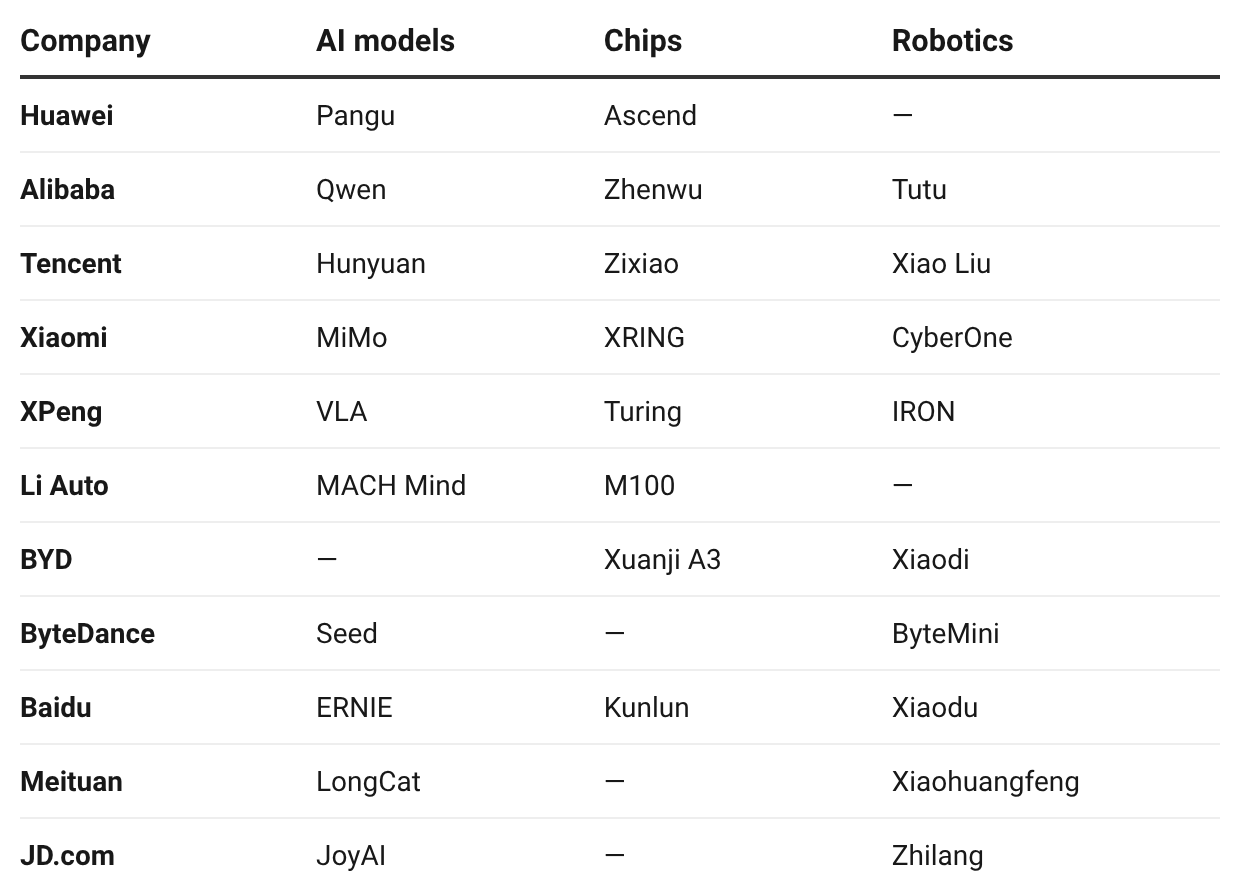
What’s new is how much these technologies are starting to converge in China.
People used to talk about Chinese tech firms competing in different racetracks (赛道), like the EV battle or the e-commerce battle. But now increasingly, Chinese tech firms are branching out and competing in the same spaces.
These days, nearly every major Chinese tech firm has its own AI models, custom chips, and robots. Instead of EV or robot companies, China now has all-in-one physical AI companies.
What’s driving China’s tech convergence?
The physical AI stack
China is mastering the building blocks of an emerging physical AI stack that combines AI and autonomous systems with the electric tech stack. The core elements include:
electric motors and actuators
sensors (lidar, millimeter-wave radar, cameras, force and torque sensors)
batteries
power electronics
semiconductors (silicon, SiC, GaN)
thermal management systems
AI models (LLMs, VLA, world models)
data collection pipelines
These building blocks are increasingly shared across EVs / autonomous vehicles, robotics, drones, smart logistics and transport infrastructure, data centers, smart grid infrastructure, and clean tech.
This allows Chinese tech firms to move from one sector to another, drawing on these shared ecosystems and capabilities.
The best example of this is the shift from Chinese EVs to humanoid robots.
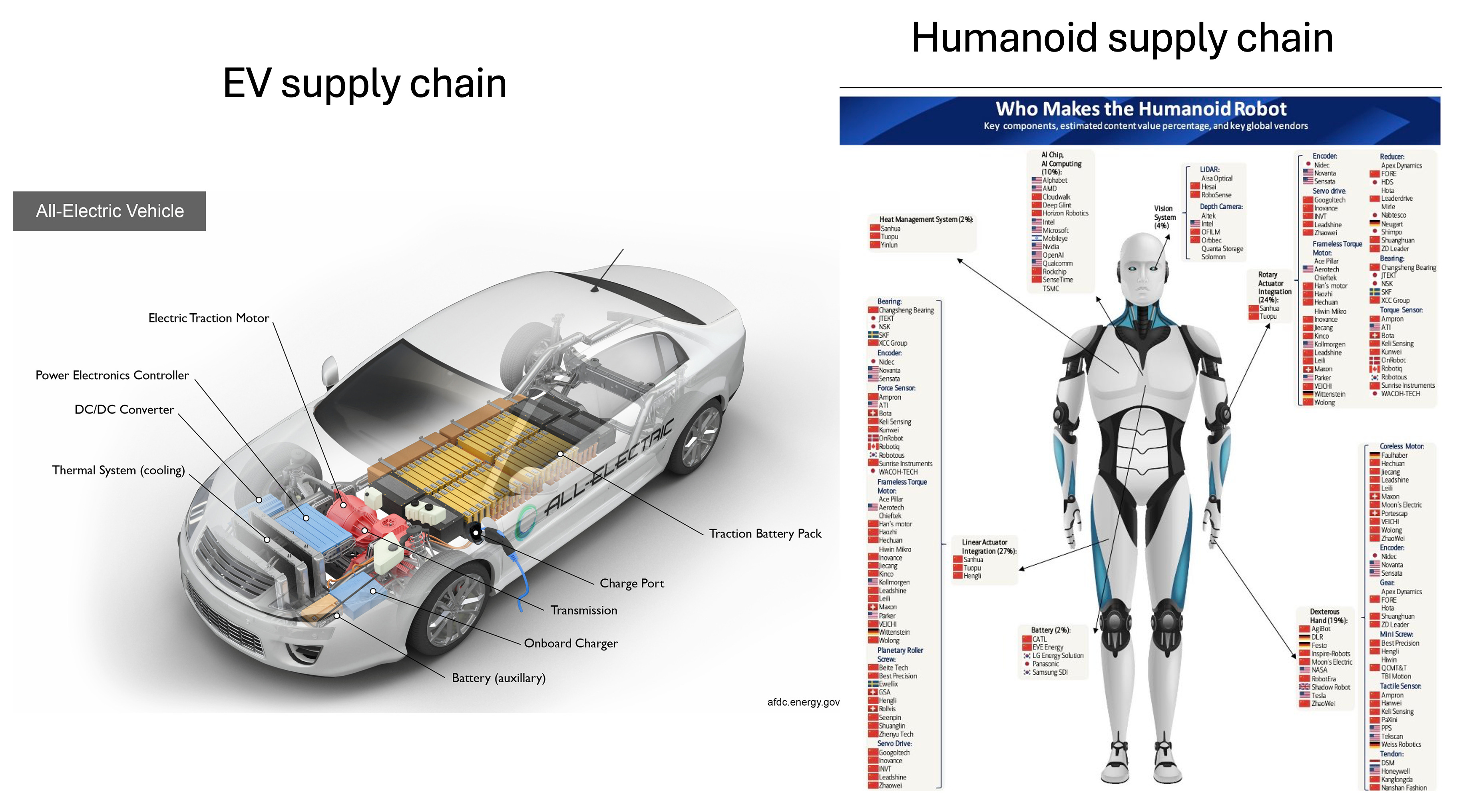
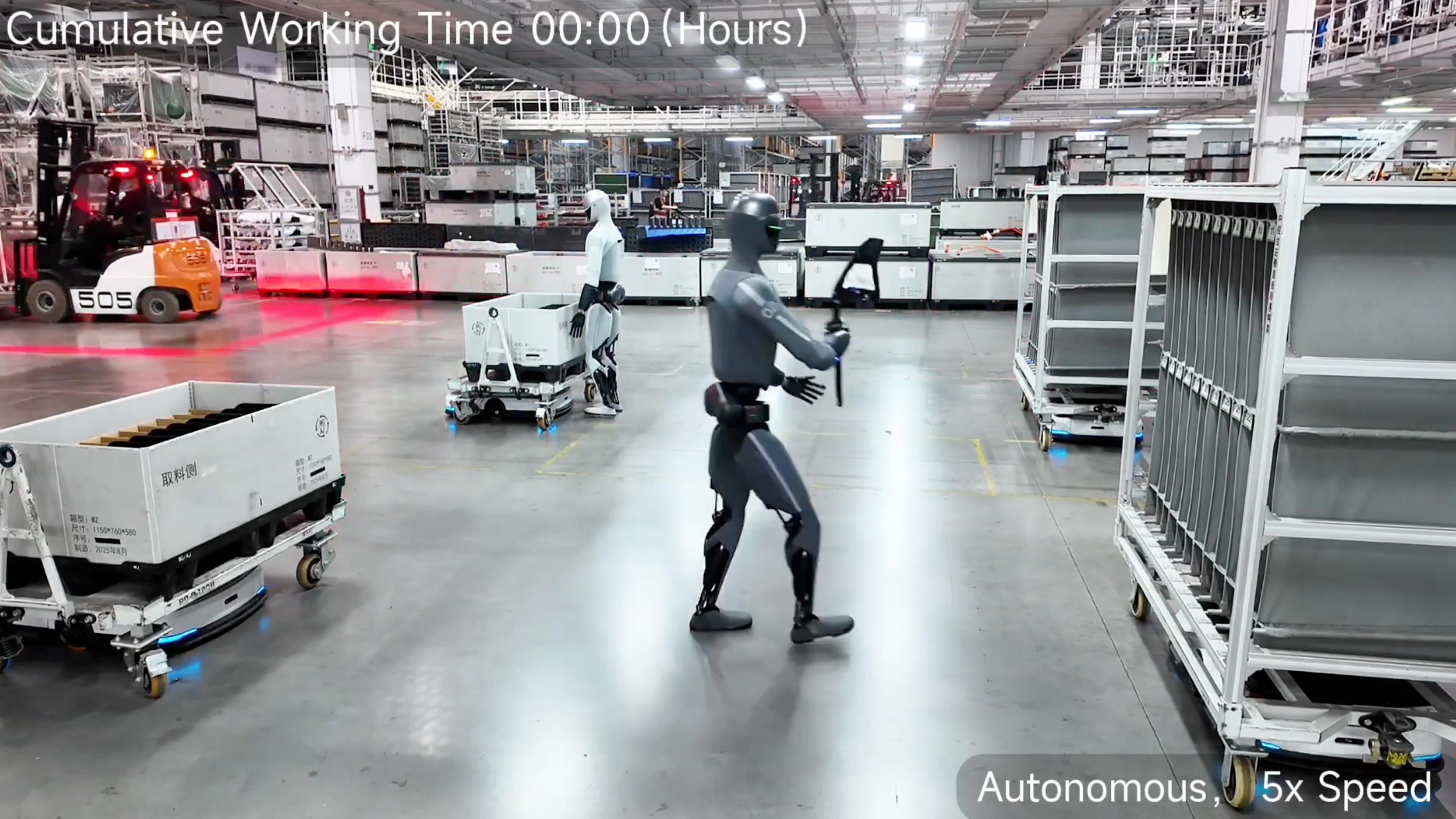
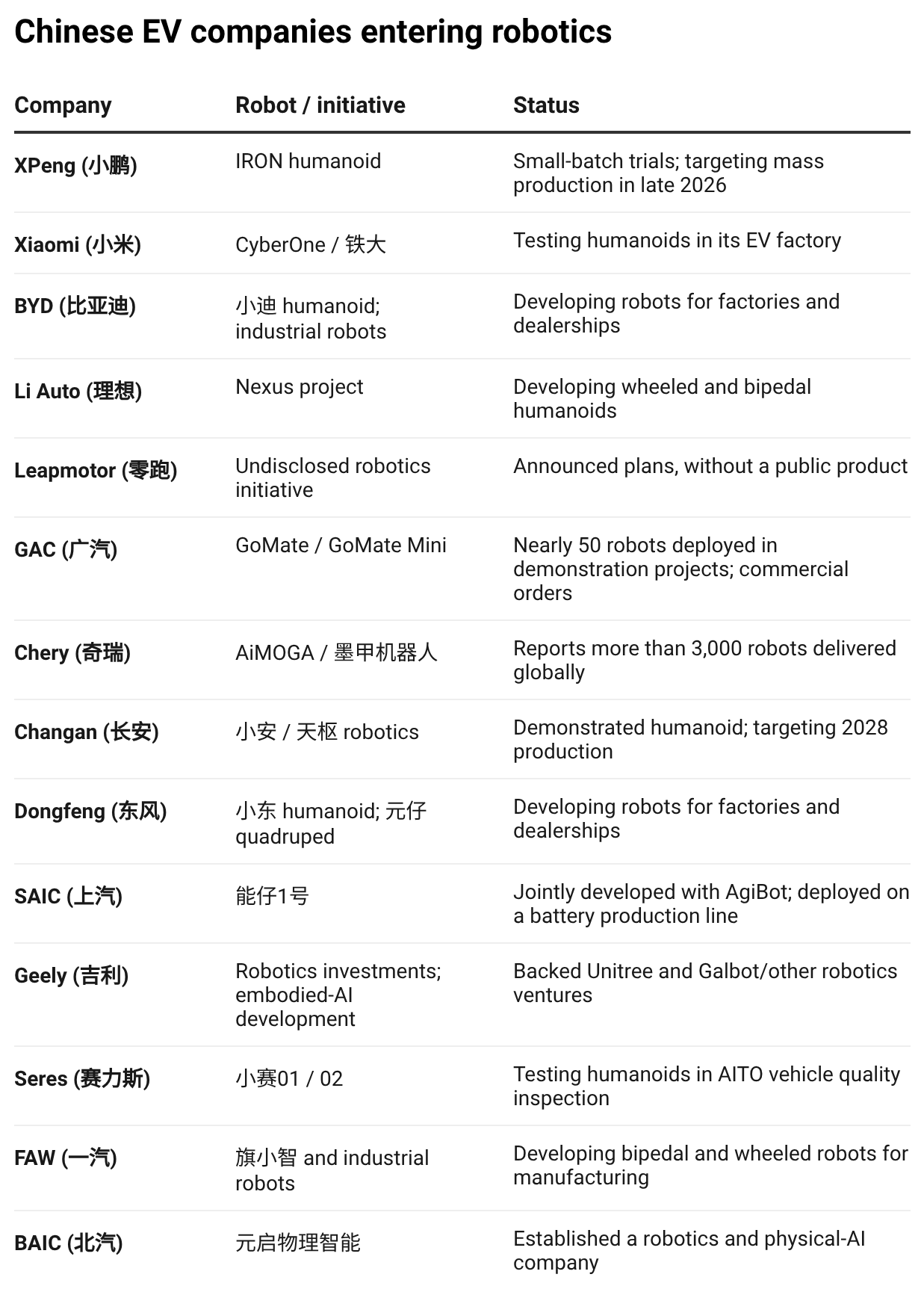
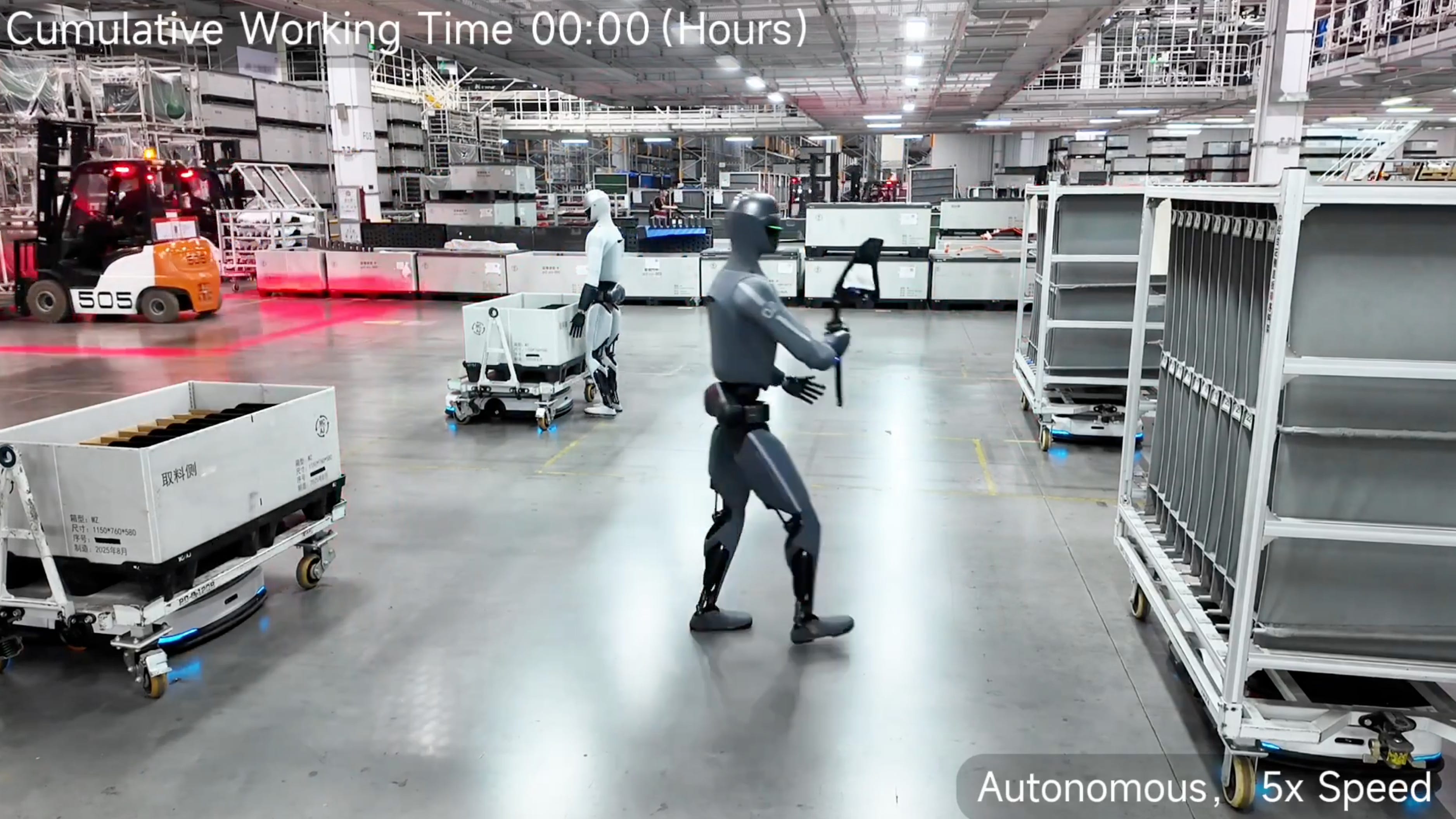
At least 14 Chinese EV makers have now begun making their own robots, including BYD, Chery, GAC, Xiaomi, and XPeng. Some are even starting to deploy their own humanoid robots on their own EV assembly lines. Xiaomi recently claimed to have their own humanoid robots doing autonomous 8-hour shifts on their EV production line.
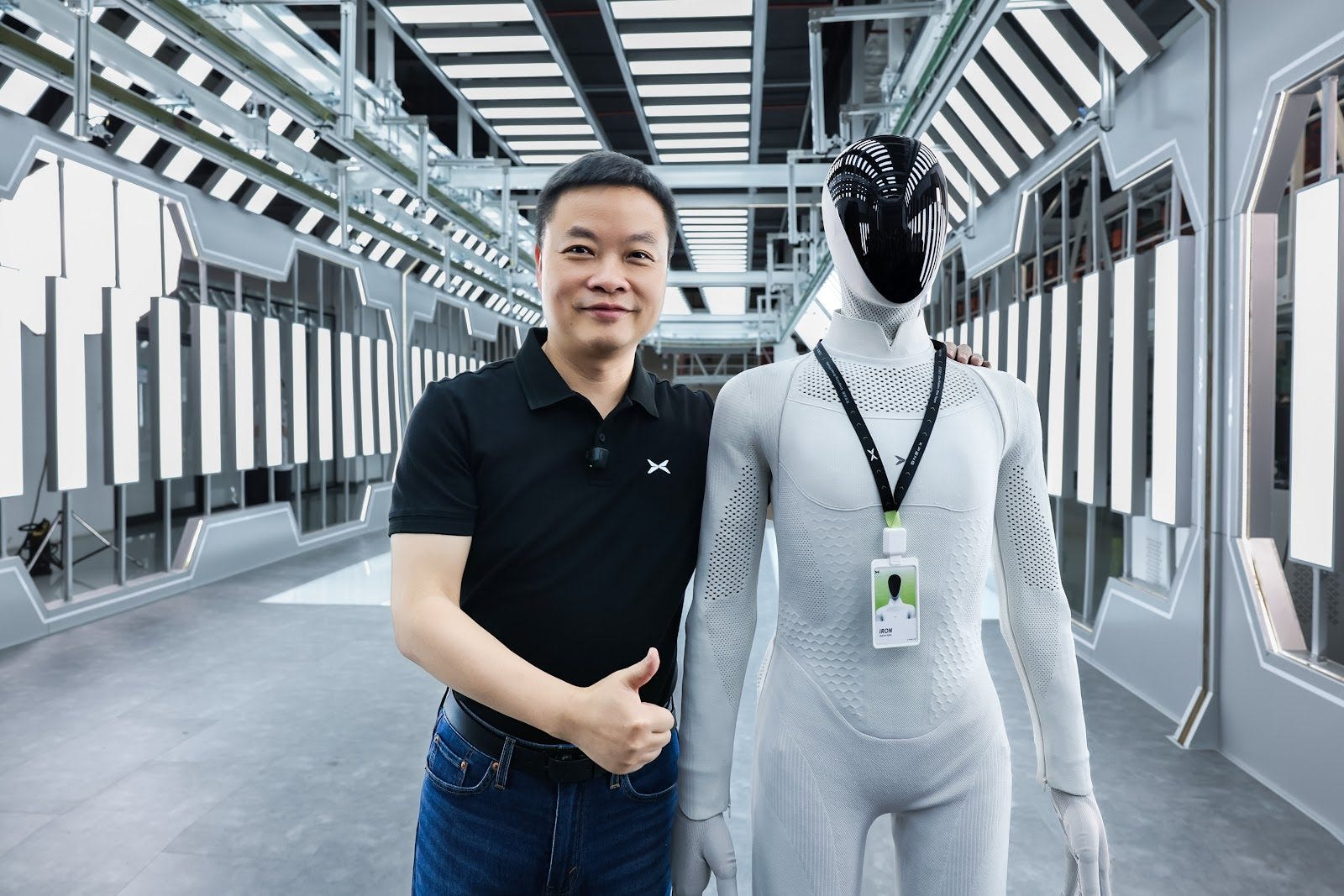
A top executive at Dongfeng Motors explained that intelligent vehicles, humanoid robots, and low-altitude aircraft have a 60-70% overlap in their components. XPeng founder He Xiaopeng has said that “future AI car companies will ultimately become robotics companies” (“未来 AI 汽车公司,终将成为机器人公司”). Chery’s chairman has said that autonomous vehicles are basically just mobile robots.
Crucially, China’s humanoid push doesn’t just benefit from shared technologies with its EV industry. It benefits from the incredible scale that China’s EV industry has created for robotics components, making them cheap and readily available. This has helped China scale up production to a projected 100,000 humanoid robots by the end of 2026. (For more, I highly recommend Sunny Cheung’s work on Chinese robotics.)
Going vertical
Another driver of China’s tech convergence is a desire for greater control and efficiency, particularly by making core components in-house. Some of China’s most successful tech firms are renowned for their aggressive vertical integration.
BYD makes its own batteries, electric motors, and power semiconductors. Unitree makes its own actuators, joint modules, and motor controllers. DJI makes its own gimbals, cameras, chips, and flight control systems.
This vertical integration helps drive down costs by cutting out margins that would otherwise go to third-party suppliers.
But it’s not just about costs. Developing components in-house also offers greater performance and efficiency through customization and co-design.
XPeng founder He Xiaopeng explained in an interview why he wanted his EV company to start making its own semiconductors: “A general-purpose chip might have 100 functions, but you only use 20 of them. The other 80 functions add both cost and power consumption.” By making his own custom chips, he reasoned, he could optimize their design for his specific use cases.
In addition, he said: “If you develop your own chips, your chip design team and your software and algorithm teams can work closely together.” This internal co-design process allows you to squeeze out more performance from the same generation of chips.
Many American tech firms are making their own chips for similar reasons, including Google with its TPUs, Amazon with its Trainium chips, and OpenAI with its Jalapeño chip. Apple has long championed the deep integration of hardware and software design.
A similar story is driving AI models in China.
When DeepSeek R1 was released, Tencent thought it could just build on other companies’ AI foundation models and focus on applications. But then it reversed course, realizing that the foundation model was too important to simply rely on other companies for. Tencent recruited Yao Shunyu from OpenAI and now has a cutting-edge AI model series of its own. (See Grace Shao’s fantastic AI Proem newsletter.)
Now some of China’s top AI models come from some unlikely companies, including a food delivery company (Meituan), a fintech company (Ant Financial), and a smartphone company (Xiaomi).
Why did these non-AI companies decide to build their own AI models? Because they wanted to tailor them to their own needs or their own data. Xiaomi’s MiMo models are designed to work well with Xiaomi’s smart devices. Meituan’s LongCat models are designed to leverage Meituan’s extensive proprietary data.
Chinese tech firms increasingly see themselves as AI-driven at their core. They see the mastery of foundation models as being critical to the way they operate going forward.
Searching for new growth drivers
Another reason why Chinese tech firms are branching out in so many directions is because they’re looking for new growth opportunities—particularly if their existing businesses are facing headwinds.
Huawei is the most famous example. After getting hit by US tech restrictions in 2019 and 2020, Huawei scrambled to pivot to new areas. In April 2021, not long after US tech restrictions, Huawei’s chairman Eric Xu announced the company would shift focus toward areas that were less dependent on advanced chipmaking, such as software, EVs, and clean energy.
Now these are some of Huawei’s fastest-growing businesses—to say nothing of Huawei’s leading role in China’s semiconductor efforts. (See my earlier piece “Huawei the Hydra.”)
Xiaomi’s pivot to EVs is another interesting example. Xiaomi’s CEO Lei Jun revealed in a speech that a key factor behind his decision to enter the EV industry was that he’d heard the company was about to be put on a US sanctions list. He feared this might be an existential threat to the company’s booming smartphone business, so he decided to take the leap into EVs to save the firm.
Not long after, Xiaomi began working on its first EV, the SU7. And now this year alone, Xiaomi is targeting EV sales of over 500,000. While this patriotic story might not be the whole picture, it could be a plausible factor motivating a company like Xiaomi to make such a risky bet.
Beyond these more high-profile cases involving geopolitics, there are plenty of more mundane examples of Chinese tech firms facing a slowdown in their main business and deciding to pivot to a new growth area.
Baidu has invested heavily in its Apollo Go robotaxi unit as its online advertising and search business faces declining revenues. Alibaba’s pivot to AI and cloud services has helped to offset its stagnant e-commerce business—as well as help bring Jack Ma back from exile. Meituan has been moving beyond traditional food delivery to more intelligent, AI-powered delivery and logistics. And broad pressure in China’s EV industry is pushing EV makers to turn to robotics.
Following Beijing’s spotlight
There’s one final driver behind China’s tech convergence that’s unique to China. To put it bluntly: it’s the government, stupid.
Chinese tech firms aren’t jumping into new industries for purely commercial reasons. They’re following the spotlight that Beijing is pointing at certain technologies or sectors deemed to be national priorities. It’s no coincidence that many of the areas that Chinese tech firms are crowding into are the same ones in China’s latest Five-Year Plan: AI, semiconductors, robotics.
Entering these strategic industries can unlock a whole range of government support. At the national level, this includes access to state-backed investment funds, state bank loans, and subsidies.
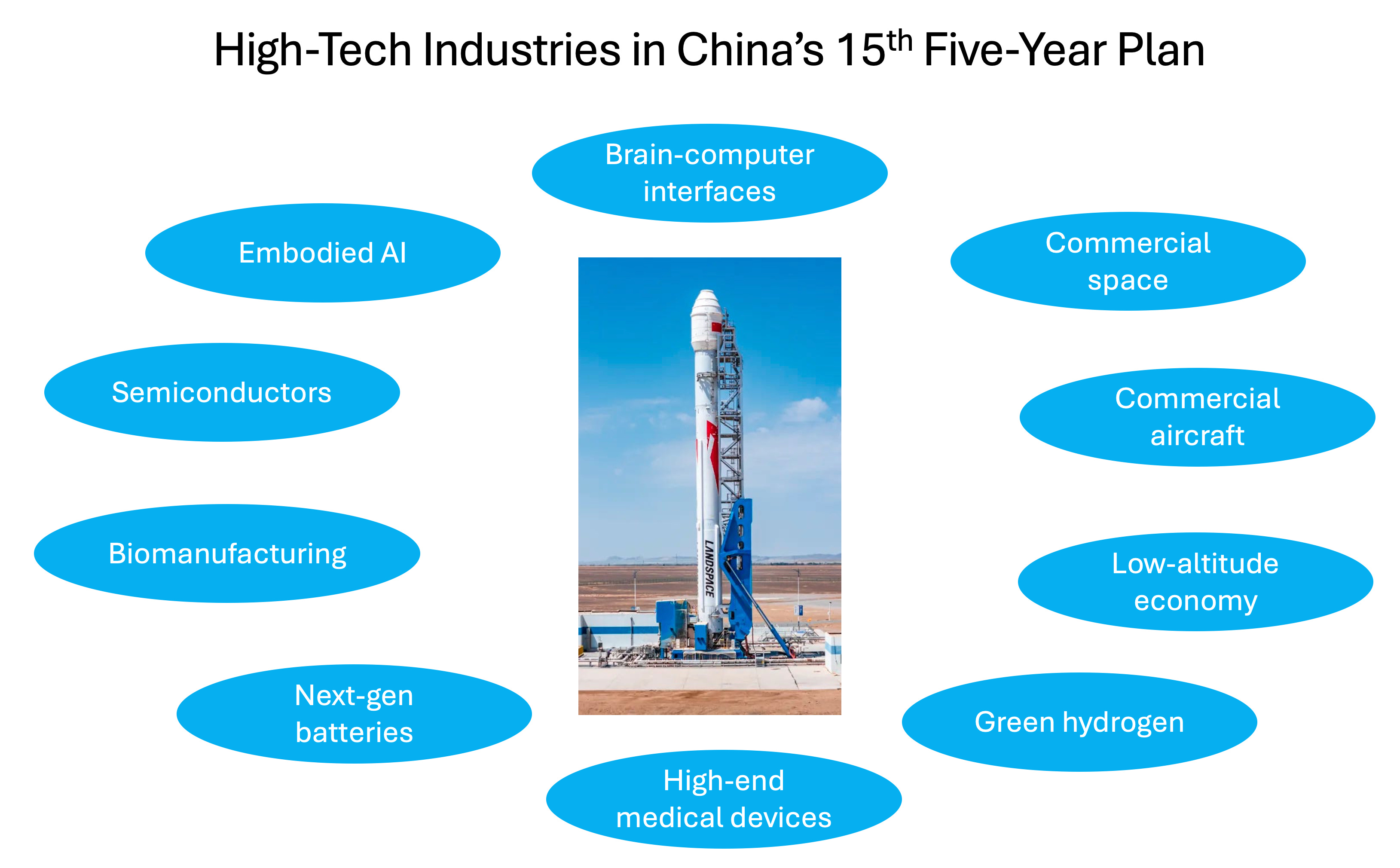
The NDRC recently announced it would “make coordinated use of multiple funding channels, increase fiscal and financial policy support, and guide private and other non-state capital toward emerging pillar industries” (“统筹用好多种资金渠道,加大财政金融等政策支持,引导社会资本支持新兴支柱产业发展”).
Beijing also helps create demand through government procurement, pilot programs, and demonstration projects designed to encourage the adoption of new technologies.
Perhaps even more importantly, this also unlocks local government support.
Local officials want to show that their jurisdictions are delivering on Beijing’s tech-industrial priorities. Hangzhou, for example, explicitly encourages software and manufacturing companies to move into humanoid robotics, offering R&D subsidies, computing resources, and even free office space. In Shanghai, government-backed investors have financed humanoid robotics startup AgiBot, while a state-owned industrial park operator has helped it establish factories and find customers. Beijing’s Yizhuang development zone even offers subsidies covering 10% of humanoid robot sales.
At the same time, Beijing is worried about overcapacity, redundancy, and wasted resources. Xi Jinping famously asked whether every province really needs to jump into the same areas of AI, computing power, and EVs. (The irony is that he’s the one who’s been signaling that these are priority sectors for the country.)
The latest official policy statement on “new quality productive forces” includes an NDRC commentary that warns against “rushing headlong into emerging and future industries.” There’s already a ton of discussion about a humanoid robotics bubble in China where over a hundred companies are vying for a share of mostly non-existent market.
What this all means
Chinese tech companies are getting stronger, evolving into full-stack physical AI generalists, even as they face growing pressure from all sides. They’ve demonstrated a knack for jumping into complex new technologies like chips and robotics—and doing a pretty decent job in a very short period of time. They are becoming more deeply AI-driven, building not only the applications and services but also the foundation models that power them.
But they are facing growing competition as they crowd into each other’s spaces and duke it out in one common arena. And they face pressure to find new areas of growth, particularly as their revenues and margins are eaten away by competitors. On top of all this, Chinese tech firms fear both Washington and Beijing—although there is one that they clearly fear more. ■
China's overlapping tech-industrial ecosystems

China has developed multiple tech-industrial ecosystems that overlap in terms of the firms and technologies involved. China doesn’t just have a smartphone industry or a battery industry or an electric vehicle industry. It has all of these industries and more. China’s strength across multip…
Huawei the Hydra

Huawei’s role in China’s industrial policy, centered on Eva Dou’s incredible new book House of Huawei.
Thanks Kyle, and very informative. One minor suggestion, maybe in expanding your EV analysis to include heavy vehicles, many of which are autonomous, exported globally eg. those used in agriculture, and mining which China increasingly seems to be dominating. Cheers.
Thanks for another great article in the tech stack series. I learn a lot from every one of your articles. Thanks Kyle.