


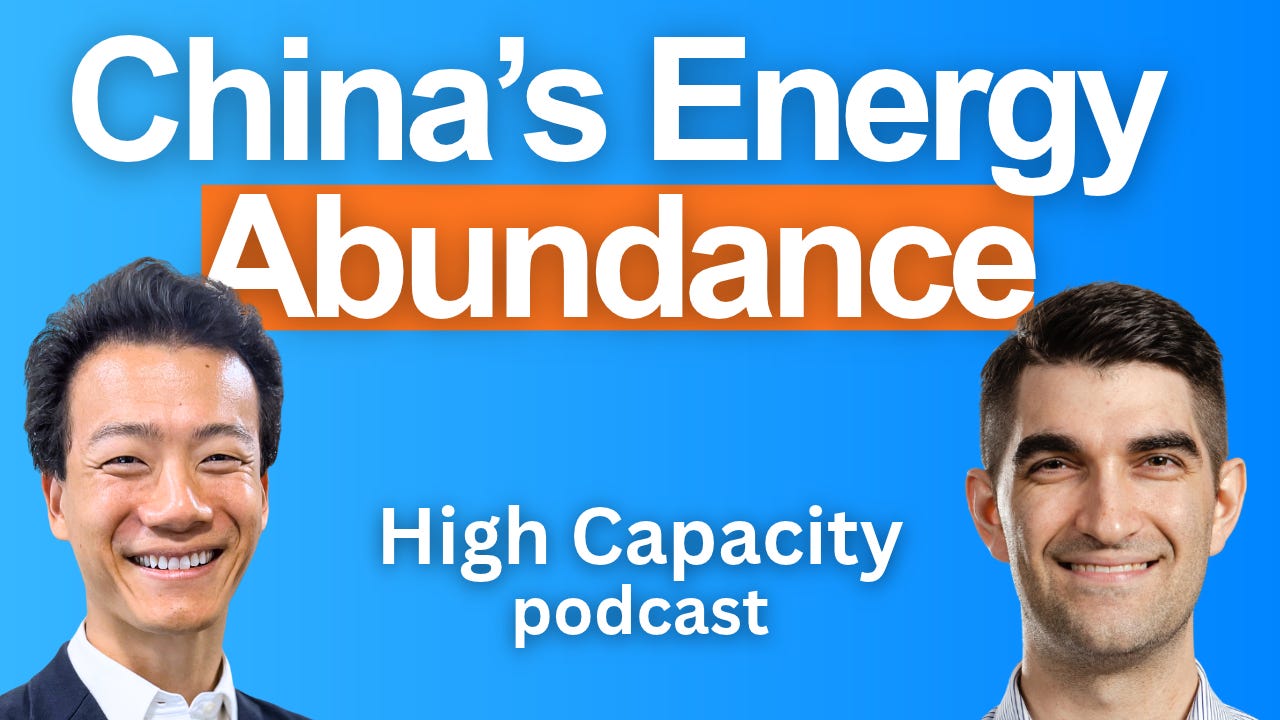
Watch or listen to the High Capacity podcast on:
How is China scaling up energy to feed its industries and power its AI boom? I talk with David Fishman, a China energy analyst and principal at the Lantau Group, about China’s massive energy buildout and what it means for AI.
We discuss:
How can China be a clean energy superpower and still keep building coal plants?
Does China’s electricity surplus give it an advantage in AI?
Why is Inner Mongolia becoming a hub for clean energy data centers?
How does China build nuclear reactors so quickly—and why isn’t that enough?
How is China upgrading its grid and electricity markets to handle it all?
Follow:
David’s newsletter, Crossing the River by Feeling the Stones
David Fishman on LinkedIn
Transcript
Kyle Chan (00:00)
Welcome to the High Capacity Podcast. I’m your host, Kyle Chan, a fellow at Brookings. I’m super excited to be joined today by my guest, David Fishman, a principal at the Lantau Group, and probably the single best analyst of China’s energy landscape in the English speaking world. Welcome, David, and thanks for coming on the show.
David Fishman (00:20)
Thanks for having me, Kyle. Very happy to be here.
Kyle Chan (00:23)
So China is a clean energy powerhouse, adding over 400 gigawatts of solar and wind capacity in a single year alone, 2025. That was something like eight times what was added by the US. And yet China remains heavily reliant on coal for half its electricity and continues to build new coal-fired plants. China’s total electricity generation has surged by over 80% over the past decade, breaking past 10,000 terawatt hours annually. So that’s more than two X the US. How do you make sense of China’s energy landscape today? What are some of the key trends and features that you think people should be paying attention to?
David Fishman (01:04)
You know, it’s almost banal to say it at this point, but it’s still consistently true. The size matters so much. Not just the existing size, which is, as you correctly pointed out, huge, right? And when you start talking about thousands of terawatt hours, we get to use the word petawatt hour, which doesn’t come up very often. But we’re up over
Kyle Chan (01:23)
Right.
David Fishman (01:24)
Ten, pushing eleven petawatt hours of electricity in China. And it continues to grow at a middle income, upper middle income economy’s pace, which is four or five percent annually, in line with GDP growth. So it means it’s also adding four hundred or five hundred terawatt hours each year, which is already the size of, you know, I always say, I say that’s a Germany, right? It’s adding another Germany of electricity every year. So what you can and can’t do in your energy transition and what wind or solar or nuclear, what any energy type can or can’t do is determined by that. Right, how large it is and then what growth means, what four percent or five percent growth means when your stock is that large.
So yeah, how do you cover growth each year? What mix of resources actually delivers 400 or 500 terawatt hours of electricity of any kind? And when you start breaking down the numbers, you’re like, my goodness, it’s like, we built eleven gigawatts of nuclear. What’s that good for? 70 terawatt hours maybe? Like okay, that’s pretty good, but like we’re still missing the other eighty percent of our annual growth budget. And so then you start saying, Okay, well what does two hundred gigawatts of solar get us? What does a hundred gigawatts of wind get us? These are all stupendous numbers, right? And then you work them back and you’re like, my goodness, it’s still not even enough to cover growth.
Or we’re just barely covering growth each year. And so that’s the situation that China’s in right now, where it’s like sprinting as fast as it can on all of its new energy sources that it can add on the capacity side to just barely keep up with growth. And so you can say, you know, they’re still adding coal. If they didn’t add coal, they’d be shedding load. If they didn’t add coal,
Kyle Chan (03:13)
Right.
David Fishman (03:14)
They didn’t add all these other energy sources, they would be failing to meet the growth needs of the energy economy. And of course you can say, if they optimized the assets they had already better, if they ran the market differently, if they made better use of their long distance transmission, maybe they wouldn’t have the need to add so much new capacity. Okay, yeah, sure. That might be true too. I mean it’s a market that’s in reform also. But the simple mathematics are just very, very challenging. That’s the first fundamental thing to understand is that it’s just huge and it’s still growing at a very high pace.
Kyle Chan (03:47)
Yeah, I think that’s the part that’s so hard to get your head around. It’s like the industrial expansion that the energy needs from industry transportation, and maybe now adding to all that AI is astronomical. So if you just want to keep pace and not do anything superhuman, but just be able to supply stable electricity to your industries and population, this is sort of like what it takes.
David Fishman (04:17)
Yeah, definitely. So it’s funny that, you know, conventional industry is still the biggest driver of power consumption growth. It’s you know, it’s still at two thirds of all power usage in China. And each year about half of the incremental growth still comes from conventional industry. And that’s only recent. That’s only possible because services and residential, those other two segments, have seen such high growth in recent years. In the past, most of the growth was also coming from secondary industry. It’s only a recent phenomenon that about half of every you know, I said four hundred terawatt hours each year, so two hundred of that will be from households and services, commerce, and the other two hundred roughly will be from industry.
Those are again just stupendous numbers. So even as the industrial sector slowly starts needing less electricity, it starts to you know, cement is gonna be contracting for a long time. A lot of other heavy industries are going to be contracting for a long time and using less electricity. But commerce, you know, shopping malls and hotels and all that will keep using more electricity and the residential sector will certainly keep using more electricity. If you look at Chinese households and how much electricity they use, just their usage on a per capita basis, it’s still like a third to a quarter of you know the OECD level. But I don’t expect them to use as much as a North American family, right?
We don’t need to have North American refrigerators and hairdryers and clothes dryers, but like maybe you know a Japanese standard for electricity consumption.
David Fishman (05:52)
They’re still pretty far off from that level. And so So there’s so much room for the Chinese economy to use more electricity just to get to an equitable level of consumption
David Fishman (06:01)
Per capita.
Kyle Chan (06:03)
Well, I want to dial in on one particular source of demand growth, which is the AI boom. In the US, energy is becoming a major bottleneck for the AI compute build out. You hear, you know, CEOs of hyperscalers complaining about how long it takes to get connected to the grid, or how long it takes to build new power plants. It’s a slow and complicated process in the US. China seems to have the opposite problem. You were recently quoted in the Financial Times saying that parts of China have not just abundant energy, but almost like an electricity surplus, an oversupply, and that quote, data centers can help soak up this excess power.
I think for a lot of people in the US, where we’re so concerned with getting more power, this is sort of shocking to hear. Can you explain what’s happening in China?
David Fishman (06:58)
Yeah, I mean the underlying feature here is the political economy and the financing environment that gets things built in China. When you have a mostly or entirely market oriented energy sector, the kind of prevailing philosophy is that you want to build just enough just in time. Because if you build too much in advance it’s inefficient, with capital or you know, with resources in general, if you built it before it was needed. And there’s very little penalty or downside on the Chinese side for building more than you need in advance of when you need it. There might be certain incentives that say actually the act of constructing the thing is useful in and of itself.
It adds
Kyle Chan (07:44)
Right.
David Fishman (07:45)
Velocity to money, it keeps money circulating through the system, it turns loans into somebody’s income somewhere in the system, right? Like that’s a useful thing to do. But then also we’ll need it someday. We will. We expect that electricity consumption growth will keep growing. For certain types of electricity, it might not be so true anymore, right? Like can we ever possibly use all the coal-fired power that has been built in China? Probably not, right? We’ve got a fleet of, you know, I don’t know, fourteen hundred gigawatts of coal, something like that, and it operates less than fifty percent of the time on average throughout the year. There’s an entire latent extra Chinese coal fleet just sitting there if they doubled their capacity factors.
Or I mean they can’t get to a hundred Percent, maybe 90% annual capacity effect. That would be running them hard, but it’s doable, right? That’s more than the entire Chinese the entire US power sector. There’s an extra US power sector hiding in the unused capacity of Chinese coal plants. And there you don’t well, we certainly hope they don’t use it, right? We hope they don’t go use all that coal-fired power, but you get all this stuff built out in advance of its actual demand. In some cases, certain types of resources cannibalize each other’s business. This does happen, especially with solar, right? It all operates through the middle of the day, so you can end up having surplus.
Certain types of plants are only needed at certain times of the day, right? The power sector is kind of special. It’s built around peak instances, right? We have to be able to serve the peaks, but most of the day is not demanding what the peak demands. Most of the year is not demanding what the peak demands. So there might be a couple days in the middle of July when we’re using most of the resources, and then most of the rest of the time we’re not. And that’s just one of the you know the features or bugs of the power sector. Not just the Chinese power sector. Power sectors everywhere have to confront this problem.
But that’s one of the you know interesting features of China. There’s so much dormant capacity out there. And for a couple days out of the year it’s not so dormant, right? July twentieth, when they set the new you know peak demand records each year like okay, maybe in that moment it we weren’t at so much surplus. But the rest of the time There’s such incredible play in the system.
David Fishman (10:01)
And then when it comes to you know northern China, northwestern, northeastern China, where the resources are fantastic for renewables, so you want to get renewables built, but then they struggle to get on grid. They struggle to find access to transmission capacity to bring them west or south or wherever the load centers are. And they don’t want to be curtailed because curtailment is a KPI for the local officials, right? They want to keep curtailment levels low. So the idea of bringing in industries to soak up power is a great you know a great thing for them they’re saying you
David Fishman (10:33)
Know please help keep our curtailment levels low allow us to approve more projects in the pipeline you know we had stalled those because we were worried about more wastage now we can keep things moving again so yeah you get this very very different dynamic and the build you know none of this three to five year interconnect stuff right we’re talking about you know you have to go through the process but it’s months not years
David Fishman (10:56)
And the production of new gas turbines, the production of new transformers, all that stuff. Again, it’s happening domestically and the lead time is gonna be months, not years. And so all of that allows building to happen so smoothly that, you know, you end up with the bottleneck being finding customers for the power, not actually building the power.
Kyle Chan (11:16)
Right. Yeah. This is super helpful. I was wondering if you could talk a little bit more, you touched on this about sort of the regional differences in resources and power capacity and how things like central government policy and maybe local government policy kind of shift around this sort of unequal distribution of resources and especially linking that back to the sort of uneven distribution of demand throughout the country and then across, you know, sort of different sources of demand, you know, whether it’s AI data centers or just everyday consumers.
David Fishman (11:56)
Yeah, yeah, so the sources of your load are gonna be your more industrialized coastal provinces, right? You know, Shandong and Jiangsu and Zhejiang and going down to you know Guangdong all just bringing the coast, right? And that’s by and large in China not where your best energy resources are. In terms of raw materials, right? You’ve got coal up north in the northwest, northeast and north, but you know, especially center north, right? Inner Mongolia, Shanxi, Shanxi and you know a little bit out west towards Xinjiang. There’s your coal. And so if you wanna have coal fired power on your coastal regions, you have to have a solution to getting that coal to your coastal regions or down south.
When you talk about gas, China doesn’t have that much gas, but what it does have is in the southwest or out west, or Up north again, so far from the load regions. Then we talk about wind and solar resources. Solar is generally better up north in China and especially good in the northwest, which is about as far as you can get away from the coastal regions. And then wind, you know, so besides offshore wind, you know, China has excellent offshore wind resources along the coast, but it’s pretty expensive still, and then certain areas are difficult to build in. But beyond that the good onshore wind resources are up north, northeast, northwest.
Again. Finally, hydropower, southwest. And central a little bit, but southwest. So consistently just have this pattern of all the energy resources of any type being far away from the coastal regions. The only exception perhaps is nuclear. Nuclear can be built, actually it’s necessary to build nuclear along the coasts right now because they need bodies of water for secondary loop cooling. But that’s it. So you have this mismatch, and that means either you move the load to where the energy is. Which has happened in the past. Traditionally a lot of the you know the state-owned industries, the heavy industries of the 80s and 90s, that was their reason for existing in central North China.
Shanxi
David Fishman (13:55)
And Inner Mongolia and Shanxi wouldn’t have had much of an economy at all were it not for the fact that they had the coal resources or the mineral resources there to for it to make sense to put the heavy industry there. That’s not where you put light industry or export-oriented industries or services or anything like that. So that was the mismatch. Data centers, which is, you know, of course a new driver and they say, does it make more sense to put some of these data centers close to the energy resources again? What we gain in terms of energy costs we will sacrifice in terms of processing speed. Do we have applications that don’t need such fast data?
Right? Can’t do financial trading data, but you know, can we train another
David Fishman (14:41)
Slow data that’s being exported, so to speak, across the country to Inner Mongolia. Yeah, maybe we can. So that’s how the organization is happening now. And some of the heavy industry is also being pushed in that direction. When heavy industry is being given a renewable consumption quota, for example, you must consume this percentage of your electricity as renewables, it’s gonna be very expensive or even impossible to meet that quota in certain parts of the east or the south. And so your only solution would be to move production to Sichuan or to Inner Mongolia where you can access affordable or even the capacity to meet your load from clean energy versus exists up there.
So this is an ongoing issue for just how China organizes its industrial economy and its energy, this geographic mismatch, and then what
David Fishman (15:32)
Comes out of it in terms of heavy industry, how you organize services, how you organize AI, do you run UHV lines in one direction or five? Like these are the spatial planning aspects and it’s extremely relevant.
Kyle Chan (15:48)
Yeah, yeah. It’s useful to see this as sort of like layers of infrastructure networks on top of each other. And you can move, you can try to reallocate the energy, you can try to reallocate the compute, you can reallocate, you know, some of these different things, but you fundamentally have this allocation mismatch problem to start with, and you just need to kind of figure out a way to integrate that and distribute it in a way that makes sense.
David Fishman (16:14)
And yeah, like China’s a continent sized economy. It’s you know, a cliche, but it’s true, right? So you have to, you know, trickle down policy making from a rough idea at the national level to implementation and experimentation at provincial levels and lower. And so you also have this kind of encouraged competition between different provinces or different cities where they’re able to pursue their objectives through their own local policies that sometimes compete with each other. Sometimes they might be operating around the margins of whatever Beijing thought was the right plan. And so you also have to try to get them to coordinate with each other. That’s where we get some of these long distance transmission problems can sometimes be frictions between two different provincial level entities.
That State Grid Jiangsu and State Grid Sichuan are having trouble getting along when it comes to the specific pricing of hydropower being carried across the line or who gets to use the line at what time. And if Sichuan is having a drought, should that power still be flowing to the east coast or should it be allowed to remain in Sichuan based on a contract that was signed five years ago? These are issues that you encounter when you have a massive continent sized country where individual actors at the provincial level are trying to work together to ensure energy supply for an entire country.
Kyle Chan (17:39)
Yeah, very, very helpful. There’s one province in particular that has gotten a lot of attention lately, and that’s Inner Mongolia. Ulanqab seems to be the new global hub of compute, at least for part of the world. And you have these interesting projects like I’m sure you’ve done a lot of work researching like the Envision sort of solar plus battery energy storage plus data center sort of like almost all vertically integrated. I think SemiAnalysis just had a write-up too about this. What’s going on in Inner Mongolia? How come there’s like this boom of data centers there and it seems to be very strongly linked to energy players. You know, you don’t normally think about you think about like data center builders and you think about the energy sector folks, but you don’t think about a crossover and especially in this region of the world.
David Fishman (18:35)
Yeah, well so so first off, Inner Mongolia, the province, the region, is the promised land when it comes to energy resources. It’s got everything. It’s got you know, the on the grasslands or on the plains, the sun shines all day, the wind blows all day, ground is thick with coal beneath your feet. They’ve even got uranium mines. They have every type of energy resource in Inner Mongolia.
Kyle Chan (18:57)
[Laughter]
David Fishman (18:59)
And they’ve also got a grand total of I don’t know like six million people to share
Kyle Chan (19:03)
Right, right.
David Fishman (19:04)
It’s not that low, but it’s like a pretty modest population for a giant region incredibly rich in energy resources. And so as a result it’s definitely an exporter, a net exporter of energy resources. But then Then when you look at the needs of some individual industries, so you talked about data centers. If they’re being put into these designated regions in China, they’re called the computing hub nodes. If these new data centers are going into computing hub nodes, they have to meet 80% of their power consumption from renewables. That is a difficult prospect for many parts of the country. It is not particularly a difficult prospect to do that in Mongolia.
Between the wind and the solar resources. And the and storage and then you get some thermal to firm up the last 20% of your load and you can meet that quota without too much pain in Inner Mongolia. Then when it comes to Envision’s thing, so yeah Envision is a wind turbine manufacturer who has gotten into other verticals around their business. So they also build power plants, they have EPC now, they also have an energy trading business and they’re they’re selling electricity to factories. They do all of that. This zero carbon industry park that they built is a new vertical for them. But thematically they’re basically saying if we build this park using the resources we have available to us with our wind business, our solar business, our storage business, our virtual power plant, energy optimization software, we will ensure that anybody who moves into our zero carbon thematic park can claim safely that they’re a hundred percent renewable power.
That side of it and will offer you a very unique tenant position. Move in, and you don’t even have to go through all the math and the accounting to prove to somebody that you’re 100% green because we’re an island. We only serve green resources to this island. Tencent, come on in. You’re not just
David Fishman (21:09)
A hundred eighty percent, you’re a hundred percent when you’re operating in our green island. This is a product for them, right? They’re selling a thematic product to a certain type of producer or power user who wants to be able to sell themselves as being a hundred percent green because they used Envision’s product. That’s the type of product that you can create and try to sell in Inner Mongolia because of the wealth of the resources up there and would be very, very difficult in other parts of the country.
Kyle Chan (21:38)
Yeah, yeah. It sounds like the perfect example of a product formed from the confluence of the sort of natural energy landscape, but then also the policy incentives. Like you just would not find this kind of setup so attractive, a one stop shop, plug and play data center and renewable energy source. I think in most other parts of the world. You mentioned before or you’ve written about visiting Inner Mongolia. And a solar plant there, I think it was a gigawatt scale solar plant. What was that like? I read your write-up; it was super fascinating. But yeah, what was it like to visit in person? Like what did you learn from going there?
David Fishman (22:22)
Yeah, so that one it’s a continually being expanded demonstration park. It’s actually maybe like six different developers that keep adding on to it. So it’s over a gigawatt now and I think it just keeps growing. It’s in the desert, north of Ordos, and just a little bit south of Baotou. And it’s right on a little corner of that desert there. I think what’s the name of the desert? Forgotten. But it’s a little it’s a little desert by Chinese standards. That’s but just it’s a sandy desert, like a proper sandy desert. And so you’re driving through just the kind of the northern Chinese rural countryside, and then all of a sudden you see like sand dunes appear ahead of you, and you’re just crossing from this kind of dry, arid, like savannah-like landscape into just straight up desert moon landscape and Sahara style mounds of sand, and then you appear at the gates.
Of this it’s an open demonstration facility so there’s an open gate and you drive into the solar farm and then it’s just solar panels on both sides of the road as far as the eye can see. And they are you know you’ll get to this section it’ll be like China Three Gorges Solar Farm and the next section will be like the China General Nuclear Solar Farm and then it’ll be State Power Investment Company’s solar farm but they all look the same pretty much it’s just
Kyle Chan (23:43)
[Laughter]
David Fishman (23:44)
Solar panels and sand dunes and the occasional substation and that’s it. And it just goes Now what’s really interesting about this is you look at it from the map view, from like satellite view, which you can do in it’s in Baidu maps or something like that, and two things are immediately apparent. This endless solar farm on the ground occupies this tiny little corner of this big desert that’s equally empty and full of nothing but sand dunes. So it’s like huge solar farm that’s actually barely occupying any space in this context of this desert That’s only like the 14th largest desert in China or something like that.
Kyle Chan (24:25)
[Laughter]
David Fishman (24:26)
And the second thing is they’ve got enough space so that they can make patterns and pictures in the solar panels. And this one, they’ve laid out the solar panels in the shape of a galloping horse. So if you look at it from the satellite
Kyle Chan (24:37)
Wow.
David Fishman (24:38)
View, it looks like a horse galloping across the desert, which is pretty
Kyle Chan (24:41)
[Laughter]
David Fishman (24:41)
Cool too. But the so that’s the impression, right? It’s just endless solar panels. You kind of park your car on the side of the road and you can drive over and look at them. They’re fenced off. They’re behind fences. But then also you can see some efforts to try to cultivate underneath the solar panels to let weeds or grasses or desert brush to grow up in the shade of the solar panel so they’re not getting hit by sun all day long where they can’t grow. And that has been part of the anti desertification measures around that part of Inner Mongolia too. When we went out there we had a local guy who was our tour guide and he as we were getting close to the desert, he said this used to be desert too.
Where we are now, that’s becoming more of like a savanna landscape. When I was a kid this was also desert. This has been reclaimed. I was part of the anti desertification campaign. So it’s interesting you’re seeing kind of this intersection of more of a climate resilience plus the very overt electricity generation. And so Inner Mongolia is that facility at least is a nice showcase for that. And again, nobody took us there. It’s one of the few just totally open projects in China. We just got a driver and drove out there and drove into the farm.
Kyle Chan (26:06)
Genius move. I mean, I wish I could go out and check out that place. I mean, nothing says energy abundance than being able to draw pictures of galloping horses with solar panels in the sand. It’s like, wow, kind of showing off there.
David Fishman (26:20)
If they’ve done a few of those too. You can probably find like a top ten list of things China has drawn with solar panels on online or something.
Kyle Chan (26:27)
[Laughter]
David Fishman (26:28)
And if it doesn’t exist, maybe I should make it. Maybe that will be my next final social media post. But yeah, it’s it is a little bit of a flex.
Kyle Chan (26:37)
Impressive. Well, now I want to pivot to nuclear. And that’s an area that I think you originally started your career looking at. So China’s nuclear power build-out has been making a lot of headlines. China has something like thirty-seven nuclear reactors currently under construction, and that’s on the order of half of all the nuclear reactors under construction in the entire world. China is expected to become the world’s largest producer of nuclear power, at least by install capacity, by twenty thirty, surpassing the United States. So what’s going on here? How is China able to build nuclear power so rapidly? And what’s China’s strategy for nuclear energy?
David Fishman (27:25)
So building a nuclear power plant is, depending on the regulatory regime you’re operating under, either a story of regulatory oversight or a story of construction competence. In China’s case, they’re good at both. So both of these things are more condensed, right? The pre-construction phase, which is your site selection, environmental impact reports, financeability, just all of the pre-construction stuff, or pre-FCD, first concrete date. So that means getting through the provincial approval, getting on the kind of long list, and then going through all your site selection, all your evaluations, and then getting the state council approval, which is your short list, and then a construction permit.
That process in China is condensed down to, you know, five or six years at this point. And then construction happens. And that’s the part that everybody talks about, right? From the moment you pour the first barrel of safety related concrete to first criticality, grid connection, trial operations and then commercial operation. They’ve got that down to sixty four months or so. It’s averaging between sixty and sixty five months. So that’s another five years. So ten years from idea to power. Which is a long time, actually. That’s a decade. But if you’re sure it’s a decade, you’ve done it previously in a decade, you know the next one is gonna take a decade, then it’s no longer a super risky, uncertain thing.
It’s just a thing that’s valuable that you do that takes a decade. And the
David Fishman (28:58)
Ability to think about it differently like that is where China’s at now. It’s not a debate that has to happen. It’s not going to be an extended brawl over what’s the right feed in tariff. Should this thing be operating on a feed in tariff versus some type of subsidy versus full market exposure. They just say it’s a thing that takes 10 years. We knohow to build it. We have the supply chain. It’s just a you know a factory product. And at the end we’re gonna have a gigawatt of low carbon electricity that’s gonna operate for at least 60 years and maybe 80 depending on how life extension goes. And so they get to plan like that.
They get to build them like that now because they went through the process at the beginning of it not being like that. Of it taking twelve years or fifteen years, of projects getting hung up in approvals, of working out the kinks in the construction phase, and it took eight years to build some of the earlier ones, right? It wasn’t easy at the beginning. We talked about first of a kind versus n of a kind, folk versus nook. They’re clearly in the n of a kind phase now, and so they get to reap the rewards of that. That being said, they’re approving ten a year, roughly. Eight to ten units per year.
So when I say approve, I mean that’s the final approval. That’s the state council approval. Shortly after state council approval they’ll be issued a construction permit and they’ll start to work, get to work. So after c approval, six to twelve months for construction permit and then sixty months you know five years for construction so 2021 batch all under construction now 2022 batch all under construction 2023 batch all under construction there’s one reactor from the 2024 batch that hasn’t poured concrete yet and 2025 batch mostly not under construction yet one of them I think just started pouring concrete maybe two weeks ago something like that and the 2026 batch of course not yet started But so we can trade pull those forward and say, okay, 2027, that’s when our 2021 reactors come online.
2028, that’s when our like we ha we get that forecast stability. We get this pretty reliable outlook. So we say by 2030 we’ll have this many reactors operating. I know exactly how many. It’s the ones that were approved in 2024 or earlier. And if they were approved in 2025, they won’t hit till 2031. Okay, great. That’s nice to have those numbers, but you know, what does 10 reactors give us? These are all gigawatt level reactors, so 10 gigawatts, 11 gigawatts, right? Operate them at 90% annual capacity factor, right? We’re gonna build in a little space to refuel and do maintenance. Okay, 90% capacity factor for 10 to 11 gigawatts.
What does that give us? 70, 80 terawatt hours. Great, so much electricity. It’s a quarter, it’s less than a quarter of the Annual growth. And there’s the problem.
David Fishman (31:44)
Nuclear is great. China’s nuclear build program is huge, largest in the world, and also somehow still very modest compared to the overall needs of the Chinese power sector. Forget about stock, just flows, just the incoming flows of new power consumption. It looks small. Now keep building in that pace for 25 or 30 years out to the 2050-2060, you know, carbon neutrality 2060 deadline. Now we’ve got a stock of 300 reactors performing. However, they perform. Maybe that could get up to 10 to 15% of the Chinese power sector. Wonderful. We’re gonna need clean dispatchable generation because it gets really, really difficult to do it all with wind, water, solar, and storage, at least based on the technology we have right now.
But the grid really struggles. So 15% clean dispatchable generation, fantastic. Could it be faster? Could it be 15 gigawatts a year? Could it be 20 gigawatts a year? I don’t know. Maybe they’re running out of coastal sites right now. They
David Fishman (32:39)
Gotta start improving inland sites again so far. Those are all still frozen following Fukushima. And so
David Fishman (32:45)
To get larger than where it is right now, will take some additional regulatory changes. And then
David Fishman (32:50)
Do we even have 15 gigawatts worth of engineers graduating from our schools every year? Do we have 15 gigawatts a year worth of regulatory capacity? Because every plant also needs corresponding regulator capacity. Can we build 15 reactor coolant pumps, 15 steam generators, 30, sorry, it’s two of them, 30 steam generators, 15 reactor pressure vessels. Every year. Now we’re asking our supply chain, can you scale up for this? So it’s tough. So they’re the biggest in the world but also somehow too small to be really moving the needle.
Kyle Chan (33:23)
Yeah, yeah. It’s an incredible story. It’s like, yeah, when you look at it as a percentage of total installed capacity, it actually looks quite small. And so you’re just like, what is going on and why put in all the effort? But as you’re saying, you gotta diversify, you gotta have especially this sort of a clean, stable energy source. So yeah, I mean, also there’s a variety of different designs, right? And they have kind of standardized around a couple major designs, including some that are Chinese, or at least more based on Chinese IP. I was wondering if you could say something about sort of what’s the strategy there. And I think SMR small modular reactors are also you know, in the pipeline, as well as of course fusion, the holy grail.
David Fishman (34:13)
Yeah, so the you’ve got two main designs that are being deployed now, the kind of indigenous homegrown technology. It traces its lineage back to a Soviet technology on one side and a little bit of French technology on the other side, but that you know, there’s thirty-year-old reactor designs at this point. They’ve gone through a lot of Chinese iterations along the way. So the Hualong one, that’s kind of the backbone of deployments for most of the Chinese fleet. And then you’ve got the Chinese AP 1000, the CAP 1000 from Westinghouse, which has also gone through its own modifications and indigenization and is now being deployed at less scale but still appreciable scale.
And which one you choose to build depends on which one you have access to, right? There’s four companies that are licensed to operate nuclear reactors in China. So if they own their own technology, they get to build their own. If they’re building, you know, the CAP 1000, they have to license it from the company that was created in China to bring over Westinghouse’s technology. So there’s commercial arrangements there too. But that’s you know that’s they’re both third-generation reactors, they’re both you know gigawatt-level lightwater reactors, and they’re that’s most of the fleet. Then you’ve got your handful of kind of next gen stuff. You’ve got some fourth gen reactors, sodium cooled, high temperature gas reactors.
There’s a couple of mature designs there that they’re sprinkling in here and there. The Shuwei plant is pairing conventional light water reactors with a high temperature gas reactor, and that’s a pilot scheme to provide nuclear industrial grade nuclear steam for the nearby petrochemical park. So trying to step up light water reactor steam, which is nowhere near the temperature that’s needed to, you know, to crack ethylene, for example. But you could step it up with a high temperature gas reactor and you get into the low levels of what you can start using for some cracking applications, but also a lot of medium heat applications. So that’s something that they’re looking at using with this next generation reactors, the high temperature gas reactor.
Then you’ve got, you know, your thorium molten salt reactor that’s out there, kind of an experiment to figure out both if you can use molten salt for a coolant as well as using thorium as a fuel instead of just uranium. And then small stuff. Yeah so small modular reactors is a couple of plays for those. The thing about SMRs in China is that it’s really just another thing to explore for them. It’s not like, oh, we need to make a big bet on SMRs because for whatever reason large reactors are super difficult to get financed, to get built, the supply chain doesn’t make sense, whatever. So they operate in a different space compared to, you know, the United States, for example, where SMRs are clearly a response to other pressures.
Like we can’t get others built, or it takes too long, or we think data centers need them now today and these will be faster. Whatever the driver is for SMRs in the US is very different from China, where it’s like, might be fun to have some of these for like disaster relief, or
David Fishman (37:18)
We could export them to countries that really just need a small reactor. You know, it’s a different a piece of the of the constellation of the technology landscape for China. And then fusion, yeah, they’ve got fusion plays. I like fusion as a concept. Our children will ride spaceships to the stars on fusion reactors, but I don’t think we
Kyle Chan (37:42)
[Laughter]
David Fishman (37:44)
Will be decarbonizing our power sector with fusion reactors in our lifetime.
Kyle Chan (37:50)
In the near future. Yeah, yeah. That’s great. I mean, it’s just incredible the range just within the nuclear sector alone of what China’s up to. And in some of those areas, they’ve already scaled up quite dramatically and standardized designs and production and construction. So you do get this sort of more modular approach that makes it faster. But then also they’re experimenting with like a whole bunch of other new technologies as well. So I think that’s just a fascinating aspect. You can kind of drill down to each one of these parts of the Chinese energy industry and find similar stories of experimentation and rapid scale up of multiple technologies at the same time.
So I think that’s what makes it so interesting. Now I want to ask about the grid because I think the grid sometimes doesn’t get enough love. There’s so much focus on power generation, on the impressive, you know, gigawatt install capacity or terawatt hours, but how it all moves around, how it all gets managed, and especially for such a complex energy mix like you have in China, where you have especially a lot of this sort of intermittent you know, solar wind, clean energy, trying to manage all that and trying to build out things like ultra-high voltage lines, battery energy storage systems. I was just wondering if you could talk about what’s going on with the grid in China.
I think there is something like a new pledge to spend five hundred plus billion dollars on like the grid infrastructure, not the power generation, but just the grid alone. What’s going on and how are they sort of like upgrading their grid to deal with some of the challenges that arise from, you know, the way that they’re going about their energy strategy?
David Fishman (39:39)
Right, so The grid, really there’s two layers to one you know, the conventional understanding of the grid. There’s a physical layer and there’s a commercial layer, and both are really challenged by having a huge mix of different types of resources with loads all over the country, very, you know, imbalanced loads and resources, and then also lots of intermittent generators, non dispatchable generators like wind and solar in the mix. On the physical side, yeah, you can Bring power from surplus areas of generation to areas of load without the physical connection, and so all the excess generation in the world hanging out in Gansu is not going to be helpful if I physically can’t transport it to Jiangsu or to Zhejiang.
David Fishman (40:28)
And lines have physical limits, right? You can’t overload a line with more than it’s designed for. Also, lines have physical properties. They lose electricity. There’s line losses along the way. So if you want to transmit a long distance and you also don’t want to lose a bunch of electricity along the way, you try to step up the voltage. That’s what the high voltage, and then in China’s case, ultra-high voltage UHV lines are all about. About recognizing there’s simply no need for this electricity in this location. We need to send it 2,000 kilometers away, and we need to send it in a way that won’t result in 40% of the load disappearing.
Disappearing, forty percent of the power disappearing by the time it gets there. So ultra high voltage helps with that. And so that’s the physical aspect and they’re constantly building more. So that’s transmission lines, that’s distribution lines, like getting into communities, right? When you know, I mentioned previously that residential power growth. Power needs are rising. That becomes a very unique distribution problem. In the past, you could assume that your large loads were going to be industrial centers or industry parks, and so you could build a medium voltage feeder line out to that industrial park and serve load there, and you could use a very modest, a skinny little distribution line to serve some villages.
But in the last 10 years, all of a sudden all these villages have seen record-setting heat waves and all got wealthier and bought air conditioners. And all of a sudden that village
Kyle Chan (41:54)
Right.
David Fishman (41:54)
Village that used to be fine to serve with a skinny little distribution line can’t be served with just a skinny distribution line. Oh, and also they all installed rooftop solar, and which is aggregating into a local substation, and they’re trying to feed that back into the trunk, back into the game
Kyle Chan (42:08)
Right, right.
David Fishman (42:08)
Grid. So now you have these distribution needs growing from both directions. So you have
David Fishman (42:13)
Very meaningfully so a distribution upgrade demand, a transmission upgrade demand, including long distance transmission, and then all the physical stuff along the way transform. And substations and things like that. So when State Grid says we need $500 billion, that’s a reasonable number. Their budget last year was $80, $90, $90 billion to build new transmission infrastructure. So $500 over five years sounds normal at this point. That’s doing
Kyle Chan (42:39)
Yeah.
David Fishman (42:41)
State grid things. And then there’s the commercial layer. So the commercial layer of making sure all this power gets to where it goes in a reasonable way in a market, not an actual regular. Regulated sector, but a market sector is something China’s building out very aggressively. It’s necessary when you have such a complex system with so many different types of generation and load. It becomes impossible to do it all through regulatory mandates and dispatch mandates and kind of top-down planning. You need the market to start doing some of the work, to choose where power should go and what is the correct price of power at this moment in this part of Shanghai.
Is it because supply is abundant in Jiangsu? Should that affect the price of power for me in Shanghai? You know, market economists would say yes, the supply should affect the price of power in Shanghai. So that’s something that when we talk about the market, the power exchanges,
David Fishman (43:40)
Building out market infrastructure. And State Grid is supposed to try to focus on physical loads. They’re supposed to divest now from the market aspects of it, like the power exchanges are They used to be part of the grid company. Now they’ve been ordered to split out and they’re supposed to divest their majority shares in the power exchanges. But like how are you actually gonna dispatch power without being really closely integrated with the guy who physically tells you what’s possible to transmit
Kyle Chan (44:08)
Right, right.
David Fishman (44:09)
On the lines? And so that’s the big second angle of it. If solar power, if the you know the sun comes out and solar goes behind a cloud, all of a sudden the solar output decreases by seventy percent or ninety percent or whatever it is. That should affect the price of electricity, right? Like suddenly supply got scarcer. Suddenly I need a more expensive generator to respond. I need a coal or a gas, a rapid response generator or a battery storage facility to start doing something differently instead. And I also need them to be ready to immediately step back off the gas when the sun comes back out. This is the market side, the market infrastructure, and how that works determines how much generators get paid, which is airports.
Crucial for should I build more of what where?
Kyle Chan (44:55)
Right, right.
David Fishman (44:56)
And what power users pay to use electricity, which is crucial for the welfare of your citizens and the competitiveness and predictability of your industrial power sector. So all of this is incredibly, incredibly complex and thank goodness is being looked at by very smart people from the best schools in China. ‘cause
Kyle Chan (45:16)
Yeah.
David Fishman (45:16)
It’s certainly certainly over my head.
Kyle Chan (45:20)
Yeah, yeah. Yeah. I was amazed. I think I had seen like Tsinghua’s list of like where they send their grads and it included you know your usual assortment of you know tech companies and stuff like that, but also State Grid. And I was like, wow, yeah, they are both a sought after
David Fishman (45:34)
Yeah. No State Grid is the destination for top grads. You find all of the in the past when I worked in the nuclear sector, everybody every single one of them engineering grad from Tsinghua. They it’s so it’s like a prestige destination to end up doing like you wanna work coolest stuff, the coolest tech and the strongest company in China. Well yeah, it’s State Grid. Or it’s China General Nuclear.
Kyle Chan (45:57)
Yeah.
David Fishman (45:59)
You if you’re working in consumer tech or something like that, yeah, fine, go work for BYD, but electricity engineering, that’s the prestige destination, is the big SOEs.
Kyle Chan (46:12)
Yeah. I mean, that just sort of underscores the difference in sort of respect and prestige for some of these different industries between China and the US. It’s hard to imagine. Like you know, I leaks wanting to go to their equivalent of you know, the utility or the grid management system.
David Fishman (46:32)
Yeah, it’s like, you know, and we do have some state utility, state owned utilities or state invested utilities in the United States. So like imagine you go to TVA and TVA
David Fishman (46:43)
Is just full of grads on electrical engineering from MIT and Caltech. That’s the equivalent.
Kyle Chan (46:48)
Right, right.
David Fishman (46:49)
And so that’s what they enjoy as human capital resources. So I make the joke in the past about, you know, China previously didn’t have this type of technology, this type of reactor coolant pump, this type of whatever it was, they were importing it, but they wanted to localize it. And I said and maybe the foreign company thought they had a moat. They thought they had a 10 or 15 or 20 year moat. And they said, we spent such a long time developing this. And said, you underestimate what a thousand PhDs from Tsinghua and a billion yuan can fix. Because that’s what they’ll throw at the problem until the problem fixes itself.
Kyle Chan (47:28)
Right, right. Yeah. It’s like if the problem is big enough, crucial enough, like it will get solved. Yeah. I think we see this not just in the energy sector, but in industry after industry. This is the one of the big stories of our time. Well, this is fantastic, David. I learned a ton from you. Where can people follow you and your work?
David Fishman (47:53)
Yeah, so I’m on Twitter, of course. I tweet about a bunch of different stuff, but I do tweet about work, tweet about electricity and energy policy in China. So that’s on Twitter. You can search David Fishman and the handle is pretentious what W H A T. And then on Substack, where I write a little bit about energy and economy some traveling around China social ethnography stuff that’s feeling the stones dot com as in crossing the river by feeling the stones. I’m also on LinkedIn just search up David Fishman where I talk about work stuff.
Kyle Chan (48:26)
Yeah, definitely. We’ll definitely link to all that. Yeah, I mean your Twitter account has just been like such a valuable resource. I’ve learned a ton from that. I think that’s probably where a lot of people know you from. But highly recommend a follow there. Well, thank you so much, David, for an amazing conversation.
David Fishman (48:45)
Thanks for having me, Kyle.
Kyle Chan (48:48)
If you like this episode, please rate and subscribe on YouTube, Spotify, or Apple Podcasts. For transcripts and more, check out the High Capacity newsletter at highcapacity.org. I’m your host, Kyle Chan. Thanks for joining and see you next time.