


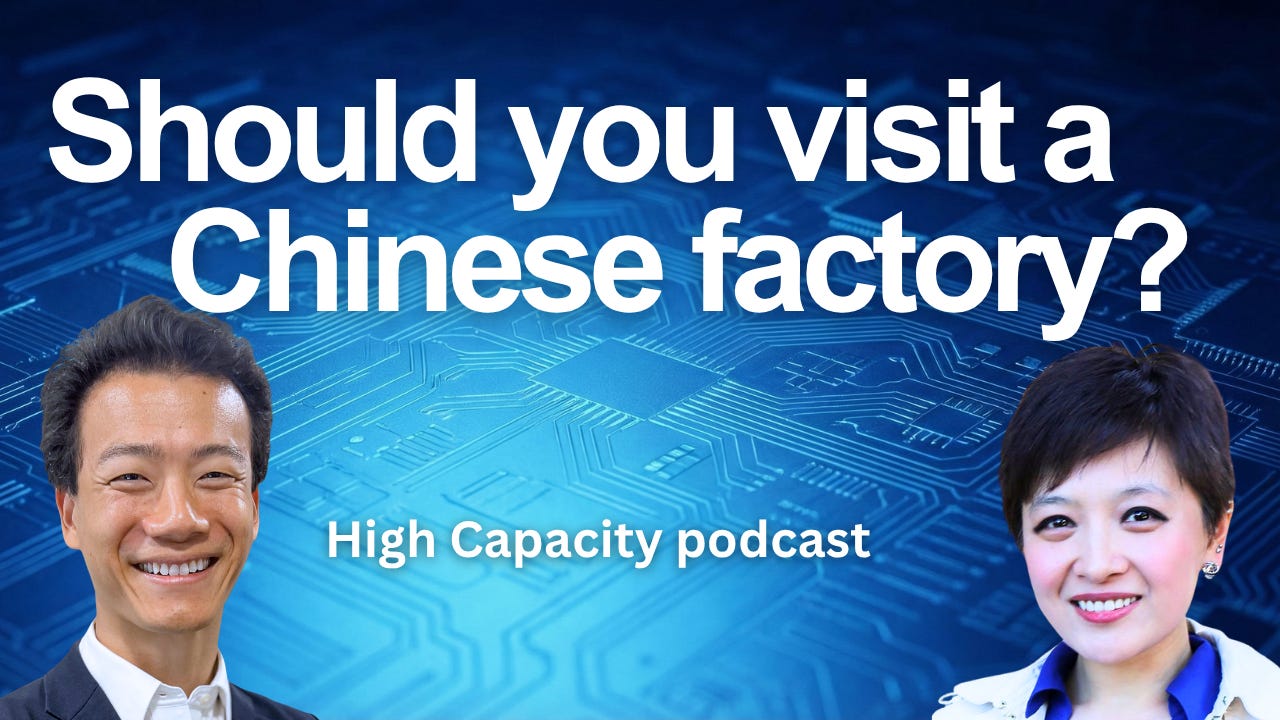
Watch or listen to the High Capacity podcast on:
Rui Ma, founder of Tech Buzz China, explains the real sources of China's tech strengths and where the US still has the advantage. From industrial parks to capital markets, we talk about how to understand China's tech landscape at a deeper level -- and why so many people are eager to tour Chinese factories.
Links:
Transcript
Kyle Chan (00:00)
Welcome to the High Capacity Podcast. I’m your host, Kyle Chan, a fellow at Brookings. I’m thrilled to be joined today by my guest, Rui Ma, who is one of the most insightful and knowledgeable experts on China’s tech scene I know. She’s the founder of Tech Buzz China, which provides research on China’s tech landscape and also organizes trips to visit factories and startups in China. Welcome, Rui, and thanks for coming on the show.
Rui (00:27)
Hi, thanks for having me, Kyle. Great to be here.
Kyle Chan (00:31)
I wanted to start by asking you a broad question, which is something that you’ve written a lot about and clearly thought a lot about. What are China’s real strengths when it comes to technology? What is the foundation on which everything that we see and hear about in the news with AI, robotics, you name it, is built? And what do you think really sets China apart from other countries that might be targeting some of these same technologies?
Rui (01:03)
I think that really, China is just really good at building entire ecosystems around technologies, especially ones that the government has identified as future core economic drivers. And I think pretty much this—I’m not sure if I have that much more interesting insight to add, because lots of people have said China really excels in process innovation and not necessarily just coming up with new technologies. But I think it’s not just as narrow as process innovation. It’s really building the entire ecosystem, right?
And that includes not just the minute improvements in the supply chain and the factories, but thinking about how I’m going to have this industry be birthed right from scratch. How do I change these entire cities? As we were saying right before this podcast recording, we had recently gone to what is probably the battery factory capital of China. And it used to be a really chill town for sightseeing, drinking tea, and bamboo forests. How did it become this entire new energy battery capital of the world?
Well, that really has a lot of—there was a lot of thinking about how to build the educational capacity, the physical infrastructure, and then also not just building the physical infrastructure, but actively recruiting and responding to the entire industry and making sure that the entire supply chain is co-located. And what are the things that all these companies need to be co-located here, right?
So the state really does a lot and has gotten increasingly better at doing it. I think if you look back 25 years and look at the industrial parks and look at what they’re doing today, it is, I think, underappreciated how much progress the government has made in building up industrial capacity.
Kyle Chan (03:22)
Yeah, those findings from that trip are so interesting because I think they also go against maybe some people’s conventional views of what government support looks like. I think maybe, especially for a lot of Americans, you might think of tax credits and subsidies, but it’s a lot more than that, and it’s sometimes certain levers that are pulled that might be more important than just giving extra money.
Rui (03:49)
Yeah, not to say there isn’t extra money given. There definitely is. But that’s typically at the beginning of an industry, and it’s usually kind of small scale, I would say. You see that in a lot of emerging industries, and they’re giving it to small companies. They may give a big tax break, just like here in the U.S., to get an industry leader to come establish a site in the city.
But then after that, why do companies stay? Or why do they even come here? Because a lot of cities can offer the same thing. It’s really about the speed of execution and, again, the entire ecosystem building, right? So if I came here, how does this connect to the logistics supply chain that I need? Does it connect to waterways, key waterways? Does it connect to key railroad lines?
And then where am I going to get the labor? One of the things that became more obvious—you probably already know this, but it became much more obvious when you get there—is that there are spikes in manufacturing. It’s not like January to December, everyone is working eight hours a day. There are lots of spikes. When a new product comes in and there’s surprise demand, then I need flexible labor.
Right? I need to have double, triple, maybe the capacity. I need to be able to run my factories 24 hours a day and run three shifts. How do I make sure that happens and it all stays within a roughly contained area instead of me having to go to another province or redirect my entire process somewhere else? So all those things have to be thought about and contingencies planned for in advance. And again, it’s underappreciated how difficult that is to do.
Kyle Chan (05:48)
Yeah, it’s funny to see the contrast where I think in the U.S., this is normally viewed as an organic process that can’t really be accelerated that much. Or maybe that’s a feeling today. And so the idea that you get these agglomeration effects where you have not just one major firm, but multiple firms in a given industry, and not just in a given industry, but their suppliers and their suppliers’ suppliers all in one place, and then with that broader shared labor pool, and then hooking up to the infrastructure—there’s a sense that it doesn’t just have to roll in natural time, that there are certain things you can support or step in on, and maybe even some areas that you can speed up from a permitting or licensing standpoint as well. I think you had written also about this sort of one-to-20 policy.
Rui (06:47)
Yeah, many places have it. The specific city we visited was like, we’re going to give you approval in 20 days. It’s contingent upon you following through on your paperwork. We’re still going to check, but we can give you that approval for any factory site. And the goal is always to get the factory up and running, from submission for approval to things rolling off the line, in about a year.
Kyle Chan (07:18)
Yeah, yeah, yeah. So then if you are thinking about starting up or choosing a new factory site, the speed really matters a lot. It’s not just who can have the best deal on tax breaks. It’s that you want to get your business going and revenue flowing as fast as possible.
Rui (07:35)
Yeah, and everything else too. I think speed is just a core factor, not just in companies choosing where to build, but also as their core competitive advantage. In many industries, China may not necessarily have substantially better quality. And in fact, sometimes we talk about maybe it’s 80 or 90 percent the quality of somewhere else that’s world-leading.
But if you can deliver—in the case of one transformer factory that we went to, they were able to deliver, in their words, in 10 months, what global leaders, I think German and Japanese, were delivering on in the order of three to four years—then that’s how you win. So it’s not just a matter of undercutting on price or winning on quality, because a lot of these things—we’re in the real economy here—you’ve got to get the product. So it’s not just about what I see in the inventory booklet.
Kyle Chan (08:37)
Yeah, definitely. It’s funny. Maybe American consumers are used to an Amazon model of delivery, and maybe that kind of speed and nimbleness is crucial in a lot of other areas.
Rui (08:55)
In a lot of other areas as well, especially large products. I think that was a little bit surprising to me, that there was that kind of speed differential. Again, I’m not saying everything is on that magnitude of difference, but it was like, oh wow. Because that was one of our questions. It’s like, how are tariffs affecting you?
Kyle Chan (09:19)
Yeah, yeah.
Rui (09:20)
And they were like, well, they’re not really, because our customers still need their products. It’s kind of like life-saving healthcare, right? The difference is, I need this now in order to make the rest of my business work. Then I’m just going to pay up.
Kyle Chan (09:30)
Yeah, yeah, yeah, exactly. Well, I want to step back and just ask you about these factory visits. It’s so interesting right now. There’s almost a genre of people writing about their trip to China and how they went to see a Xiaomi factory and were blown away by the levels of automation and everything. And you guys help lead some really interesting trips. I was just wondering, what do you get out of visiting a Chinese tech company or visiting a factory? And what don’t you get from visiting in person?
Rui (10:20)
Yeah, well, generally, we run typically five-day trips, and then we have one day where we take you to visit the factories. A lot of it is whatever is relevant—we do bespoke trips, so it’s dependent on the sector.
I think a lot of it is people just want to say they’ve been there, because I actually think they’re very difficult to get to. And if I had a choice, I would rather not go. They’re usually in the middle of nowhere, and it takes a long travel time. And you don’t see that much. Unless you are some kind of process engineer, you’re not going to be able to understand the finer details. And you can see a lot of this online, right? There are lots of drone fly-throughs of this and that factory. I don’t personally feel like it’s that different.
But I think people just want to understand, especially people who are going to China for the first time, where are these places located? We went to a fourth-tier city, for example, for the battery stuff, and Americans in particular, I think, don’t really have a good idea of what a fourth-tier city might look like and what it might be like to live there. Where are the factory workers staying? And by the way, they’re very nice now. We did go to a top-end fourth-tier city, but they’re largely quite nice now, and they actually look very close to urban city centers, in my opinion.
So I think that kind of texture around what the entire country is doing is helpful. Again, the factory visit itself—now, lots of factories actually offer this as group services. You kind of have to put together a group and then go, and sometimes they’re more limited in what they show you. We try to go to more exclusive ones where they’re not generally open to the public. But again, what you can learn is that you can confirm that there are lots of robots. And what you can really learn is that, again, it’s not some isolated factory. It’s a whole ecosystem. They sit in large industrial parks, and you’ll see that many of the suppliers are next door or a couple of blocks away.
Kyle Chan (12:39)
Yeah.
Rui (12:41)
And that’s where the whole speed advantage comes from. And by the way, going back to what you were saying earlier, I think that is the way that the U.S. used to work. I’m not some industrial historian, but as I was posting this on Twitter, lots of people jumped in and said, well, you should look up such-and-such steel plant. And if you look it up, that is exactly how it used to be structured.
The risk, of course, is that you concentrate this industry here, and then when that industry goes away, you’re left with this potential dead zone. And I think the fallback to that is that you just have to keep on going. You can’t just rely on this industry to support your economy forever.
So you always have these core industries. The way these cities and municipal governments generally think is, I’ve got core industries, and I always have these other emerging industries I’m nurturing. And there are usually at least two or three that I’ve gotten central government approval to go invest in. And then hopefully one of those ends up becoming big and replacing one of my current really cashflow-generating businesses if it dies off.
And that’s kind of how entrepreneurs should think. You should never be like, this product is going to be best-selling forever. I either need to upgrade, or the competitive landscape changes and I need to move on to something else. Imagine if Apple only sold the Macintosh.
Kyle Chan (14:04)
Right, right, right. Yeah, yeah, yeah. So there’s always this balancing between wanting to support maybe what you see today as your core business, and maybe that’s your cash cow for right now, but knowing that you need to diversify, that there could be changes around the corner and there could be new opportunities, new industries coming out where you want to be part of that and have your foot in the door.
And maybe that applies not just to the Shanghai, Beijing, Shenzhen tier-one cities, but especially maybe further out west or further away from the major urban centers as well. I mean, they’re all urban centers now, I guess.
Rui (14:57)
Yeah, yeah, yeah. Actually, the manufacturing is largely in tier-three and tier-four cities. It doesn’t really make sense to— even in Shanghai, right? If you go to the Tesla factory, which I haven’t been to, but we’ve considered going there, it’s quite far away from the city center. You can say it’s Shanghai, but it’s really like—if you were in the Bay Area, it’s like saying your factory’s in Stockton and it’s in the Bay Area. I mean, I guess, like, an hour and a half away.
Kyle Chan (15:31)
Yeah, yeah, yeah. That kind of layout reminds me more of Germany, where there’s industry more spread out. I don’t know the exact reasons why that is the case, but you have this Mittelstand with all the tier-three, tier-four suppliers, and they are hyper-specialized in making this one component, and they’re not necessarily in Berlin or Munich. Definitely not Berlin. That’s not an industrial city anymore. So that kind of geography really matters.
Also, I was wondering—these are very high-level questions—but a lot of people ask how innovative China’s tech industry really is. There is this idea that the U.S. does zero-to-one innovation or invention, and China scales one to 100. And there’s that division of labor. Another way to put this question is, some people say, well, ChatGPT would not have been able to come out of the Chinese tech ecosystem, or mRNA vaccines, or something else. What do you think about those arguments, and how do you think about the idea of innovation itself?
Rui (16:49)
Yeah, that’s good. It’s interesting you mentioned mRNA vaccines. I’m not a bio expert, so I couldn’t tell you. But ChatGPT, I think, is a very good example of where the U.S. would be much more likely to come upon this innovation.
I have a finance background, so maybe this biases the lens through which I analyze this stuff. But I like to say that China excels at really near-term commercialization. And that’s just because of the nature of the capital markets. Capital markets overwhelmingly reward—I mean, until recently, before the AI robotics hype—but I would say even then, in general, they reward seeing cash and seeing returns and profit versus something more narrative-driven.
That’s why in the past five or six years, you see people funding pool-cleaning robots and lawnmower robots. I have plenty of VC friends who funded these companies, and that would never get funded in the U.S. because they would not be considered big enough. They would not be considered high-growth enough. But in China, you kind of have to show that you can do that. And then the idea is that if you can at least make money on this one thing, then maybe you can pivot into other things.
But you can’t be telling me, five or eight years from now, I’ll make money. No. It needs to happen ideally this quarter, but maybe next. So you see a lot more near-term commercialization happening in China. Or even with Unitree—how are they able to survive? It’s because they were like, I’m not going to make the most advanced demo. I am just going to make this good-enough physical thing that other labs can buy, because I know that I can immediately sell to research labs. That’s the near-term opportunity. So I’m going to deliver a product that is going to be able to get sales right now.
Where China also excels is these really long moonshots, like literally going to the moon or making rockets. That’s really state-driven, and there’s a whole strategy behind it.
And where the U.S., I think, is best at—and that’s really in large part because of the way our capital markets are, how everything is financed—is what I call this medium term, like five to 15 years, where there is sufficient ambiguity that in China it’s just considered too risky to put money in, especially when there are other near-term opportunities. You just have much more appetite for that level of risk.
No one wants to take the 20-year risk. It’s kind of how the venture capital industry is structured. It’s like 10 years, kind of, but in reality many funds have to extend multiple times. You’re really looking at 10 to 15 years to recover your capital. So it’s really set up for that kind of bet.
ChatGPT really falls nicely into that, right? You needed a couple billion dollars, but it was a five-to-10-year timeline. It was something that, if you believed in the technology, was kind of sequential and you could kind of understand. And it wasn’t as pure strategy as going to the moon. There are some near-term commercial implications, but in China, again, the risk appetite for that would be very low. You would not be able to get private funding to the tune of billions of dollars.
Now, I think that could change in the future, but I still think in general you can see the U.S. as being better at that. It’s just the way the entire ecosystem works.
Kyle Chan (20:57)
Yeah, I mean, this is an impossible question, but is there a cultural underpinning or some structural factor? And could this change over time? I think about how the tail can wag the dog too, where I feel like the Silicon Valley narrative-driven culture is now becoming the whole American—or maybe it is the original American—story overall, telling these big stories. AGI is just about the latest huge aspirational dream.
So I don’t know—why do you think today it’s more short-term, at least for the private capital markets in China? So you get this bifurcated private versus state capital, and that’s different, and obviously they are solving different problems, right? Reasonable rockets, you know.
Rui (21:31)
Yeah, yeah. Again, it’s really related to the whole financial structure. If I am an LP, a limited partner in China, and I’m investing in fund managers who are then investing in innovative companies, I tend to be someone who doesn’t have access to this steadily compounding 7 percent S&P market. That doesn’t exist for me. So I need you to kind of return me money. I’m not looking at putting 90 percent of my capital in these safe, steadily appreciating assets and then going crazy with the remaining 10 percent. I kind of need to have reasonable risk on everything I’m doing.
So in the past—again, this is kind of changing—but I would say overall, the investment horizon is just so much shorter in China. It used to be—by the way, there were RMB funds that had three-year, not deployment, but three-year fund lives. And then even eight was kind of like, you had to be a really great fund manager. And then 10 was really unheard of. Whereas here it’s like, yeah, 10 is the standard. In reality, everyone knows it’s more like 12 to 15, like I said.
But that’s because everyone’s acting rationally due to the relative attractiveness of the other investment opportunities they have. People are not stupid.
And I don’t ascribe personally to the cultural explanation. Of course, there are some cultural things, like China tends to be very hierarchical. Those are social things. But the actual innovation is purely incentive-driven. Why are Chinese entrepreneurs—I’ve talked to so many of them—so interested in cloning a known technology? Why are they like—
I used to joke, but this is absolutely true: before Replit’s pivot, every Chinese entrepreneur I found was trying to make some clone of Replit, some clone of Zoom, some clone of Miro. And I’m like, why are you doing that? No one will fund this in the U.S. But in China, they will.
Again, because of the lower level of risk that investors are willing to take, they want to see that your Tsinghua team can show me that you’re going to be 30 percent more cost-effective than this unicorn company that’s already proven the market. Whereas in the U.S., you’re a VC, especially a tier-one or tier-two VC, and you tell your LPs that, hey, I just funded the 10th clone of Replit. People are going to be like, that’s a bad strategy. What are you doing? Where are the outsized returns?
People don’t even want you to fund the third place these days. They really want first, maybe second.
So it’s just a very different ecosystem. And because that behavior—again, it’s the entire ecosystem—those are the incentives. That’s what leads to the quote-unquote innovation. By the way, when U.S. capital was more active in the mobile internet era, you saw a lot more crazy company ideas. And that was because the funding came from the same sources. It was a lot of U.S. LPs, and it was a much smaller market. So again, it was more USD-driven.
And now it’s an overwhelmingly RMB-driven funding market, and overwhelmingly domestic capital market exits, with more state capital participating. They’re going to have different incentives, and people are going to be working on different things. No state fund entity is going to sit here and listen to your crazy pitch that has no connection to the real economy.
Kyle Chan (25:28)
Yeah. Right, yeah, yeah. Well, what about corporate VCs or Chinese big tech companies acting like a kind of VC? What kind of role do you think they play in exit strategy as well? How analogous is an Alibaba or Tencent to a Google or Amazon in terms of playing this role of maybe helping to incubate some of these early-stage companies and then maybe eventually pulling them in, or at least being this potential signal at the end of the journey that there could be this big exit, that maybe they could be a strategic buyer or whatever? Or is it a different kind of logic for the Chinese big tech corporates?
Rui (26:28)
I think the big tech corporates—the few of them, because Alibaba, Tencent, et cetera come from an earlier era, they’re listed overseas, and they’re a little bit closer to Google, Facebook, et cetera than you would think. But again, the competitive landscape in China is different. They tend to be competing head-to-head with each other in every way.
So acquiring could be good, but when you have really broad distribution, maybe you should just build it yourself. And that’s what Tencent and Alibaba were kind of accused of, right? Tencent specifically was accused of just looking at the best ideas and then trying to build them in-house. Alibaba actually did a lot more strategic acquisitions and strategic investments. But then in order to appease the regulatory authorities because of antitrust issues and blah, blah, blah, I think they’ve chilled out a little bit more on that.
And there are lots of strategic acquisitions—sorry, more like strategic investments. Outright acquisitions to the tune of billions of dollars, I don’t think have really—those have rarely happened. Because in the mobile internet era, maybe we were just too early into this next paradigm shift, but in the mobile internet era you did see a lot of mergers of largely unprofitable businesses, with first and second place having to get together and cling to each other for survival. But for many of these, you don’t see the Facebook-acquiring-WhatsApp-for-billions kind of madness. I just don’t think that would happen here in China.
Because again, the distribution channels—these companies own so much of it. They are much more likely to build it as part of their strategy in-house or have more of a partnership.
And also, they’re much smaller. Even though they’re huge companies, they’re not trillion- or multi-trillion-dollar companies, and they’re not spinning off $40 billion of free cash flow or whatever it is that Meta has or Google has. They’re really strong, but they’re really strong in the Chinese economy, whereas these other companies are strong globally. It’s just a very different scale that we’re talking about still.
Kyle Chan (28:54)
Yeah, yeah, exactly. That makes a difference. Well, related to this, I was just wondering what you thought about fads and bandwagoning in the Chinese tech world. It does seem like when something like OpenAI drops, a few AI startups start to build on it, and it’s not long before now it seems like literally every single Chinese AI company has some way of building on that.
Do you see that as something intrinsic to the way that the Chinese tech ecosystem works? Do you see that as an advantage, or is that a drawback—this sort of me-too pile-on effect?
Rui (29:58)
I don’t see that as intrinsic. Again, I see people just acting very rationally. For this OpenAI-style kind of agent that’s especially good for consumers and small businesses and maybe a little more difficult to implement for very large enterprises, Chinese AI has found it really difficult to monetize.
So we did a state of the AI report with Unique Research, who keeps track of AI applications. And yeah, the monetization is a pitiful fraction of what it is in the U.S., for consumers and small businesses in particular. So I think people see agents and they’re like, wow, token-burning machine, right? That’s how I’m going to make money. And of course I’m going to go all in on it.
Again, everyone’s acting very rationally. Whereas in the U.S., it is also a token-burning machine, but plenty of people make money off enterprise APIs already, right? Looking at Anthropic’s whatever growth rate before this OpenAI situation blew up. So there’s just not as much urgency, and there’s not as much existential feeling of, I must grab this opportunity because this is the only thing that seems to be working near term for this ecosystem.
That being said, people’s execution speed—again, China’s speed is no joke. Execution speed is very fast. And the quote-unquote bandwagoning—I’m not sure it’s bandwagoning as much as just, I’m going to react to whatever the market put out. I’m going to react to it today. I’m not going to wait till next quarter. I’m not going to wait to see how it plays out. I’m just going to react to it today.
You see the same thing with humanoid robots. I’ve had random people message me. They’re like, oh, we make some kind of very random industrial product, but we think we could build a humanoid robot. Do you think it would help our stock? And I was like, I don’t even know why you’re asking me, but maybe, I don’t know. It depends on how you could actually build and make the story.
So there is a lot of hype-driven, narrative-driven thinking, and not necessarily super well thought out. But I would argue for the most part, it is still backed by rational behavior, or at least the market normalizes quickly. There are bubbles everywhere, right? The metaverse bubble was not uniquely China. I remember looking at the metaverse bubble—Meta changed its name, and whatever—and the Korean stock market actually went up the most in response, because they also were like, metaverse, blah blah. And individual Chinese stocks did too.
And then that went nowhere. Meta has now kind of forsaken that project, and no one’s really seriously investing in it, at least not in the same exact technology stack. So yeah, I don’t think it’s cultural. I think it’s really just people reacting and reacting very quickly to what they think is a real opportunity.
Kyle Chan (33:22)
Yeah, yeah. Well, you mentioned the humanoid robots, and I’ve got to ask you about that. Why are so many Chinese companies that are not originally robotics companies jumping into the humanoid space? It feels like not a day goes by when you hear some new announcement. Some of these programs have been going on for a while. I mean, Xiaomi has been working on robotics for a while, XPeng too, but some are newer.
What do you make of all that? Why are they all jumping in now? Obviously there are some policy motivations as well, but where do you think it’s all headed?
Rui (34:05)
I think there are a lot of factors, but one of the most common threads that I see, which I don’t feel is discussed enough, is Elon Musk hyping up the industry and getting investors interested. And specifically, I don’t know that the companies are allowed to publicly talk about it, but there are plenty of reports written that this supplier and that supplier are rumored to be supplying for Optimus.
And so, yeah, he has a whole supply chain in China. And by the way, he has a supply chain working on humanoid robots. So it is not untrue that humanoid robots are actually kind of closer to EVs than—like EVs and ICE cars are closer to each other than industrial combustion engine cars are. So it makes a lot of sense. There is a lot of EV capacity in China, and a lot of suppliers are already being asked to work on some humanoid stuff.
And then the other EV companies are in this competitive bloodbath, and they’re like, hey, we could also make that. We could also make those humanoid robots. And whether or not they end up being a great success, it is a good-enough story right now for the markets. And they are showing very quick improvement.
I would consider myself a humanoid robot skeptic, but I’m not a cynic. I’m like, okay, I don’t really understand why this is so hyped, but I do understand that so much progress has been made. By the way, we just launched a humanoid robot tracker on our website, so you can look at all the humanoid robot companies in the supply chain. It’s being updated every week.
But the progress that we’ve seen from last summer, when we started casually meeting robotics companies, to today—they’re talking about very different problems already. And by the way, last summer, the domestic supply chain, especially for high-end products, still came primarily from foreign suppliers. So it was only like 55 percent indigenous, right? And now it’s looking to be potentially—depending on the model—maybe closer to 70 percent soon. And then the idea is that it will be entirely indigenous in the near future.
So people are really excited because, by the way, those things don’t all only go into humanoid robots. These are real technologies that also go into other things. So the entire supply chain is excited, I think, for a new growth avenue that is currently welcomed by the capital markets. That always helps, right?
Kyle Chan (36:55)
That all lines up. Yeah, yeah, yeah, definitely. It’s so true—whatever direction the humanoid robots themselves go in, whether they end up becoming the nine trillion, or I forgot whatever Morgan Stanley estimate, by 2050—how do you know what’s going to happen, right, or not? But regardless, a lot of those components, those capabilities, being able to develop really outstanding VLA models to operate autonomously, that will probably come in handy regardless of whether humanoids themselves are the final form factor.
Rui (37:32)
Yeah, exactly. I don’t know if we ever want to do stuff like that, but the autonomous aspect of it and being able to really dexterously manipulate things—I think that’s just a welcome technology.
Kyle Chan (37:52)
Yeah, definitely. I always have this sort of reverse bet that the least glamorous robots will be the ones that might be the underdogs here. Literally maybe the robo-dogs, the quadrupeds—maybe those will get more traction in the long run.
Rui (38:09)
Yeah, those are getting funded in China, by the way. Like the undersea cleaning robots, or even—I don’t know if you could really call them robots—but the logistics, delivery stuff. I think those are already here, right? And those companies are all going public very soon. And they have real revenue. Unlike some of the humanoid stuff, they’re actually doing real work and creating economic output. But yeah, they just don’t get that much attention. Doesn’t mean they’re not happening though.
Kyle Chan (38:44)
Yeah, yeah, yeah. That’s the space that I feel like needs to be examined in more detail. Also, there are so many Chinese logistics companies and e-commerce players. It’s sort of interesting, this set of overlaps between services, software, and hardware. So it’s not just that you are a robotics company moving into service or delivery robots. You could be like a Meituan or a JD and start to build out the space, and then you have a ready market, or you’re one of the biggest customers or users for this technology. So maybe we all see it in the U.S. too. Yeah, exactly.
Well, related to all this, I was wondering what you thought about Chinese AI and where—whereas robotics in some ways plays to some of China’s strengths on the manufacturing, physical hard-tech side—I was just wondering what you thought about China’s AI industry. Some of these foundation models seem to be pretty close to the U.S. frontier models, if not at a fraction of the cost. But then the economics are very difficult. Many of them are open source. Most of them are open source. And they’re not making the $20 billion ARR that OpenAI or Anthropic claims to be making right now.
Where do you think that’s all headed? Is that something where we’re going to continue to see China keep pace with the U.S., or do you think they’re going to be divergent in their approaches?
Rui (40:30)
The Chinese AI ecosystem—that’s probably where the largest overlap of talent is. And because they’re all coming from a lot of the same institutions, probably did their undergrads together, have the same PhD advisors and whatnot, and are all at the same conferences—that, yeah, like you said, if we’re talking about industrial capability, leaving Nvidia aside, it’s really kind of the same.
China is just much more resource-constrained and has a very different monetization market, which means that it invests differently even with its constrained resources. And that’s kind of why the products are what they are. And that’s why the fierce clamor toward agents, because they’re like, I see money in the future.
But I think it really depends. I have two thoughts about Chinese AI. One thing is that it does depend on where the AI hype goes. You look at MiniMax or Zhipu or whatever—they don’t have very much revenue. I know it’s growing rapidly right now, but their valuations went up almost 10 times after IPO because of the hype. To the point where when they were IPOing, I was like, wow, so cheap, right? Now I’m like, kind of Silicon Valley hype levels now, right?
So if they are able to consistently get that capital—and by the way, they had to IPO because there’s not a lot of late-stage private capital in China, unlike here. Here you can kind of stay private forever and people will give you $100 billion. They had to go public. But if they have more capital availability, maybe they can do more. Again, with some of the chip constraints and all that, but still it would really benefit their growth.
So we’ll see if that is sustainable because, again, we’re three months in, right? This is all still very new.
The second thing is that there’s nothing wrong with having an ecosystem where it fundamentally monetizes differently from the U.S. I always point to Apple versus Android. Android devices are 80 percent of the installed base, but they don’t have 80 percent of the profits. Most of the profits in smartphones go to one company named after a fruit, but they only have like 20 percent of the installed base. And I don’t think that’s going to grow. It might even go down.
But just because you have lots of usage doesn’t mean you have lots of profit. You could still have lots of influence and influence lots of different countries and economies, but maybe those are not the most developed economies, so to speak. And maybe if you segment the market, it doesn’t make sense for you to offer the most premium thing because the market has different needs and maybe you focus on the bottom 80 percent.
So it could be something like that. But I think it’s just too early to tell with AI.
Kyle Chan (43:59)
Yeah, yeah, yeah, that makes sense. Well, there’s one layer in the AI cake, as it were, that people have been talking about a lot lately, which is energy and comparing China’s power grid versus the U.S., and China’s focus on clean energy in particular, and its ability to roll out renewable energy at a scale and pace that is pretty unique. I was just wondering if you had thoughts about whether that is an area where China has a unique advantage, or whether you think it will make a difference in AI or elsewhere.
It seems to be playing a pretty big factor with the rest of its manufacturing industry. And then especially when you get a global shock like the shutdown of the Strait of Hormuz, for example, where you can’t get oil and gas so easily, it helps to have built out some of this renewable energy earlier, if not just as a hedge, but also as a hedge for these global shocks. So what do you think about the energy factor in China’s tech industry?
Rui (44:56)
Yeah, I think that’s one of the most underhyped parts of Chinese innovation. I think people don’t realize—and I myself didn’t really realize because I wasn’t that focused on new energy. I thought it was really cool as an advocate for climate change and all that, that the decreasing cost of solar, which is already very, very low in China—I didn’t quite realize how much it unlocks other industries.
I think our friends at Exponential View have this great tool—I think it’s like solar.exponentialview or something—where you can play around with some assumptions and see very clearly the total addressable market greatly expanding as solar becomes closer and closer to almost an infinite source of energy. Then you can unlock hydrogen, right? You unlock basically replacement fossil fuels. When energy is basically free, you can imagine that it completely changes how the world can operate.
And that’s where China’s going, or at least where China wants to go. I think at least in the near term, we can see that green hydrogen is very much on the table. And I think that’s something that, at least in the U.S., there’s no strategic plan toward that. And there is not even necessarily that much awareness. I’m sure there are plenty of industry experts that are aware, but I didn’t find it to be super obvious.
If you go to China and you meet with many investors, and many investors invest in energy, they were literally confused at my confusion. I was like, why is solar two cents? Why are we going lower? They were like, why are you asking this stupid question? It’s because we’re going to unlock these other industries that are worth trillions of dollars. And I was like, well, that makes a lot of sense now that you explain that, because I thought it was just electrification.
As it applies to AI, I think there are many factors that go into AI. I don’t know that it’s necessarily an overwhelming win for China that electricity is going to be stable, abundant, and all this stuff relative to many other markets, because AI also has chips, efficiency of these chips, model quality, et cetera. So I don’t know that it’s that much of an unlock, but it is definitely extremely helpful.
Especially when you see that in the U.S. we are arguing all the time about whether or not to even build data centers because they can be a net negative for other constituents in the community. And that is not as much of an issue in China. Number one, it is more top-down. But number two, if you look at their plans, it is actually not that big of an impact to the grid. I forget, I think it’s 80 percent—yeah, I think all the new AI data centers built have to be 80 percent renewable energy.
Because it’s cheaper, by the way. They’re not doing it just because, oh, green, we love being green. It’s because it’s cheaper, and we have a lot of solar capacity that we’re building out. And now that, as you said, the conflict in the Middle East has kind of proven that resilience is really non-negotiable.
Kyle Chan (48:55)
Yeah, definitely. It’s helpful to tie this back to your earlier point about seeing the whole system, both its constraints and the ways that it tries to build strengths on top of each other. On the one hand, you have some of the capital constraints or the kind of idiosyncratic private capital market that can be constraining, and also the type of market consumer behavior and enterprise demand for software—that can be a constraint.
But then on the flip side, you can have this sort of mutually dependent, mutually improving process where you have better renewable energy that unlocks other technologies. Maybe some of the manufacturing actually feeds back into the renewable energy side and allows you to produce solar panels at scale or battery energy storage systems. So you can have this virtuous cycle if you line it up well. And it seems like that’s the goal. And sometimes that’s also just the market logic, where it’s like, well, if energy is just cheaper this way, then why not? You don’t need to be prodded morally.
Rui (50:08)
Yeah, exactly. I mean, they’re not so close, but I think green hydrogen, for it to be completely economical, still has to go down something like 70 percent in price. But the actual dollar amount is not that much anymore, right? So yeah, I think, again, as you said, it’s a whole system upgrade. People are not saying, I’m only just going to make solar panels and build the solar industry. It’s part of a bigger plan. I want lots and lots of solar because at scale, that is the only way I want to get it to an economical point of production and capture so that I can actually make it more useful.
Kyle Chan (50:43)
Right, right. Yeah, definitely. Well, last question is related to global strategy. Given that you talk to so many Chinese entrepreneurs and business folks who maybe have ambitions beyond just the Chinese domestic market and are thinking about trying to reach overseas markets, what are some of their challenges and what are some of their strategies for trying to go about this?
And maybe also at a time of, let’s call it, geopolitical delicateness and tensions between the U.S. and China in particular, how are they trying to navigate all this? And it’s a big world, right? It’s not just the U.S. and China. There’s the Global South, there’s Europe, Asia.
Rui (51:48)
I think it’s, again, really easy to explain by sources of capital. If you see people who are AI entrepreneurs, well, they can raise money potentially in Silicon Valley. If you have the right product, the right company structure, the right whatever, the right fit, then they’re looking at the U.S. as the first market. The U.S. has the highest, I think, per capita spend in AI. I’m pretty sure that’s true. I haven’t looked up the exact stats, but it would shock me if it’s not the case.
But if you are in an industry where you’re in manufacturing, where it’s not really prized by investors here or even users here, then you’re looking at— in general, I find Southeast Asia is just the nearest market. Like all the EV and even a lot of the robot makers are trying to expand to Southeast Asia. It’s where they’re going to get less resistance when it comes to setting up new locations, where they’re going to see more bilateral commercial activity without too many obstacles.
So again, it kind of just depends on what industry you’re looking at. But everyone agrees, no matter who you talk to—even if you’re talking to an F&B entrepreneur—they’re like, yeah, if I can, if I’m at scale, I want to explore overseas markets because it’s too competitive in China. Because everyone is on 996. And at least overseas, you can find some markets where you can have a great strategic partnership that gives you a leg up, or some interesting capital source, or you just happen to fit within the policy of another country and you get extra support, where you can kind of differentiate yourself a little bit. Whereas in China, it’s just a free-for-all and it’s a bloodbath in every industry.
Kyle Chan (53:48)
Yeah, yeah, yeah. That’s really interesting. Also, in some cases, I think it was like RoboSense was creating a separate hub for manufacturing outside of China, like in Thailand, and some of them were really—
Rui (54:04)
RoboSense—the lidar company, right?
Kyle Chan (54:09)
Yeah, the lidar company.
But then other folks are—God, I was just listening to earnings calls for another company where they were like, we really want to localize in Europe. Everything was like local, local, local. We’re going to localize production and localize supply chains. And they’re probably thinking about the political salience too of being a Chinese company. They want to look like a partner, not just an exporter.
Rui (54:41)
Yeah. And by the way, it makes sense for many of them to do that. They’re not doing it just for political brownie points or merely to open up markets. There are real economic advantages to being at least partially locally made. But we’ll see if they can get that done.
And some of them, by the way, have very interesting technologies, and they’re willing to put the expertise overseas—but not everyone is open to that.
Kyle Chan (55:13)
Yeah, yeah, yeah. I mean, we’ll see. I have a theory about the markets that are willing to work with the Chinese technology players may end up going down a different path than the ones who don’t. Let’s put it that way.
Rui (55:30)
Yeah, we’ll see. Canada’s trying to do that, right? Maybe? Something. That’ll be a really close comparison because, you know, whatever—51st state and all that. No, just kidding.
Kyle Chan (55:38)
Economists will be studying this.
Well, I could ask you a million more questions, but I’m conscious of your time. And maybe in the future we can get you back after another interesting trip and you can report back. But for now, I just want to ask: if people want to learn more about you and your work, where should they go?
Rui (56:06)
Oh yeah, just go to techbuzzchina.com. We’ve got all of our—we’re working on a couple of new special things relating to robotics. Also AI, but I think robotics is probably our bigger focus because we think that China is more uniquely positioned when it comes to robotics versus AI. And then we’re also working on some stuff related to biotech, although that’s a longer project, so we’ll see.
Kyle Chan (56:09)
Okay. Yeah, yeah, very exciting. All right, we’ll definitely link to that. And yeah, I just want to thank you, Rui, for a really awesome conversation. I’m so glad we could finally do this.
So to close out, if you like this episode, please rate and subscribe on YouTube, Spotify, or Apple Podcasts. You can find episode transcripts and more information on the High Capacity newsletter at highcapacity.org.
I’m your host, Kyle Chan. Thanks for joining, and see you next time.