


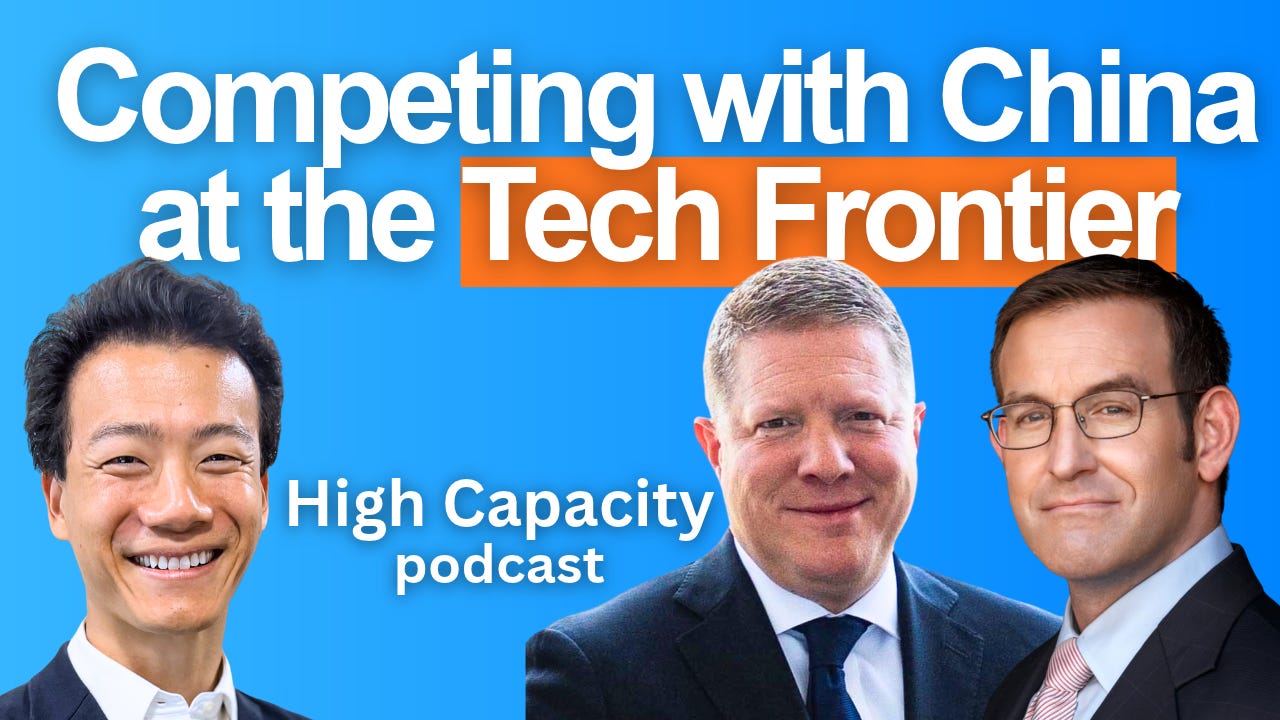
Watch or listen to the High Capacity podcast on:
How fast is China moving in space and quantum? Where else is China competing with the US at the technological frontier?
In this episode of the High Capacity podcast, I talk with Michael Kuiken, vice chair of the US-China Economic and Security Review Commission, and Commissioner Leland Miller about US-China competition in space, quantum technology, data, and critical supply chains. We explore China’s push into reusable rockets and satellite constellations, why quantum competition extends far beyond computing, and how Beijing is turning data into an economic and strategic asset. We also discuss hidden supply chain vulnerabilities and where the US government may need to step in.
We discuss:
• How quickly is China advancing in reusable rockets, launch infrastructure, and alternatives to Starlink?
• What are the differences between quantum computing, sensing, and communications—and where does China stand?
• What could quantum breakthroughs mean for encryption, medical imaging, and military capabilities?
• Why is China treating data as an asset, and how is AI making everyday information more strategically valuable?
• Where are the hidden Chinese chokepoints in pharmaceuticals, semiconductors, and other critical supply chains?
• How should the US rethink industrial policy and national security in a competition with no finish line?
Links:
Space hearing: “The Rocket’s Red Glare: China’s Ambitions to Dominate Space”
Report: “Vying for Quantum Supremacy: U.S.-China Competition in Quantum Technologies”
Data hearing: “Taking a Bigger Byte: China’s Expanding Strategy for Data Dominance”
Report: “The People’s Republic of Data: How China Is Turning Data into Capital”
Transcript
Kyle Chan (00:00)
Welcome to the High Capacity Podcast. I’m your host, Kyle Chan, a fellow at Brookings. I’m really excited to be joined today by two members of the US-China Economic and Security Review Commission: Vice Chair Michael Kuiken and Commissioner Leland Miller. Welcome to you both and thank you for coming on the show.
Michael Kuiken (00:19)
Thanks for having us.
Leland Miller (00:19)
Thanks for having us.
Kyle Chan (00:21)
I’d like to start by asking you to describe what the US China Economic and Security Review Commission is and how it works with Congress.
Michael Kuiken (00:31)
Leland, I’ll kick off, but I know we both have good stories on this one. So we’re actually celebrating our 25th year, Kyle. So we should sing happy birthday at some point during the show.
Kyle Chan (00:41)
Ha ha ha.
Michael Kuiken (00:42)
The China Commission was created by Congress in 2001. And you’ll remember this is right around the time of China’s accession to the WTO. And so prior to that, folks that are old enough may remember that Congress would have an annual vote on permanent normal trade relations with China.
And as the sort of decision on WTO accession started to play out in Congress, one of the things that Congress came to the conclusion on was basically it does not trust the Chinese and it does not trust the executive branch. And so it created this commission bipartisan, six Democrats, six Republicans, and the four leaders each get three appointments. And that’s how the commission works. In terms of how we work with Congress, our client is essentially Congress. So what we do is every year we deliver an annual report to them with recommendations. And that report usually focuses on a few areas each year. We usually just sort of do six focus areas. And there’s always at least one that is a regional issue. And then we work with Congress throughout the year to write legislation based on those recommendations and basically keep Congress sort of informed on these issues.
One of the big things that we do, my chair Randy Shriver always says we do beyond the inbox work and what he means by that, and I sort of really come around to this view of the commission is we think about things that are not sort of the alligator closest to the boat, not the things that are working on today, but that we’re anticipating will become issues in sort of 12 or 18 months. And so when you’re doing that kind of work, Kyle, one of the things that we always think about are like what are the literacy tools we need to sort of put in the report every year so that members have something that’s readily available to them that they can leverage for speeches and bills and sort of oversight efforts.
And so that’s how we orient a lot of the work each year. Leland, what did I miss?
Leland Miller (02:29)
I’ll just pile on here with what is probably the most important component of the commission, which is that it’s half Republican, it’s half Democrat. So everything we do is bipartisan. And it’s not hard to understand how important that is in today’s age when everything is a partisan issue. The composition of the commission ensures that everything we do is through consensus, it’s bipartisan. We have a series of hearings all year long. So each one is a Republican chair and a Democrat chair.
So we work on the issues together, we work on the conclusions together, the hearings themselves, which are on all these alligator away from the boat topics, are what actually influences our recommendations at the end of the year. That’s a process we’re working on right now. So we’re trying to make sure that the process from our research throughout the entire year is consensus-based and that it’s deep research, heavily influenced by how much work our staff do to prepare us for these hearings. And then we have recommendations to Congress at the end of the year that we hope influence some of the way Congress views the US China competition.
Kyle Chan (03:40)
Amazing. Yeah. The commission does incredible work really leveling up the understanding and policy making capacity that we need more than ever in Washington. So thank you for all the work you guys do. The first topic I want to ask about is space. Why does space matter so much right now? I think a lot of people think about space exploration, the Apollo missions, but it’s a strategic domain.
It’s a commercially important area. So yeah, what’s so important about space and which are some of the fields or aspects that we should be paying attention to right now?
Michael Kuiken (04:18)
Well, first of all, Kyle, it’s the final frontier. So that’s why it’s important. We actually did a hearing last year on the space issue, and there were a bunch of things that sort of remain sort of front of mind for me. One of the things, and I don’t think everybody, maybe in Washington folks, think about this, but when you leave Washington, not a lot of people think about this. Space is a warfighting domain. That’s the first sort of takeaway that I think is becoming more acute. We just saw the Russian satellite cozy up next to the commercial satellite that’s assisting the Ukrainians and that sort of proves to you that it is in fact a war fighting domain and that’s going to become more acute and more real as we think about a possible Taiwan contingency in the coming years.
That’s the first thing. In terms of exploration, one of the things that is really real right now just because of the Artemis program is that NASA’s trying to go back to the moon. And whoever gets there first, establishes a base there first—and when I say first, I mean the first time again—is really going to change the dynamics of what happens on the moon. Where are mining rights? Who’s making those decisions? Where’s the sort of source of water? What’s the way that we’re going to be able to maintain life up there from an energy perspective, from a food perspective? And so one of the things that happens in space, it’s this interesting area of convergence for a lot of the technologies that we all know about, but haven’t really deployed in space. So think about the convergence of space and bio.
Right? How are we gonna grow potatoes on Mars? How are we gonna grow potatoes on the moon? I use that as an example only because we’ve all seen Matt Damon on Mars growing potatoes, which I’m never sure actually happened. So the convergence of those issues are gonna be interesting. Everyone thinks about solar panels on the moon. I always think about nuclear reactors. I think about maybe the first place we deploy an SMR is actually not in Oregon or Wyoming or wherever Terraform is building it. Maybe it’s actually on the moon.
What are safety requirements on the moon? And how do you think about those issues? And then one of the other things that we didn’t really talk about much last year, but is sort of an underlying issue for us is the outer space treaty. This thing’s been around for a long time and it’s got a lot of rules in it. It doesn’t have a lot of enforcement. So how do we think about the outer space treaty going forward over the next five, 10, 15, or 20 years? And how do we leverage it in a way that makes sure that there’s good behavior in space?
The Russian example at the beginning is an example of bad behavior. The Chinese, one of the things we learned last year is they file all kinds of paperwork to say that they’re going to operate in a specific orbit, and then they decide to send up a satellite and do whatever the hell they want. And so thinking about international institutions, thinking about treaties and thinking about how we ensure that there’s good behavior in that ecosystem is very important. The space hearing was great. We had General Saltzman, who’s a wonderful guy. And if people haven’t watched his testimony in the hearing, I was actually really, really impressed with everything he said. One of the things that he said that was always really interesting me is he said Chinese operations in space and their capabilities in space are mind boggling. You do not hear general officers and flag officers use the word mind boggling very often.
Leland Miller (07:31)
And just I think the most important component of what Mike just said was the fact that space in some ways is the playground for all these other advanced technologies that we talk about every day. So whether we’re gonna end up building data centers in space to take advantage of the wonderful freezing temperatures or whether we’re gonna be utilizing quantum sensing, quantum communications via space. Mike mentioned biotech. So this is sort of a playground. It’s not just another component of the battlefield. It’s also a playground for some of these advanced technologies. So that’s something we’re watching pretty closely.
Kyle Chan (08:04)
That’s very helpful. How would you guys assess China’s progress in space? Just this year in July, we had China’s first successful landing of a potential reusable booster. It was captured out at sea in July with a net. And then just a month later or so, we had another successful landing of a reusable rocket.
This time by a private Chinese startup called Land Space. And that one landed on landing legs like SpaceX’s Falcon 9. So a lot of listeners are familiar with the fact that SpaceX has been doing this sort of reusable launch for more than a decade. It looks like maybe China’s starting to catch up on this area. In general, how would you assess China’s progress in space and sort of what are they doing differently now?
Michael Kuiken (08:57)
One of the findings we had in the commission’s report last year is that they are making incredible progress in space, no pun intended, in this ecosystem. How about that, Kyle? And
Kyle Chan (09:08)
Right.
Michael Kuiken (09:08)
And the thing that’s interesting, and you see this in a lot of places with the Chinese, it’s not just the technological developments that you’re seeing, right? It’s also the infrastructure developments that are happening as well. And so one of the things that we often think about when we think about SpaceX is that they launch from either Cape Canaveral, Vandenberg, or Boca Chica. That’s basically the only three places we have. And one of the stories that we heard last year is that in addition to the capabilities that we’re seeing the Chinese deploy, they’re also building out infrastructure in a very aggressive and deliberate way. And so I think you always have to sort of look under the hood to see what else is happening. And that was one of the big takeaways I had.
On the reusable rocket, I watched the videos of the two events that you mentioned. And I sort of have a few more, probably more than two takeaways, but the first thing that comes front of mind is: there’s definitely stolen intellectual property there. You look at these things, they basically look identical. There’s a reason they look identical. The second thing I would say is that one of the things we’ve learned from the Chinese is that not only do they have the ability to do sort of the fast following, but there is an iterate and innovate process that they go through that is very impressive. And so one of the things that you clearly see in those two examples is that they are iterating and they are innovating. So they may be built on the infrastructure of SpaceX’s intellectual property, but they are doing that cycle of iterating and innovating that is very important.
And I think you’ll continue to see them maybe be a fast follower, but the narrative I usually give on the space topic is everyone’s driven down a highway before where they’re cruising along at 60 or 70 miles an hour, and then some jerk comes by and flies by them at a hundred miles an hour. And you know how the car sort of shakes and it sounds like there’s air being pushed into your car all of a sudden.
We should assume that we are cruising down the road right now at sixty or seventy miles an hour and they are behind us and we see their front lights in the rear view mirror, but that car is approaching very quickly. And space is an area of competition and so we do have to be eyes wide open about that as we evaluate space competition.
Leland Miller (11:08)
Yeah. I just want to make sure Mike got in the highway analogy ‘cause that applies to
Kyle Chan (11:12)
Mm-hmm.
Leland Miller (11:12)
So much of the US China tech competition, but it’s a really good way of explaining the way the Chinese are handling space. We’re ahead. They’re coming up fast, fast, fast behind us.
Kyle Chan (11:23)
Speaking of fast catch up, I want to ask about low Earth orbit satellite constellations. I think a lot of people already know about Starlink from SpaceX, which offers satellite internet service to folks on commercial airlines.
I’ve taken flights where you get really fast streaming video on flights that you didn’t have before. But also for military use, like for Ukraine in its war with Russia. And now China is racing to build its own massive satellite constellations, including SpaceSail which is backed by the Shanghai government, and another system called Guowang, run by state-owned SATNET. So why are these satellite internet constellations so strategically important and how far behind Starlink is China?
Michael Kuiken (12:18)
Listen, on this one, Kyle, the first thing I would say is there’s a commercial anytime you get on a plane with Starlink talking about its reliability. So that’s always the first thing that sort of comes to mind, although apparently it’s not very reliable in Ukraine anymore. I can’t imagine why. The second thing that always comes to mind when I think about Starlink and these lower orbit satellites is this scene in Wally, which is a great cartoon. And if you haven’t watched it, definitely check it out, where the spaceship crashes through the orbit and it crashes through thousands of satellites. That’s really the ecosystem that we exist in today. If you have one of these apps that lets you see the stars, a lot of times you’ll also see a lot of Starlink satellites. So communications is obviously the ballgame when you’re in a conflict, right? And so if you can’t communicate with the guy in the next foxhole or the person on the other side of the hill or the ship that’s in the sea that’s providing supporting fires.
You can’t win any conflict without that. So that gives you a real sense of the importance of it in the area of conflict and war. In terms of just everything around us, like think about this podcast right now. Think about your phone. A lot of the communications either go undersea or over the orbit. How does your cell phone tell you where you are? It tells you where you are because of GPS and GPS is up there. And so that ecosystem, just going back to the first question, is something that people don’t appreciate how often in daily lives you use space and the low Earth orbit constellations are what are making the accuracy of so many of these things and the reliability of so many of these things better. The Chinese are obviously not deploying them at the same scale that Starlink is, but they’re gonna get there.
We see it on solar panels, we see it on batteries, it’s going to happen. And so as we sort of go into that brave new world, it’s gonna be interesting to see whether or not they’re a good actor. The ITU example from our hearing last year is that they’re not. So we’ll see how that plays out. And then the communications piece for them is exactly the same for us, right? They want to make sure that in a Taiwan contingency they have a reliable service in low Earth orbit that is hard to sort of knock out one satellite and shut it all down like we have historically had.
Kyle Chan (14:31)
All right, great. Now I want to turn to another strategic technology, quantum. Quantum is a big deal for the commission. In your 2025 annual report, the commission made a focus on quantum, one of its top 10 recommendations for Congress, calling for a quantum first national goal by 2030. Why is quantum technology so important? And how is China using a state-backed approach to trying to accelerate its quantum technologies?
Leland Miller (15:02)
Quantum is different than almost anything else that we research simply because there’s not one monolithic quantum.
When we looked at quantum, how do we create literacy in Congress? It’s something that we’re trying to do, as Mike said before. How’s the best way to break this down? And it’s not just quantum, it’s quantum computing, it’s quantum communications, it’s quantum sensing. All of these have very different potential military, potential commercial applications, they’re on different timelines to being potentially useful.
So part of what we wanted to do first off was understand how best to explain quantum as something other than just a monolithic beast. The second thing is it’s a little bit different than most things because so much of it is still far off in the future. So we were talking about AI, even a few years ago when we were a few years before the curve and talking about AI all the time. One of our recommendations, spearheaded by Mike, was a sort of a Manhattan project for artificial general intelligence. But this was always a couple years away. Some of the quantum developments are a number of years away, particularly in the quantum computing side. So it’s trying to understand as we are still far away from some of these success stories, hopefully, how do we understand what the domestic position should be and what do we need to worry about supply chains and how should we view the US-China competition through that?
I think the final component is that a lot of these technologies have commercial components. And in order for there to be sufficient capital going into them, you’re gonna have to be pushing the commercial side alongside just sort of government-run programs. You can’t have government labs doing all the hard work here. As a matter of fact, you don’t in the United States because there’s enormously important potential implications for some of these quantum technologies. You look at quantum communications, you’re gonna have these sort of extra secure comms. They can’t be hacked in the same way. You look at quantum sensing.
Yeah, you can have all kinds of military applications and maybe you could find submarines easier, you can find hypersonic missiles in flight, but you also have medical imaging where you could do an MRI in significantly scale levels of magnitude with more precision than you can right now. So it’s about sort of wedding the commercial side with the military side and understanding what the trajectory of this as most of it will not be a two or three-year project.
Michael Kuiken (17:32)
One of the things, Kyle, that I think is always really important for conversations with Congress on this topic is unpacking that there’s actually not just sort of one quantum thing, there’s three quantum things. And Leland did a nice job of walking through sensing communications and compute. For me, one of the big issues is post-quantum cryptography. And that’s an issue that I think the folks over at the Commerce Department and NIST have done some really good legwork on here to sort of start talking about this issue.
But this is an area where as Leland sort of described, there’s real first mover advantage, right? So if you are the first one to get sort of a quantum computer that’s able to break through public key encryption, you’ve lost. The ballgame’s over. And the ballgame’s over not just in terms of the sort of military and security side of it, it’s also the financial system. I don’t think Leland mentioned Bitcoin, but like the Bitcoin game is up. And so thinking about both post-quantum cryptography and first mover advantage in the quantum compute ecosystem is something that I think people in the national security community think about a lot. But I don’t think it’s something that people in the financial industry, in the telecommunications industry, and some of these other areas necessarily spend much time thinking about and planning for and executing too in terms of deployment these capabilities.
Leland Miller (18:53)
Yeah, and another aspect too that’s worth mentioning is we have something called an innovation flywheel that we’re constantly talking about, but AI is an accelerator for biotech, AI is an accelerator for quantum, and we don’t know the degree to which they are going to speed up, that artificial intelligence wedded with quantum is gonna speed up some of these developments. We certainly have started to see it on the biotech side. But it’s something to watch because the development of these technologies seem far off. But we may also hit a period in which the artificial intelligence capabilities become so mind blowing that they actually speed up timelines we thought impossible in getting to quantum success stories. So that’s one thing. Mike, you wanna mention the software side of this too? ‘Cause I think that was an important part of our recommendation from a year ago.
Michael Kuiken (19:41)
Yeah, no, I’m glad you prompted me on that one, Leland. So, Kyle, writing software on quantum computers is not going to be like writing software, like Microsoft Windows or like Oracle or anything like that. So there’s an entirely new ecosystem that needs to be created, and I’m sure AI will accelerate some of this. But at the same time, we do have to start thinking through these things and what it looks like when we visited one of the quantum labs last year.
I think Leland and I both fell out of our seats when we started thinking about quantum software because they were saying to us, we ran this test recently and we got some really interesting results, but no one’s ever written quantum software before, so we’re not entirely sure what’s happened here. And
Kyle Chan (20:20)
Ha ha.
Michael Kuiken (20:21)
Then Leland and I were like, What are you talking about? And so as we think about the quantum ecosystem, there is an important hardware piece of this, right? There’s fridges, there’s microchips, there’s those chandeliers that everyone’s familiar with. But no one ever sort of as part of the conversation says, but what about the software? And so that element of it is something that we tried to sort of raise awareness on and start that conversation on last year in the report.
Leland Miller (20:49)
Yeah, and another thing too, that opened our eyes on this trip was it’s about the labor force or the lack of a labor force, or the need to develop a labor force for quantum. When we were going from lab to lab, we took this trip a year ago and we’re going to quantum labs and some of the top universities that had quantum programs, spent a lot of time on the road listening to experts explain to us what we needed to know and what we didn’t know. One of the things that sort of blew our mind was the need to actually rethink the labor force on this. How our universities are rethinking programs, not just PhD level physics programs, but how you need to have graduate level programs beyond physics, you need to have college courses and other type of sort of engineering type programs that will allow us to create a quantum workforce.
Because the idea that you just need a bunch of math majors to do equations, that’s not the way quantum works. So I think that was very eye-opening. The other part of that is when you think of quantum, you think of quantum physics. I have a bust of Richard Feynman in my office, and it’s always been in my mind until I really understood what we were dealing with. It was an idea of like just running math equations. You’re just running high level math equations and that’s sort of the heart of quantum. Well quantum’s about a lot of things. It’s about developing a lot of technologies that will make this path to the end game easier. We heard a lot about chemistry. We heard a lot about material sciences in particular. Didn’t understand the degree to which China’s advances in some of these things were so absolutely critical.
So we’re maybe at the vanguard of quantum computing in terms of how many qubits we can get working with error correction. But there’s a broader ecosystem. It’s a broader ecosystem of workforce. It’s a broader ecosystem of types of technology you need to develop in terms of chemistry, in terms of new types of materials that will allow this quantum process to be undertaken with as few errors as possible. So this was an eye opening experience for us. I think it highlights a degree to which you really can’t just sit in a cubicle and read research reports on quantum. If you’re not out there talking to the labs, talking to the national labs, talking to the large tech companies who are doing this novel work, you’re never gonna get ahead of the curve because this really is, even for something that has a 10-year trajectory, 15-year trajectory on some of these things, it’s really going very, very fast.
Michael Kuiken (23:30)
Yeah, quantum is one of these fascinating dual use spaces, right? The one that Leland touched on, but let me just sort of foot stomp is quantum sensing. I thought I understood quantum sensing before this trip. After this trip, I walked away with a totally different appreciation for the opportunity that exists in this ecosystem. And so again, Washington always thinks about quantum computers, but like quantum sensing has incredible medical opportunities. Like imagine an MRI that all of a sudden you’re able to just get a level of detail that is not previously possible without cutting somebody open. Think about it from an X-ray perspective, same thing, same enhanced capability. And then think about it from a military perspective, right? You can all of a sudden see deeply buried tunnels or military facilities. All of a sudden you can see submarines under the sea.
And so there are a lot of opportunities in that ecosystem. And I think it’s something that get some attention from people that are familiar with the science. But from a funding perspective, everybody’s rushing to a quantum computer. I would also like to see more money going into quantum sensing as well because the opportunities are significant. On quantum communication, we are losing to the Chinese in quantum communication. That’s just a fact. And so that’s an ecosystem where we do have to think about the science and the engineering that needs to happen there as we sort of go into the coming years in quantum communications as well.
Kyle Chan (24:59)
Great. Yeah. There’s obviously a lot on the frontier where it depends on the rate of innovation, the rate of sort of new scientific discoveries, but there’s so much, as you guys are pointing out, that are nuts and bolts preparing for this new set of industries and applications that are coming online, whether it’s supply chains, talent and workforce, all the inputs that go into this. So it’s not about sort of waiting for the technology to be mature and then we jump in. We need to get ready.
Next, I want to actually ask what you guys are focusing on now. So space and quantum continue to be areas of focus for the commission. You guys have done excellent work, but there’s some new topics on the horizon that have prompted a lot of discussion for you and your teams. What other topics do you think Congress should be focused on at this moment?
Leland Miller (25:49)
Well, a guide to understanding where our head is on these things is to look at the hearings we’ve done over the course of the year. And those are the things that we think are the most important topics that we need to understand better in order to be making informed recommendations to Congress at the end of the year. One of the things that we’re looking at very, very closely is the idea of data. Now, data seems like an old topic. It’s something like supply chain is another thing we’re working on that seems like something we’ve been talking about for ages. But data’s very interesting because what we did in our hearing back in April was look at China’s approach to data and how different it is for the United States, and what we need to do in order to be more effective in competing with China in data. Now, a lot of people say, well, wait, why in the world data? Data is not warfare, data just pieces of information. I think what the US approach to this has traditionally been siloed. So when you think about data, you think about data’s privacy.
Data, it might be cyber hacking, data might be your health data, data might be your genome, but they’re all in silos and thought of very differently. The genius behind what China has done is to envision data as an asset, as something that is actually a core component of industrial policy. And what China has done over the past several years is build up this comprehensive data dominance strategy, is what we call it, in which they’re going to utilize data across the spectrum in ways that used in aggregate can be extremely powerful economic and national security tools. So a lot of what we’re looking at is China’s strategy, how they are looking at this more thoroughly than we are, what we need to do to change that, and also how we can sort of safeguard what we’ve got.
Because we look at this in a siloed way, we don’t think about how much of our data gets hoovered up by China, by adversaries around the globe, whether it’s through illegal means like cyber hacking, which gets a lot of press, or it’s through data brokers which are legal but are constantly shuffling our data out the front door as well as the back door. We’re looking at biolabs that until very recently have had sort of open access for China and other countries to come in and grab some of these data. We’re looking at pharmaceutical trials where a lot of our data is being hoovered up by Chinese companies. So I think one of the things that we’re trying to do is develop a mindset around how should we rethink data in the new age, particularly in the age of AI?
How can we be more smart about protecting our data and how can we be more effective in utilizing broad data to get to use it for national security purposes?
Michael Kuiken (28:25)
Leland crushed all of it. The data broker thing blows me away, Kyle. If you’ve not Googled yourself, go for it. The thing about Googling yourself is not seeing the things about you. It’s seeing the things that the data brokers have connected to you and how all of that just exists out in the open. It is, I’ll go back to General Saltzman’s word, mind-boggling. How much is just out in the wild.
And all of that stuff that’s out in the wild is available to the Chinese. And to Leland’s point, they aggregate it and they leverage it and they use it against us. And so as we think about the data ecosystem in the US, we do have to think about data governance and we have to think about these issues. And Leland did a nice job of explaining them. The other thing that’s also just totally astounding to me, and we have an analyst on our team who found this in the early 2020s, and we highlighted it just in passing in 2024, was the fact that the Chinese are allowing local governments and businesses to assign value to data. Data in the sort of democratic world is usually considered an intangible asset, something you’re not able to assign value to.
And the Chinese have actually flipped this entire ecosystem on its head and are now assigning value to data. So now think about all the things around you. Think about how long you linger over the screen on whatever your preferred social media platform is. Think about all of the holdings of a company or a local government. One of the best interviews I saw in Bloomberg was actually the Chevron CEO, believe it or not, who casually in passing during the interview says, we have a hundred years or at least a century’s worth of data.
Kyle Chan (29:58)
Yeah.
Michael Kuiken (29:59)
And I was like, my God, can you imagine how actually valuable that is? Geological surveys, core samples, refinery data. I can’t even imagine what Chevron’s sitting on in terms of data. But now think if you’re allowed to assign value to that.
And you find a way to exchange that data. Now think if you’re a local government and the data that you have, scientific data or other kinds of data that you may collect just as a matter of a routine activity of government. Now in China you have to be a little bit more concerned because it’s obviously an authoritarian government. But like just think about assigning values to those things and you really do take, I can’t remember how Leland said it the other day when I was talking to him about this idea, but you will fundamentally change so many things about the financial ecosystem that assigning value to data is something that we do need to be thoughtful about and we need to think about it in a way that allows us to make sure that we’re not falling victim to how the Chinese write the rules of the road in this space. And so that’s something else that we’re sort of thinking hard about as we go into the report this year.
Leland Miller (31:03)
I wanna leave everybody with one of the more important, definitely most interesting things that we were looking at within the data universe, which was patterns of life data. So now that we’re entering the age of AI, data that in a vacuum is not important, whether where we go, what tracks us, the devices in our homes, all these type of data that maybe singular. You look at what you’re doing, what Leland Miller’s doing, what Mike Kuiken’s doing, it’s not interesting. But when aggregated with other data can be very telling. So we’re in the age of AI where we’re able to crunch enormous amounts of data, some of this information that traditionally was seen as pretty much useless or not important, certainly not something that would be a national security issue, is quickly becoming a national security issue because the ability for sufficient compute to be able to crunch these numbers and create these patterns of life.
So we’re entering a world in which as with AI, with high levels of compute, we’re gonna be able to crunch data that we’ve never been able to do before. So things that were mundane, parts of your life that you didn’t even realize devices were tracking in your car, in your home, et cetera, are gonna become actually useful tools, possibly commercially, certainly possibly militarily as well. So this is a big thing and we’re just at the very, very cusp of developing ideas around it. But it’s something that we thought we needed to highlight and we’re working through ideas and try to communicate these ideas to Congress right now.
Michael Kuiken (32:40)
Kyle, one of the most terrifying and sort of also awesome things in the pattern of life space. I said this to a senior Australian legislator, parliamentarian recently. I told him about tire pressure management systems. Most people don’t realize this, but the tire pressure management system communicates with your car, not through some wire that’s inside of the tire, but through a remote control of device essentially that sends something over a radio signal to your car to tell you when your tire pressure is low, the fact that it is beaming out that radio signal also allows it to be collected by things other than your car. And so when you think about tire pressure management systems and pattern of life issues, and you think about all the cars around us, and you think about flock cameras and license plate readers and all these things, there’s plenty of ways to track your car. And it’s not just your license plate.
Kyle Chan (33:35)
Yeah, that’s a really important point. There’s a parallel here with the whole quantum discussion where things that were previously invisible are suddenly being revealed through new AI tools, things that you thought were unstructured data, too messy to really make any sense of, are suddenly it’s like an X ray where you can suddenly triangulate and spot movement of a person through time based on all these different sorts of exhaust or emissions coming off of that person, whether it’s what you do digitally or even in the physical world.
Leland Miller (34:06)
And add
Michael Kuiken (34:07)
Yeah, you put your finger on it. Sorry, go ahead.
Leland Miller (34:09)
To that the fact that for years governments have been storing data. Certainly China’s done this, data that they can’t decrypt right now, but they’re saving it for a day that they can decrypt it. And then when they have that data, they’ll likely have the means, as will other countries, to be able to not just understand the data, but to put it in tandem with the other data that they’ve been collecting and to make a composite picture that otherwise would have been impossible. So we’re just at the cusp of this universe where AI is gonna translate the importance of data into something that we’ve never seen before.
Kyle Chan (34:45)
Great. Okay. Time for one last topic. What else are you guys working on? What else do you want to call out here in terms of really pressing issue that you have your teams furiously trying to figure out and come up with recommendations for Congress?
Leland Miller (35:02)
I’ll throw one thing out. It’s not a technology. It’s a mentality. Because I think if you talk about what’s happening in terms of the need for reindustrialization, we have done a lot of work in our hearings over the past two years on Beijing’s control of supply chains, particularly the advanced technology, but beyond that as well. And the idea that it’s gonna be able to allow them to change your policies in the future simply by them leaning on you and denying you goods. When you talk about supply chains right now, you talk about typically critical minerals and rare earths because that’s been the big US China spat over the past year. But a lot of our work in the commission has been to look at the other vulnerabilities in the supply chain. It’s the component of China Shock two point where China has essentially become a manufacturing production and export powerhouse.
And as it exports all these, it produces these things and it controls these supply chains, certain supply chains of ours which we think are free of any particular leverage point from another country are actually not at all. So we’ve done a lot of work on pharmaceuticals, for instance. The underlying APIs, the active pharmaceutical ingredients, these are things that have been if you look at the division, China controls some or China builds some and India builds some and some are Europe or Southeast Asia, it doesn’t look like a problem. But underneath the surface, China controls most of the key starting materials in these supply chains and so has enormous leverage upstream that can allow them to control things downstream. Control of antibiotics and heparin and insulin and all these other things that are incredibly important for everyday Americans to get their medicines.
So we’ve been looking a lot at supply chains, but we’re also trying to work through the mindset for that. And this is something that we get asked about a lot. A lot of us have been free market guys for most of our lives. Like how do you look at these industries and actually put them through a lens where you can identify national security priorities and say what is government’s role? You can’t do everything. Where should government be jumping in? And I think one of the things that we’ve been trying to work through and communicate is necessary going forward is that we’re gonna have to create a national priority, a national security priority set. Here are the handful of things that we absolutely need to produce at home. And when we do them, we’re going to need to take them out of the economics bucket, and we’re going to have to put them in the national security bucket.
And that’s going to be something the government is going have to take a role in. So whether we’re talking about pharmaceuticals, we’re talking about other things. We identified printed circuit boards, foundational semiconductors, and other things as things that may require some sort of government role, whether it’s setting long-term contracts to build at home or with allies, whether it’s putting price floors in. So it’s not a technology, it’s a mindset saying we in this new world where if you leave things up to supply and demand, China often controls the supply of a lot of these things and can turn them on and off. It could flood the market with minerals to crash prices. It can turn the spigot off in order to take supply away. You have to move core things in the national security area outside the economics bucket and put them in the national security bucket.
So a lot of what we’ve been doing the last couple of years is trying to work through what are these things that we’re particularly vulnerable on? How do we see national security issues? What are the true priorities?
Because you get 10 people together, you’ll have 10 different versions of this. But I think it’s a mindset. As we enter this new stage of competition and as supply chains, advanced technology and otherwise become these incredibly important battlegrounds between the US and China in the future, where are the areas that we need to be most focused on and how do we create a robust supply chains that essentially de-risk China, but also empower the United States and its allies to build these things up on our own terms. So this has been a big area. It’s something probably outside the technological areas that you’ve been focusing on, but really thinking through this mindset has been important for us in terms of scoping out our policy recommendations.
Michael Kuiken (39:23)
I’ve never heard Leland’s mentality thing. That’s a good riff, Leland. Let me actually just pile onto it because I think it’s important to sort of add something to what Leland said, which is I think a lot of times we think about competition, whether it’s with China or with another country, as a race with a finish line. And this doesn’t necessarily have a finish line. It’s one of these things where it’s gonna be a constant cycle of measure, countermeasure.
And we have to sort of be prepared for that. And a lot of the things that Leland just walked through, I think, are really good to sort of put in people’s mind when they think about mentality. And then the second thing I would say, and this goes back a little bit to the conversation about reusable rockets, Kyle, which is that sure China has stolen decades worth of American and democratic world’s intellectual property, but there is an innovate and iterate cycle that they are incredibly effective at.
And too often I think we don’t appreciate the fact that pretty soon they’re not going to be a fast follower and they are going to be way ahead because they are so effective at iterate and innovate. And so we do need to be very thoughtful. And so when we hear X number of months lead or X number of years lead, you shouldn’t assume like, yeah, it’s going to be like that forever. We should think like that is a closing window, not an opening window. And we have to have the mentality when we think about policy choices that we make and funding decisions that we make. And that’s some of the things that we’re trying to sort of maintain a good focus on with our clients in Congress.
Leland Miller (41:01)
Yeah, and just dancing around from these various topics, we’ve hit some very disparate subjects in the last forty-five minutes. I think it reflects the way that the commission views its job right now. When we talk about technologies, people often say, Okay, you guys must be focused on AI, you have AI recommendations, you must be focused on quantum, you have quantum recommendations.
Yes, sure. But a lot of what we’re trying to do is assess how the landscape’s changing over time. So in terms of data, we assess that the Chinese have figured out that data is a whole of government, whole of society effort that they’re trying to gain advantage by putting together a plan. It’s something that we have not been doing on the US side. So how do we rethink our approach to data? Talking about supply chains. We’ve traditionally said, well, we’ve got great companies. Our companies can compete against other companies, but we’re in an age in which our companies aren’t competing against other companies. They’re competing in the background against the might of the Chinese government and the party’s plans for supply chain dominance behind that. So we’re trying to think through how to rethink supply chains, how to rethink reindustrialization in a smart way. So I think this gets to a lot of what we’re trying to do. We’re trying to think through not just topically how do we win a technology, but how do we rethink the way the landscape is changing in US-China competition and how do we do better on our side.
Kyle Chan (42:26)
Amazing. I will be sure to link to these hearings. People can listen in from you guys and the other experts that you hear from. I will link to the annual report and other written products. The research that you guys do is incredible. As a research nerd, I appreciate the granular detail and all the sort of ins and outs of these technologies and the US China competition. But then also for those who want the high-level picture.
They can get that as well. And I think that’s also where you guys can offer a couple of those succinct points for those who don’t have time to wade through all I forgot how long your last annual report was, however many hundreds of pages.
Leland Miller (43:07)
Huge. Huge.
Kyle Chan (43:09)
So that all backs up the findings, right? But I’ll link to all that. And if folks want to follow the commission’s work, how can they do so?
Michael Kuiken (43:20)
USCC.gov and Kyle, just as I was listening to you, I think both Leland and I have been remiss. Leland and I, you’ll be shocked to learn are not doing the research here and not doing the translations. We have a staff, small staff that is small but mighty and they do incredible work in terms of translating a lot of the Chinese language source materials and do an absolutely incredible job. And so that granularity is a result of many, many long hours and right now they’re putting in even more long hours as we sort of get to the closing window on the report. So just let me make sure I foot stomp that.
Kyle Chan (43:59)
Absolutely, yeah.
Leland Miller (44:00)
We do have a LinkedIn page too. We do put videos out, so we’re on Twitter.
Try to be everywhere and share our views and share our research as it comes out.
Kyle Chan (44:11)
Awesome. Well, thank you so much.
Leland Miller (44:13)
Thanks, Kyle. Appreciate you having us.
Michael Kuiken (44:14)
Thank you, Kyle.
Kyle Chan (44:16)
If you like this episode, please rate and subscribe on YouTube, Spotify, or Apple Podcasts. You can find episode transcripts and more information on the High Capacity newsletter at highcapacity.org. I’m your host, Kyle Chan. Thanks for joining and see you next time.