


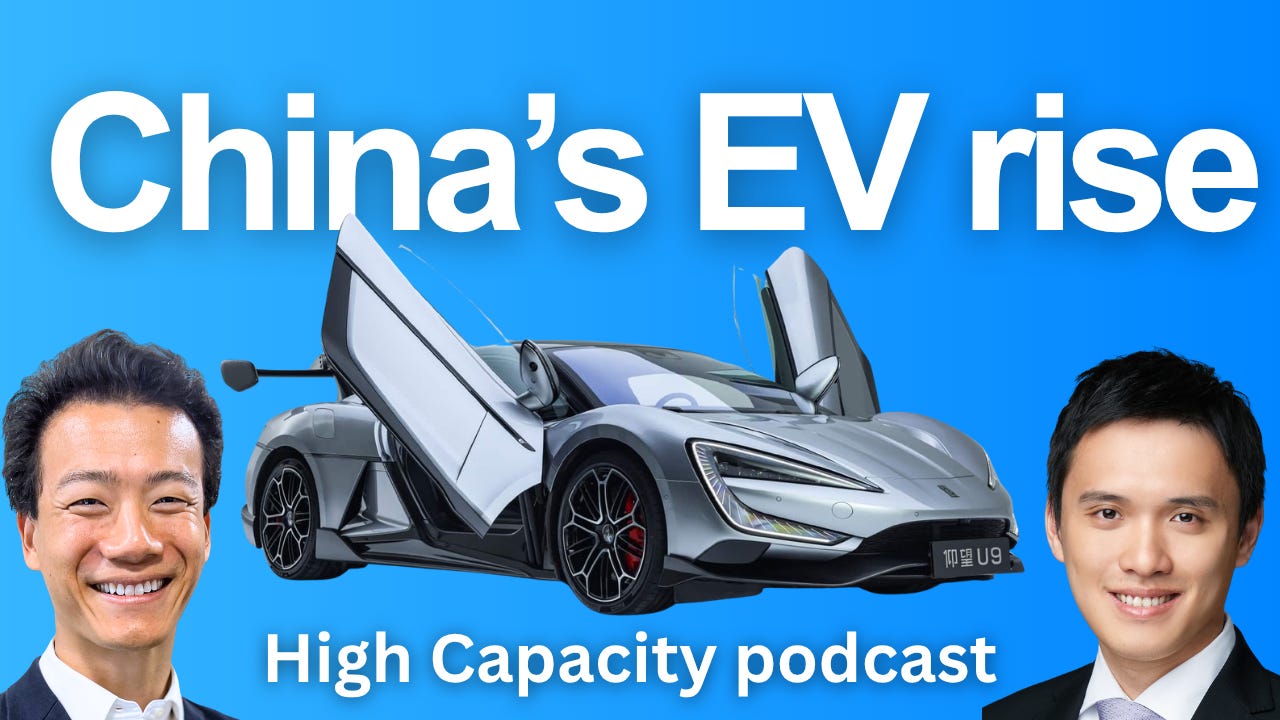
Watch or listen to the High Capacity podcast on:
How did China build a world-leading EV industry? China didn't just pick winners. Local governments and private entrepreneurs played a critical role alongside a broader national push into batteries and electric vehicle technology.
In this episode, I talk with Fengming Lu, an assistant professor at Australian National University, about China's decades-long effort to build a world-class auto industry, its pivot to EVs, and what lessons other countries might learn.
We discuss:
• How Chinese local governments act like VC investors
• What China learned from foreign automakers like GM, Volkswagen
• The rise of upstarts like Geely, Chery, and BYD
• What caused a wave of Chinese EV startups like NIO, Xpeng, Li Auto
• The "Hefei model"
Links:
• Research article: The Rise of China’s Electric Vehicle Industry: Strategic Alliances Between Local Governments and Private Capital
• Fengming's personal website
• Fengming on Twitter / X
Transcript
Kyle Chan (00:00)
Welcome to the High Capacity Podcast. I’m your host, Kyle Chan, a fellow at Brookings. I’m thrilled to be joined today by my guest, Fengming Lu, an assistant professor at Australian National University’s Bell School of Asia-Pacific Affairs. Fengming has done extensive research on China’s political economy and the rise of its electric vehicle industry.
Welcome Fengming, and thanks for coming on the show.
Fengming Lu (00:23)
Thank you for having me, Kyle. We haven’t seen each other for a long time. It’s really great to see you again, virtually.
Kyle Chan (00:28)
That’s right.
So you recently published a fascinating new research paper with Ma Xiao at Peking University titled “The Rise of China’s Electric Vehicle Industry: Strategic Alliances Between Local Governments and Private Capital.” The paper has gotten a lot of attention and challenges some key assumptions about China’s EV industry and China’s industrial policy more generally. So at a high level, what is your paper trying to do?
Fengming Lu (00:56)
It’s one of the first papers I’ve been publishing for my EV-themed project, and I think it’s part of a larger project. I’m working on a book manuscript and also working on several other papers, just to form a big argument about the rise of the Chinese EV industry, which a lot of people are very interested in.
What’s really interesting is that this paper talks about one aspect of the whole argument. My argument is that to fully understand the rise of the Chinese EV sector — and probably for some other industries — you need to understand three pillars underpinning it. The first one, which a lot of people are very familiar with, is the central government’s industrial policies. We have seen a lot of discussion about that in policy circles and also in academia. But I think it’s also very useful to point out the other two. Kyle, you have discussed some of those before. For example, local governments — their developmentalism, or their developmental strategies, is a very important part of that. And also the global capital market.
So this paper is mostly about the first two, or the linkages, responses, and reactions from local governments to the central government’s industrial policies. What’s really interesting in the EV sector is that those three pillars are very important, but the linkages between them are also fascinating, because local governments also respond to the central government’s industrial policies. Some of them are promoting the EV or automotive sector, but some of them are actually posing barriers and restrictions. And local governments have developed their own ways to circumvent such restrictions over the past three or four decades. So that’s pretty much my motivation behind this paper.
Kyle Chan (03:09)
That’s awesome. You know so much about the broader auto industrial policy in China, both before and with the EV boom. So I was wondering if we can go back to an earlier era with traditional automotive strategy. What was China’s auto industrial policy in, say, the 1980s and 1990s, and especially the strategy of using joint ventures with foreign automakers like Volkswagen and GM? What were they trying to do? What were some of the problems with this approach? What was that era all about?
Fengming Lu (03:48)
Absolutely. When we’re talking about Chinese automotive industrial policies, China had its first set of automotive industrial policy in 1994, and there was a prototype of that one back in 1987. There were a lot of fascinating stories behind that. We probably don’t have enough time to go over them, but long story short, the Chinese government somehow found out that there were some foreign automakers who were interested in China — not very many of them, because China was still very poor.
Back in the eighties or the nineties, China sold roughly half a million, or a little bit more than half a million, cars every year. And the main buyers were mostly government agencies — those danweis, or government-owned businesses. So private people — I still remember that time. I think none of my classmates, or maybe one of them, had a car, in primary school or in kindergarten. And that car actually didn’t belong to that guy’s father. It belonged to his father’s business. So that was pretty much the case.
Kyle Chan (05:04)
Hm.
Fengming Lu (05:14)
So for the Chinese government, you have this tempting future of the Chinese car market — maybe twenty years from the perspective of the 1980s or 1990s, but it’s just so far away. At the moment you only sell about half a million cars. In the words of the CEO of General Motors back then, it was just roughly the size of Poland. So how do you attract foreign car makers into your market? You cannot establish too many joint ventures, because if you have too many joint ventures, it won’t sell and it won’t make money. The Chinese were taught by the Germans, taught by Volkswagen, that the minimum size of scale of economy was about 150,000 cars a year. Below that you probably won’t be able to make money at all.
So the Chinese did their math. The rough size of the Chinese car market toward the end of the 1990s was roughly about one million. So just divide one million by 150,000 — about six. So that’s why the Chinese government roughly had this quota.
Kyle Chan (06:33)
Mm-hmm, mm-hmm.
Fengming Lu (06:38)
Of what people later call “three bigs and three smalls.” There were some local governments who made the move earlier in the 1980s to establish either joint ventures, or they bought licenses from foreign car makers. Like Guangzhou — they collaborated with the French company Peugeot. And Shanghai was also one of the front movers, and also the famous Beijing Jeep. Some people even wrote a book about that. So those were the joint ventures who got the licenses to manufacture cars.
And later on, two former defense contractors, which were basically also state-owned, got licenses later to make mini cars. But that’s it. So you just have six plus two. Those were the legitimate car makers in China after 1987, pretty much.
I wouldn’t blame the Chinese government, wouldn’t blame Beijing, for making that decision, because they had their concerns — and I think a lot of them are actually shared by a lot of other people nowadays. They thought that with a market the size of China, you cannot have too many car makers. You need to consolidate them. A lot of people still think so today, right? And also they had this anxiety about fragmentation, because China just inherited this fragmented economy from Mao. I think someone has done the count — in 1995 China had over 130 car makers. Almost every province had its own car maker, except Tibet. So it was just too many of them.
Kyle Chan (08:25)
Wow.
Fengming Lu (08:35)
And also, China had this — it’s very hard to imagine nowadays, but back then the Chinese government was very, very anxious about the WTO accession. They anticipated that China would probably join the WTO, of course after finishing negotiations with the United States, in the late 1990s or early 2000s. And after that, China needed to lower its tariff. Because back then, in the nineties, China had over 100 percent — often over 100 percent — tariff on car imports. But after China joined the WTO, China needed to lower its
Kyle Chan (08:40)
Hmm.
Fengming Lu (09:05)
import tariff to like 25 percent. Actually it was 25 percent in 2006. So they were really worrying: up to 2006, could China have a domestic automotive industry that is good enough to produce its own cars, rather than just importing foreign cars and exhausting the foreign currency reserve? That was their main concern. At that moment they didn’t really care whether China was manufacturing Volkswagens or any other Chinese-owned brands. They just wanted those cars to be built in China.
And you talk about the two landmark joint ventures in the eighties and nineties for China — Volkswagen and General Motors. They both formed joint ventures with Shanghai, and of course Volkswagen also had a joint venture with FAW, with Yiqi and Changchun. A lot of people are talking about whether Volkswagen, when they made the deal with China thirty or forty years ago, made a bad decision — is it now backfiring on them? But I don’t think that’s really the case. Volkswagen really made a lot of money.
Kyle Chan (10:29)
Mm-hmm, mm-hmm.
Fengming Lu (10:29)
From the Chinese market, especially starting from the nineties. It’s not only selling cars in China, but also royalties and many other things. From the Chinese perspective, Volkswagen was very important to tell the Chinese what a modern automotive industry actually is. You need to have a scale of economy, you need to have quality manufacturing, you need to build up your own supply chain. When Volkswagen was first building cars in China they found out that they were building basically on greenfield. There were almost no qualified suppliers in China, and you cannot always just import parts from Germany 100 percent — it doesn’t really save you money. And also quality control.
Kyle Chan (11:09)
Mm-hmm, mm-hmm.
Fengming Lu (11:27)
You will see that many of the first batch of people who started working for China’s own car makers in the nineties, who used to work for those joint ventures, were mostly working in quality control, because before that no one had any idea about how to do quality control in China. Many Chinese-made cars before the eighties actually wouldn’t pass any quality test today.
And for General Motors, they were even more ambitious about the Chinese market. They also had more hope, for several different reasons. And Shanghai chose General Motors for a very good reason, because after about ten years of collaboration with Volkswagen, of course they learned a lot. They started negotiating for another joint venture somewhere around ‘92, ‘93.
What they learned is that they learned quite a lot from the Germans, but there’s one thing the Germans wouldn’t release. The Germans don’t put any R&D in China. To take an example, whenever you want to design a new part, even one component on a car, no one can do that except in Wolfsburg, in their headquarters.
Kyle Chan (12:33)
Hm, right, right.
Fengming Lu (12:49)
No one can do that in Shanghai. You need to do that from Wolfsburg. So that was something that really frustrated the Chinese — both the Chinese government, and Shanghai, and later the Shanghai Automotive Company, which is later known as SAIC. That’s why eventually they tried to negotiate with General Motors and Ford to see whether, as a part of a joint venture, they could move some of the R&D into Shanghai.
So eventually General Motors won, and General Motors did. General Motors established, except for SAIC-GM which we know today, an R&D entity called Pan Asia Technical Automotive Center, PATAC — in Chinese, Fanya. It later became pretty important to teach the Chinese how to do design. Initially all the early work they did was pretty rudimentary — just changing the body panels or something like that. But later on they started to do something more sophisticated. For example, changing the interior, and starting from around 2010, PATAC started doing engineering from scratch, building architecture, building platforms.
And they have been very intensive later on. They have been part of the globalized R&D network of General Motors, just like Opel in Germany and Holden — of course, the late Holden — in Australia. Because for General Motors back then, probably not today, but back then, General Motors was a very globalized company. They wanted to outsource many of their R&D activities for the rest of the world. So it was actually matching what China really wanted.
And it’s not only PATAC. I recently did an interview with a senior engineering executive from SAIC. He told me that after the financial crisis, because General Motors was trying to cut cost, General Motors actually started developing engines, internal combustion engines, with SAIC, with the Chinese. So a lot of people say that China did EVs because they were lagging behind in internal combustion engines. It might be true in the 2000s, but in the 2010s, it’s not that much the case. Although you don’t have a lot of Chinese cars on American roads, actually
Kyle Chan (15:35)
Mm-hmm, mm-hmm.
Fengming Lu (15:42)
after model year 2015 and 2016, you do have half-Chinese engines on those cars sold in the United States. Some of the smaller Chevys, like the Chevy Cruze, or smaller Buicks, like the Buick Encore — their engines are actually half made and designed by the Chinese. A lot of people didn’t know that.
Kyle Chan (15:48)
Right, right, right.
Yeah. So it’s interesting that from a pretty early stage, at least from the Chinese side, there was strong interest in trying to bring over some of the R&D. It wasn’t just enough to have final assembly. And I was wondering, just as a quick follow-up, for a company like Volkswagen, why were they reluctant to agree to invest in R&D? Later on, I think other German companies did build R&D centers, like Bosch famously, or some of the German chemicals companies. But was there a sense already from Volkswagen that they wanted to retain this technology edge? Or was it more just that this is how they did things and they weren’t used to doing R&D in other countries?
Fengming Lu (16:46)
I think both. It’s especially true for German car makers, German OEMs. For example, Bosch started doing R&D in China pretty early on, starting from the 2000s. I have several friends who work for them, doing R&D in Suzhou. But for German OEMs, the automotive industry is sort of the national identity or national culture of Germany, in several ways. And you’re in Germany right now, right? You can probably sense that it’s part of their national pride. They wouldn’t really allow people outside the country to do core engineering. In China, starting from the 2000s, they allowed Chinese engineers to do some of the localization — for example, tweaking suspension or something like that. They did similar things, for example, in
Kyle Chan (17:18)
That’s right.
Fengming Lu (17:44)
Brazil or in Mexico, sort of like that in the United States, but still very limited. It’s very different from American or some Japanese car makers, who are willing to outsource engineering a little bit more outside of their territory. It only changed until 2021, 2022 — actually 2022, 2023, when Volkswagen eventually decided they would buy equity of Xpeng and also later collaborate with Xpeng and develop what they call “in China for China” models, especially EVs in China.
But this is quickly changing. For example, recently there was a lot of discussion about the massive layoffs that could happen to Volkswagen in Germany. And there has been discussion, I think first brought up by the Chancellor of Lower Saxony, that maybe we can start building those “in China for China” models engineered by Xpeng in Germany. So it’s just dramatic how quickly the tide is changing. If you were talking to someone back in 2019 or 2020 about German companies outsourcing their engineering, core engineering,
Kyle Chan (18:54)
Mm-hmm.
Fengming Lu (19:09)
to China, or even making those vehicles in Germany — that guy would probably be seen as crazy. But now it’s really happening.
Kyle Chan (19:17)
Yeah. Right, right, right. It is quite an incredible transformation.
Well, to get back to the story: in the nineties you saw the rise of this JV model, but at the same time, there started to be new entrants into China’s auto industry, new players like Chery and Geely. I was wondering if you might describe how these firms emerged and what challenges they faced.
Fengming Lu (19:48)
Absolutely. If we’re thinking in a counterfactual way, if China had just stuck to this JV path, maybe China would eventually also have developed its own indigenous engineering capabilities by maybe 2030 or something — but much later than what we see nowadays. Because one problem a lot of people are sensing in China today is that this joint venture scheme, designed by the central government, only allows certain, mostly state-owned, enterprises to form JVs with foreign partners. So they pretty much don’t really have incentives to compete with or challenge their foreign collaborators. And you wouldn’t be able to see so many startups in China either.
So the companies you’re talking about, Chery and Geely — they can be seen as the first batch of auto startups in China, in the 1990s. It’s something unique to China, because in other countries you don’t really see startups in automotive manufacturing. It’s not a very profitable sector and you have very established incumbents, right? No one thought about starting a car company in the US in the nineties to challenge the Big Three. It would be crazy. But in China it was true, because first, this industrial policy still had some loopholes to circumvent. And second, in China, local governments and also the emerging private entrepreneurs were also very tempted by the automotive
Kyle Chan (21:23)
Right, right, right.
Fengming Lu (21:47)
industry. So that’s why we have seen companies like Chery, Geely, and also other companies such as Great Wall Motors emerging in the 1990s. Chery and Geely are very good examples because they are now expanding very quickly outside China. A lot of people didn’t know them a few years ago. And they have very different
Kyle Chan (21:56)
Mm.
Fengming Lu (22:12)
roots in many ways. Chery is originally a company founded by a city called Wuhu and also backed by Anhui Province, which were relatively poor, below average, in China back in the 1990s. And Geely — a lot of people know its founder, Li Shufu.
Kyle Chan (22:42)
Geely, yeah.
Fengming Lu (22:42)
Yeah, Geely. His first business was actually taking photos for his classmates. He was a photographer. That was his first job. But later on he changed his business model several times. He started making fridge parts, making fridges, making motorcycle parts, making motorcycles, and later on he found out that it’s most
Kyle Chan (22:50)
Hmm.
Fengming Lu (23:10)
profitable just to make cars, because cars were so expensive in China back then. Basically if you can make cars — some people even smuggled cars — you can make a lot of money. So that was the basic motivation behind those people.
For Geely it was a little bit more straightforward. In the 1990s, Li Shufu started to make cars initially by making knockoff versions of Mercedes, but later he realized that it was just too hard to copy Mercedes. He decided to copy cheaper cars. And initially he didn’t get any license or approval from the central government. But somehow the government of Zhejiang, my home province, found out that there is a company making cars.
Kyle Chan (23:42)
Ha ha ha.
Fengming Lu (24:01)
And they thought maybe we should give him a little bit more space and room. Because Zhejiang has been pretty famous for its car parts industry, starting from the 1980s. It was Zhejiang because it’s just next door to Shanghai, right? It’s one of the main beneficiaries of those joint ventures, like Shanghai Volkswagen. But when you sell those parts to those companies, you always have the uncertainty of whether you will still be their supplier next year, and you don’t reap most of the profit. So the Zhejiang government thought maybe if we have our own car maker, we would be able to claim more of the profits, more of the revenue, within our jurisdiction — which is a very common logic in China. So that’s how Geely eventually managed to survive the first few years and was eventually granted a license to manufacture and sell cars across China in 2001. And Chery was an even more fascinating story.
Kyle Chan (25:14)
Yeah, yeah. Can you tell the story of Chery, and especially the role of Wuhu in Anhui province, and how they helped to support this new player in the industry?
Fengming Lu (25:28)
Absolutely. Initially Anhui didn’t really think about making cars, because they thought it was too sophisticated. But starting from the early 1990s, they saw some smaller township and village enterprises making maybe a few thousand cars a year but still making a lot of money, and they realized that maybe we should give it a try.
Back then they had two ventures. One is a company called JAC, Jianghuai Qiche, which is still doing okay today but not that well, in Hefei. Another venture was in Wuhu, because Wuhu was one of those cities with a little bit more industrial and manufacturing companies in the province. So they put a lot of hope on that city. They initially formed a joint venture with a fridge maker and also FAW, Yiqi, by pulling personal connections. But it didn’t work very well, because FAW, Yiqi, in China had the nickname of “the eldest son of the People’s Republic.” They just had too many choices
Kyle Chan (28:34)
Hmm.
Fengming Lu (28:43)
on their table. So they wouldn’t give their core business — just like the Germans. They wouldn’t give their core business, like engines and car assembly, to Wuhu. So Wuhu decided maybe we should try to start our own car company by putting resources all together. Initially they sold a local cement works to another cement company nearby and they got some money. And later on they used that money, and also bank credit, to create a car company.
And at the same time they heard that they might be able to buy an engine assembly line from Ford of Britain, in Wales, at a discounted price. So they thought maybe we have some chance. They decided to start a car company by also recruiting some of the employees working for FAW-Volkswagen. Some of them happened to be people from Anhui, because for Anhui province, one of their strengths is that they have Anhui University of Technology, which is probably not the best university in China, but it’s one of the major universities training automotive engineers for China. So they happened to have this network across Chinese car makers that they can use. They decided maybe we can buy that engine assembly line and also recruit people using our own network. And maybe we can just copy one of the most popular FAW-Volkswagen models, because we do have people who have that expertise.
So initially they started out by manufacturing a car that is very similar to the Volkswagen Jetta in the late 1990s. And initially it was so difficult for them because they didn’t have any license to manufacture cars properly. They could only sell their cars with Anhui license plates outside the province. One very funny story I read in Chinese car magazines: someone living in Chengdu bought a Chery car. He was one of the first batch of customers from Chery, but somehow the car came with a license plate from Anhui. So the first batch of people raising complaints were actually not other car makers but
Kyle Chan (29:49)
Yeah, yeah.
Fengming Lu (30:09)
police in Chengdu, in Sichuan, because if you just carry license plates from another province, we just cannot find you. We cannot deduct your demerit points from you. So they said, you cannot do that anymore.
But somehow Chery still survived. In 2001, 2002, with the help of some senior leader from Anhui, they formed a temporary agreement with Shanghai to join SAIC temporarily for a few years, because SAIC had a lot of licenses so you don’t need to worry about that. But eventually it was not very long. They quit very quickly for several reasons. For example, their cars were sort of copying from Volkswagen, and they were procuring parts from Volkswagen part suppliers, which Volkswagen said, we’re going to sue you. We’re going to sue you to bankruptcy. So eventually Chery exited from that short-lived marriage with SAIC.
And in 2004 — actually I was posting about this on Twitter the other day — 2004 was very important for Chery. They decided maybe we should stop copying other
Kyle Chan (30:45)
Mm-hmm, mm-hmm.
Fengming Lu (31:05)
car companies, we should just start investing in our own engineering. So that’s why Chery started to pivot into developing their own technology and recruiting a lot of people outside China to start their own R&D business. But of course that’s another story.
Kyle Chan (31:29)
Yeah. No, this is great. Up until now we have just a much messier story of China’s auto industry — one that isn’t just about Beijing picking a few national champions and then they take off. But it’s also not the case that that whole JV approach was useless, because you have the seeds for the supply chain, for the talent, and then you have these local-central government dynamics, some kind of back and forth, negotiating, allowing these new players to step in.
Well, now let’s get to the extra exciting part: the rise of EVs in China. Many people point to the early 2000s, especially a turning point around 2007 when Wan Gang, an auto engineer who was working at Audi,
Fengming Lu (32:00)
Yeah, absolutely. Please.
Kyle Chan (32:27)
became China’s Minister of Science and Technology and started to push for this national EV program. And then later on in 2009, you have the Ten Cities, Thousand Vehicles program to try to boost EV production and adoption. And a lot of that was focused on local policy experimentation. So I was wondering, in your view, what were some of the key elements of China’s EV industrial policy? How did they change from the older auto industrial policy approach, and what were they trying to do here?
Fengming Lu (33:00)
Absolutely. The 2000s was so important for the Chinese automotive industry. You saw China join the WTO, you saw the tariffs quickly dropping. You saw all those foreign car makers swarming into China to find joint ventures, because the Chinese government lifted the quota. And you saw industrial policy being in this very exciting stage where everyone is trying to grasp control of the automotive industrial policy. It’s a little bit like what’s happening with the Chinese AI sector nowadays in terms of who would control the industrial policy.
So what’s really important to point out here — and it’s something I can write about for my next few papers and also in my book manuscript — is the role of the Ministry of Science and Technology, MOST.
Kyle Chan (33:41)
Right, right.
Fengming Lu (33:58)
MIIT, right? But MIIT was established in 2008. And before that, before 1998, the regulator was the Ministry of Machinery Industry, Jixie Gongyebu.
Kyle Chan (34:16)
Mm-hmm.
Fengming Lu (34:26)
The Ministry of Machinery Industry was abolished in 1992, so the control of the automotive industrial policy had been shifting between several different agencies within that ten years. So for MOST, it was a very important window of opportunity for them. And they saw this change with China changing guard — Jiang Zemin was replaced by Hu Jintao. They saw that with the new leaders coming, maybe it’s our time to better perform our own policy agenda, because MOST was one of the biggest advocates for what they call zizhu chuangxin, indigenous innovation.
So they started with several steps. As early as 2000 or 2001 they started to organize conferences and seminars discussing what are the potential industries where China can have a breakthrough in terms of indigenous innovation. And Wan Gang actually came back from Germany to China around that time as well.
And starting from 2004, the Ministry, MOST, started to make some moves. For example, in 2004 they commissioned a series of policy reports harshly criticizing China’s automotive industrial policy, because they had formed so many joint ventures which made a lot of money but were making cars for foreign companies, nurturing very little indigenous engineering capability — because Shanghai General Motors was still in its early phase, right?
Many of the writers — I know some of the writers and you probably know some of them as well. For example, Feng Kaidong and his mentor Lu Feng. I know Professor Feng Kaidong pretty well. He was actually one of those people who wrote
Kyle Chan (36:30)
Yeah, yeah.
Fengming Lu (36:43)
those articles. And they were the first batch of scholars with government backing visiting the companies we just mentioned, like Chery and Geely. They really praised Chery and Geely’s efforts in their policy report.
After that, MOST started their two-way strategy. One of them is promoting those emerging car makers like Chery and Geely with research grants and so on. That really helped them quite a lot around 2004, 2005. They were even dispersing research grants into some cutting-edge technology like hybrid technology to companies like Chery back then.
And the second part of the strategy, as you mentioned, is that they started devoting more efforts, more resources into what they call new energy vehicles — xinnengyuan qiche — of which a big part is EV, right? Nowadays it’s pretty safe to say that China has pivoted toward EVs, especially battery
Kyle Chan (38:31)
Mm-hmm.
Fengming Lu (38:35)
electric vehicles, very early on. But back then they decided to have this internal competition or horse race approach a little bit. Of course a lot of people would prefer battery electric vehicles, but there were also resources devoted to, for example, plug-in hybrid vehicles. And I think Wan Gang’s own favorite is actually fuel cell, hydrogen fuel cell, because he probably believed that it was the most promising approach.
But what’s really remarkable about him is that he didn’t use his own opinion to dictate the direction of the industrial policy. So you will eventually find out that China conducted a series of demonstration programs, like in the Beijing Olympics and also in the Shanghai Expo in 2008 and 2010, and later on the Ten Cities, Thousand Vehicles program, starting from 2009 and all the way into 2011.
It was a very important step, because the Chinese government started to subsidize application of EVs especially in public use vehicles like buses, taxis, or urban cleaning vehicles. It had some modest success by the end of the program, but it was also pretty important in letting Chinese cities know that EVs may be the future for the Chinese automotive industry. And a lot of companies actually benefited from those programs quite a lot, like BYD.
Kyle Chan (39:51)
Yeah, yeah. So it’s about creating that space and making that technology pivot. I was wondering if you could talk a little bit more about the Ten Cities, Thousand Vehicles program and what it was trying to do, and how it was sort of a mix of this central-local government policy experimentation.
Fengming Lu (40:11)
Yeah, absolutely. The Ten Cities, Thousand Vehicles program is a little bit misleading, as you know. It eventually had twenty or thirty cities, because a lot of cities wanted to sneak into this program. They thought it’s a good program to showcase their performance, and they were thinking that maybe it’s also an opportunity for us to
Kyle Chan (40:24)
Right, right.
Fengming Lu (40:40)
wandao chaoche — to overtake existing champions, right? But at the end of the day, you will find that in 2011 or 2012, not all cities actually hit the targets. A lot of cities eventually only had a fleet of one or two hundred EVs running on their streets. Many cities were not very successful. But for those very successful cities,
Kyle Chan (40:45)
Overtake on the curve.
Mm.
Fengming Lu (41:10)
you do find this partnership between EV makers — many of them private EV makers — and the local cities. For example, the fascinating examples I mentioned in the paper are of course Shenzhen, the hometown of BYD. They were very proactive in having BYD help them achieve the targets, because Shenzhen didn’t have any car industry before.
And another very interesting city is Changsha. In terms of how many cars are manufactured, Changsha is in the top five or top ten cities in China nowadays. But back then it was almost nothing. They just had a failing coach builder, previously owned by Midea. Midea, of course, is very successful in home appliances nowadays, but they
Kyle Chan (41:38)
Mm-hmm. Mm-hmm.
Right, right.
Fengming Lu (42:04)
have something they don’t want to mention, which is that they had this unsuccessful venture in automotive back in the 2000s. So after the financial crisis they decided we have no hope in car making or automotive manufacturing. We’ll sell that factory in Changsha to BYD. So BYD took that chance to convert that into one of their main bases for making their famous electric buses.
Kyle Chan (42:09)
Ha ha ha.
Fengming Lu (42:32)
And Changsha really took a lot of advantage from that, because they could simply procure their electric buses and also electric taxis locally with relative ease. So both cities were overperforming in the Ten Cities, Thousand Vehicles program. And later on, BYD was really an expert at
Kyle Chan (42:32)
Mm, right, right.
Fengming Lu (42:59)
combining their own strategies with local governments’ policy targets. You’ll find a lot of cities — whenever they somehow landed a BYD factory, you’ll find out that their taxis were replaced by BYD taxis almost overnight. So whenever you see a lot of BYD taxis running on the streets, you can probably sense that there is a new BYD factory.
Kyle Chan (43:15)
Right. Yeah, that’s a good indicator.
Well, so along with the rise of BYD — now such a well-known national champion of sorts — you had a whole wave of new EV startups, especially starting around 2015. I was wondering if you could talk about what caused this boom in new Chinese EV startups, and what role local governments played in supporting these new companies.
Fengming Lu (43:26)
Yeah, absolutely. 2014 or 2015 is a very important milestone for the Chinese EV industry, because so many things happened. One thing that you mentioned that really makes that a milestone is the emergence of those EV startups like NIO, Xpeng, Li Auto — all of them were founded around 2014 or 2015, for a lot of good reasons.
First of all, I especially need to note, since a lot of listeners are outside China, that many of them are not doing particularly well outside China, to be frank. They have smaller sizes, and many of their overseas market strategies have been quite confusing. But they are very important catfish
Kyle Chan (44:38)
Yeah, yeah.
Fengming Lu (44:50)
for the Chinese automotive market, because many of those more established car makers like BYD, like Geely and Chery — if there were no EV startups in China, they probably wouldn’t have changed their strategies that dramatically around 2020 or 2021. Because if you looked at their earlier EV models, many of them are very unattractive. Many of them were just normal ICE models — not, in terms of Chinese customers’ language, very intelligent, not very smart. But after they saw the dramatic rise of those startups, they decided we need to pivot our strategies as well. And of course Tesla played a lot of a role.
Kyle Chan (45:28)
Mm-hmm, mm-hmm.
Fengming Lu (45:42)
So back to the story: why did all those startups emerge in 2015? First, it’s about Tesla. Tesla sold their first batch of Model S to Chinese customers around 2013, 2014. Many founders of those EV startups were the first batch of Tesla owners in China. William Li from NIO, and also Li Xiang, founder of Li Auto — they were the first batch of Tesla owners in China. So they saw literally that EVs will be dramatically different from existing cars.
And also 2014 was an important year. If you still remember, the hottest
Kyle Chan (46:11)
Right. Wow. Yeah, yeah.
Yeah.
Fengming Lu (46:39)
topic in China back in 2015 was what they call shuang chuang — dazhong chuangye, wanzhong chuangxin — mass entrepreneurship and innovation. The Chinese government opened the floodgates, allowing a lot of PE and VC funds to start in China around that time. And in 2015 they relaxed the regulations on establishing automotive companies, especially for private capital, especially for PE and VC capital in China.
So it would be hard to believe nowadays how hot the VC market was in China back then. I was just checking some statistics for my next few papers. It’s very hard to believe that between 2015 and 2017, China was the largest VC market in the world in terms of the size of VC transactions. It was even more active than the United States between 2015 and 2017. And in terms of the total size of transactions it was about four or five times that of Europe,
Kyle Chan (47:45)
Mm.
Fengming Lu (48:02)
and about 20 or 30 percent higher than that of the US. So that’s how crazy things were.
So if you look at all those EV startups in China which still survive today, like NIO, Xpeng, Li Auto, Leapmotor, they all took a lot of very generous VC investments from mostly domestic and foreign VC investors in 2015 and 2017, which means that they just had enough cash to burn until they made their first commercially successful car. So that’s a little bit similar to what happened in the US — you had Tesla but also some follow-ups like Lucid and Rivian. But China even had more.
At the same time, the other pillars that I mentioned were also working. You had pretty generous subsidies from the central government
Kyle Chan (48:50)
Right, right.
Fengming Lu (49:01)
for you to buy EVs, cutting upfront costs. And starting from 2016, 2017 you had this whitelist of power batteries, which obviously favors Chinese domestic, indigenous battery makers like BYD or CATL.
But something I would also like to point out is that this similar logic — that the capital market is fueling those emerging businesses, and also very importantly local governments collaborating with those PE and VC funds — also took place in batteries. A lot of people think from today’s perspective that maybe China is destined to be the world’s largest battery maker. But fifteen years ago that was not necessarily the case. Back then the powerhouse of batteries was Japan and South Korea, right? China was doing okay in smaller batteries, but in terms of larger batteries China was not really the case.
I looked at some of the origins of China’s early battery makers. Many of them were also the result or product of this linkage between the central government’s industrial policies, local governments, and also the capital market. For example, one city I visited several times, Changzhou, is now known as one of the Chinese capitals of power batteries. They first learned about the potential of power batteries from a VC fund.
They somehow heard from a VC fund in 2011 that there is a company called Boston Power in the United States who claimed themselves to be a Tesla killer. They claimed to be making better batteries than Tesla’s Panasonic batteries. So they thought maybe it would be a good idea, and that company was actually thinking about moving to Asia, because
Kyle Chan (50:57)
Yeah.
Fengming Lu (51:24)
if you want to make batteries back then you need to move to East Asia — either Taiwan or Japan or South Korea or China. So they eventually worked with that VC fund to make sure that company relocated to China. But Boston Power didn’t survive; it didn’t sustain the competition. It fell pretty much around 2014.
But later on, what’s really interesting — and this is also the fascinating thing about those Chinese local governments — is a lot of policy diffusion. The officials from nearby counties somehow learned that there is a very interesting business called power batteries. And if you know a little bit about where the industrial policy will be heading in the next few years, it’s not very hard to imagine that it would be a very profitable business. So
Kyle Chan (52:21)
Mm-hmm, mm-hmm.
Fengming Lu (52:21)
after Boston Power went bankrupt, the nearby counties started to create their own power battery makers — some of them somehow convinced CATL to found a subsidiary in their county, and some of them eventually convinced another power battery maker, CALB, to relocate to their county. So that’s also similar: the synergy between local governments and the capital market, the private VC funds, was actually also taking place in power batteries and of course in the EV sector.
So back to our story. What you find is that after 2015 you saw the emergence of EV startups in China. They were not the only type of startups — I mean those startups relying on funding from the capital market. There were also some EV makers in China emerging after 2015 trying to finance themselves through the old ways. You see some companies just establish a joint venture with the local government, mostly relying on the local government’s money. And you have seen some companies trying to use their parent companies for financing to sustain them.
But what really happened to them is that they somehow ran out of cash, either around 2018 or 2019. I think one that sustained a little bit longer was a company called HiPhi, Gaohe. Initially they looked pretty good. They recruited a lot of people who used to work for Shanghai General Motors.
Kyle Chan (53:59)
Right, right.
Fengming Lu (54:17)
They also had some funding from the city of Yancheng in Jiangsu province. But they somehow decided that we are not taking any money from the PE or VC funds because we don’t want to be controlled by them in any way. But they ran out of cash starting from around 2021 or 2022. When they were trying to go to the capital market for further financing, they found out that — because it was pretty much a downturn of the Chinese capital market — you don’t have a lot of choices, a lot of options anymore. So eventually in 2023 they entered into some negotiation with Saudi Arabia. But I don’t think the Saudis were that stupid, to just invest billions of dollars into that company. So they somehow went bankrupt.
Kyle Chan (54:53)
Yeah, yeah. Ha ha.
Fengming Lu (55:14)
So that was basically the story happening after 2015. You had a lot of EV startups — I actually did a count. It was somewhere around 65 to 70. It’s not 100, but still a lot. And if you count all those existing incumbent car makers, it’s pretty much 100. So that’s how crazy things were.
Kyle Chan (55:29)
Right. Mm-hmm, mm-hmm.
Fengming Lu (55:41)
And for the local governments — although before 2020 some of them were of course making direct investments into those EV makers — I think their role, especially if you look at the more successful ones, was mainly twofold.
One is helping those startups to solve some regulatory hassles. For example, many EV startups back then still needed to collaborate with some existing car makers to have that qualification, shengchan zizhi — for example NIO and so on. So local governments actually helped them to solve those issues.
And another one is that local governments did give subsidies to those EV makers in several different ways. Although not as dramatic as some people imagine, I have seen local governments giving them, for example, loans — but not too many loans, mostly loans from local banks. And a very popular form is what they call facility credit. The local government will build the facilities, like the factories and so on, for the firm and lease that factory to the EV maker, and later on, after several years, you probably need to buy back the facility. So at least local governments have some asset or collateral in their hands. So it’s not that straightforward, but there is some sort of support
Kyle Chan (57:13)
Mm-hmm, mm-hmm.
Fengming Lu (57:28)
that you will see in many other places in the world.
We’ll talk about what happened to them later, but I think the turning point for the support from the local governments was 2020. Before 2020, when local governments were trying to make equity investments into those EV startups, there were very few of them. If there were some, they were relatively small. For example, Li Auto — I visited Changzhou, of course. The local officials told us that they were very early in making equity investments into Li Auto. They made an investment of somewhere about fifty million US dollars as a series investment into Li Auto. It was not actually that big, as a lot of people imagined.
Kyle Chan (58:18)
Mm-hmm.
Fengming Lu (58:25)
Their idea was very simple, very straightforward. Because they saw that a lot of early investors were reaping maybe tens of times the return after companies went for IPOs. They saw that since we have some money, maybe we should do that as well. And that’s why for those Chinese local governments, they were looking forward to that IPO in Nasdaq.
Kyle Chan (58:45)
Ha ha.
Fengming Lu (58:54)
for those EV startups, because that was a moment where they could get rich as well. But after 2020 — before 2020 it was also true that some EV startups were very reluctant to take government money, because if they take equity investment from a local government, it also means that you need to accept a lot of terms and conditionalities.
Kyle Chan (58:55)
Yeah.
Fengming Lu (59:21)
So that’s why senior executives from companies like NIO told me that before 2019 they never really thought about taking money from the government. But after 2020, they had no choice, because a lot of those companies were hit hard by the first few months of 2020. And 2019 was very hard for the Chinese EV market — there was a sharp decline in EV sales in China for several reasons. Then COVID and so on.
So I think everyone now probably knows the Hefei model. Hefei’s one billion US dollar investment into NIO pretty much rescued NIO from the crisis. After that you will see more companies taking equity investments from their local governments, like Xpeng. And many more established car makers like Geely used that method to accelerate their own in-house startups, like Zeekr. So that contributed to what we see in the Chinese EV market later, because before that it was mostly established car makers using more traditional models
Kyle Chan (1:00:26)
Mm.
Fengming Lu (1:00:45)
competing with EV startups. But after that, especially also in 2019 you see the first batch of China-made Teslas rolling out. So you suddenly found out that you’re in a market of intense competition. You have China-made, much cheaper Teslas, you have very attractive EVs from EV startups. You have no choice. You need to take money
Kyle Chan (1:00:56)
Mm-hmm.
Fengming Lu (1:01:13)
from the local governments basically to survive in the market. So that’s why even until today there are still about fifteen to twenty car makers competing against each other in the Chinese EV industry. It will probably consolidate in future, but it will take a lot of time.
Kyle Chan (1:01:32)
Yeah. Well, bring us up to that present moment. What is the line that connects the participation of local governments to China’s current overcapacity issue? And what is China trying to do about it? Is there anything that China can do about it, or is this some kind of deeply entrenched structural issue? What do you see as happening now?
Fengming Lu (1:01:59)
If we’re looking at the EV sector, we had the surge of new participants in two waves. One of them is 2015 to 2018 — you had all those influx of new EV startups. But another wave was the wave caused by the Hefei model, and also partially by the arrival of Teslas. You saw the companies
Kyle Chan (1:02:21)
Mm.
Fengming Lu (1:02:29)
taking more or less equity investment from the government all of a sudden swarming into the market. Or some companies were on the verge of running out of cash but somehow they had another billions of yuan in cash for them to burn.
And you have a lot of other companies, just like what happened in the 1990s. They thought EV making was such a profitable business, or something that can elevate their business model. They were not necessarily taking government money; they probably had a lot of cash. For example, Xiaomi. Xiaomi was a latecomer. They decided to make EVs as late as 2021. But they also got support from local governments — not really financial support, but those supports that helped them to accelerate or expand those red tape processes. Xiaomi had a lot of support from Beijing, of course, as we know — the Beijing municipal government. So they were swarming also into the game.
From the central government’s perspective, it’s again not actually their policy objective. They didn’t think China needs so many EV makers. As far as I know, the regulatory attack actually took place as early as 2022. Starting from 2022 — it’s never publicized, but many people in the industry know that if you want approval for a new EV factory from Beijing, it will be extremely hard. It’s something that in the developmental state literature people call window guidance. You can still go to that window to ask
Kyle Chan (1:04:30)
Right, right.
Fengming Lu (1:04:51)
for approval, but those people in the window will tell you that maybe you shouldn’t do that. So Xiaomi pulled a lot of strings to make sure they had their factories built in 2023, but very few of them were actually built after 2022.
And also you have this new regulation on fair competition review in 2024, and all those new restrictions on building investment funds through LGFVs from the county level on, starting from 2024. But what’s really happening in China is that local governments have so many ways of circumventing those regulations. For example, if the county level governments cannot establish their own investment funds, they can act as limited partners to be a part of the prefecture-level investment funds to also achieve their policy objectives.
So from the perspective of regulators in Beijing, it’s like you’re driving an old type of American big car that responds very slowly. Or even like you’re steering a train — if you are braking a train, it probably takes forever
Kyle Chan (1:05:48)
Yeah. Right, right.
Fengming Lu (1:06:17)
for you to stop it. So that’s pretty much what we have seen in China. The central government has started pressing the brake pedal somewhere from 2024, even from 2022, but it will take a very long time for the train really to stop.
And since you’re asking me whether it is really structural — I would say in many ways it’s pretty structural, because you have so many cities competing against each other. Probably they are not really competing on EVs anymore, because now the profit margin for EVs is pretty low. It’s getting back to a normal car-making level. But maybe in the future they will compete in other more promising sectors like AI or robotics, where you have this bright future of 50 percent or 100 percent profit margin ahead of you.
Or some of them can still partly be fixed by policy. You see those policy instruments in the last few years — they were sort of working partially. And something even working better is the financial stress across Chinese local governments. It’s pretty much unrelated to the EV sector, but you had this property
Kyle Chan (1:06:48)
Ha ha.
Fengming Lu (1:07:14)
bubble bursting starting from 2021. Almost every city that I visited, they were complaining that we are running out of money. So it’s true that they are a little more cautious in making big investments nowadays. For example, it’s very hard to expect Hefei investing another several billions of yuan into another grand project nowadays.
And if you are paying attention to China’s anti-corruption campaigns, one major focus recently is what people call the sanction-based approach. If you are responsible for huge financial losses, you could be in jail. You could be in jail for over ten years, fifteen years, twenty years. As government officials, yes, exactly. So there were, for example,
Kyle Chan (1:08:02)
Mm-hmm. Mm-hmm. As a government official.
Fengming Lu (1:08:10)
in a county-level city in Jiangsu province called Rugao — somehow in 2015, 2017 and 2018 they invested billions of yuan into a company called Saleen. It was a lesser-known sports car maker in the United States. Very few people heard about that. But somehow someone claimed that we can make very attractive, very competitive EVs from that. So they invested a lot of money into that company. But now the officials responsible for that deal, like party secretaries, mayors — many of them are now in jail. It’s probably not the ideal way of managing those people who are in charge of investments, but somehow it worked, in China.
Kyle Chan (1:08:50)
Ha ha. Yeah. So it’s this combination of different policy levers to kind of slow down and try to get a handle on this overcapacity issue, but at the same time not trying to be too disruptive. So you’re trying to pull back some of the consumer tax subsidies for buying new EVs, but you’re not just doing it all overnight and causing the whole industry to crash.
Well now, as we’re coming toward the end — what are some of the broader lessons from China’s experience with industrial policy for the auto industry and EVs? And can other countries learn, or is this something just unique to how China has done things?
Fengming Lu (1:09:41)
It’s yes and no. There are some things unique to China, but I don’t think none of those experiences can generate any insights for other countries. So let’s talk about those different pillars.
The central government’s industrial policy has of course been largely regarded as pretty successful in a lot of ways. It is true that the remarkable thing about their industrial policy is that first, they are pretty consistent over time, especially for EVs over the last twenty years. It’s pretty true that there is consistent support for EVs, for building EV charging facilities, for batteries and so on.
But there are two things we probably need to note. One thing is that there are still some back and forth creating some disruption over time, and it’s something that the Chinese government probably needs to avoid and many other governments also need to avoid. For example, around 2017 the Chinese government changed their way of calculating subsidies for EVs. They changed it into ways more favoring range — how much range you can cover — which was a big hit for companies that were specializing in making LFP batteries over NMC batteries, for example BYD and so on, because LFP just has lower energy density.
Kyle Chan (1:11:14)
Mm-hmm, mm-hmm.
Fengming Lu (1:11:33)
And also, it would be a little bit too dangerous just to say that this consistent expectation for policy is totally because of Beijing’s industrial policy. Because for many Chinese, they do understand that China’s reliance on imported oil is a little bit too dangerous. It’s generating a lot of uncertainty.
So if you ask people like Wang Chuanfu, or a company that a lot of people are forgetting about — they were also one of the pioneers of the Chinese EV sector, although they didn’t make a lot of successful investments — it’s Wanxiang Jituan, Wanxiang Group in Zhejiang. They were very early. They actually bought the Fisker business from the United States in the early 2010s. They bought a battery company called A123, also very early on. They had this idea that EV is China’s future back in the nineties,
Kyle Chan (1:12:16)
Right, right.
Fengming Lu (1:12:28)
when there were no industrial policies about EVs back then.
And another thing that a lot of people have been overlooking recently is that the Chinese automotive industrial policy is actually more inclusive than many other EV-promoting industrial policies. For example, in the European Union, before Dieselgate it was pretty much promoting diesel
Kyle Chan (1:12:29)
Ha ha ha.
Fengming Lu (1:12:55)
cars, but after Dieselgate you see it totally pivoting into BEVs. But for Europe there is very little industrial base for building power batteries, so it actually caused a lot of, let’s say, scandals or whatsoever. It’s not really realistic for Europe.
But for China, at the very beginning in the 2010s, they allowed for several different paths, several different routes, to compete against each other. So now you can see China is doing pretty well in BEVs of course, but also plug-in hybrid vehicles, which is a big edge for China. And China is doing pretty well also in methanol-driven vehicles, also in fuel cells, also in other forms of hybrid vehicles. And China’s internal combustion engines are not that bad, to be frank, nowadays. So that’s actually something
Kyle Chan (1:13:25)
Mm-hmm. Mm-hmm, mm-hmm.
Fengming Lu (1:13:53)
we probably need to think about.
And also the local governments — they are very important as well. In a lot of ways they’re forming those local developmental states, either by forming friendly environments for businesses, or some of them were even more aggressive, like Anhui, fostering their own local champion. But it’s not that unique to China nowadays, because when we are talking about early experiences of successful local developmental states, we do have cases like Penang in Malaysia, which was very successful in fostering their own semiconductor cluster.
And we can see signs that some other countries are trying to copy China’s experience. For example, in Vietnam we have recently seen their dramatic
Kyle Chan (1:14:37)
Mm-hmm.
Fengming Lu (1:14:49)
reform of administrative divisions. They’re trying to merge different provinces into larger provinces, so larger provinces can have more resources and leverage that can act just like Chinese prefecture-level cities or provinces.
But one thing we probably need to note is that local governments in China are not always very well informed. You do see some successful ones doing very well, but you also see a lot of local governments, especially in some central and western provinces, that don’t really have the talent, don’t really have the networks, hardly know any VC investors. So in that way, if you just force them to engage in such intense competition, they will make very, very bad decisions. And we did see some of them.
And finally, something people probably need to pay attention to is the role of the capital market. Even for those Chinese governments — now with the case of CXMT, a lot of people are talking about them nowadays. How much money Hefei can make from the IPO of CXMT? From the perspective of Hefei, its IPO is critical for them, right? Because once the company is publicly traded, the Hefei government can gradually sell the stocks with several times the return within six months and twelve months, and they can reuse those funds into the next round of investments. Just imagine if China doesn’t have those outlets like Hong Kong,
or, which used to be the case, NYSE and Nasdaq — it will be much harder for those Chinese governments to make this game run. Because China also has a pretty sizable capital market, right? If China didn’t have its own domestic capital market and didn’t have access to all those overseas capital markets, I don’t think the Hefei model or other similar models would work.
Kyle Chan (1:16:49)
Mm-hmm.
Fengming Lu (1:17:13)
So eventually I think it’s also something a lot of other countries are now trying to learn. The European Union is also trying to establish their own government-backed investment funds by different means. But the national-level ones are probably not enough. The regional governments also need to take their own initiatives. And also the capital market — for Europe, and for many other countries, it’s really a challenge for them to find where you can find those different sources of outlets for those companies to be publicly traded.
And finally, another very fascinating part about how the capital market plays into this role — of course it’s also a part of the ecosystem — is that if you look at who really invested into those Chinese EV makers, you find out that it’s pretty diverse. In the beginning, in 2015, you have those venture capital funds from the US, dollar-based. And actually it was first their Chinese branches, either dollar-based or renminbi-based, investing into those EV funds, because they are often much better informed than their bosses
Kyle Chan (1:18:13)
Mm-hmm, mm-hmm.
Fengming Lu (1:18:35)
in the Bay Area. And later you have those people in the Bay Area, but also later on you have this emergence or proliferation of Chinese domestic VC funds. You have China’s own VC funds, you have those corporate VCs either from the traditional sectors, from industrial bases like CATL — they also had their own investment arm very early on. And also very importantly those ICT sectors, those IT
Kyle Chan (1:18:36)
Right.
Fengming Lu (1:19:05)
companies. You can clearly see those links behind them. For example, Li Auto had a lot of support from Meituan — Meituan was one of their strategic investors. And Xpeng, they have a lot of ties with Alibaba. Many of them actually used to work for Alibaba, right? So you have those giants actually supporting those EV startups.
Kyle Chan (1:19:23)
Right, right.
Fengming Lu (1:19:32)
It’s something you sort of see in the United States, but it’s less diverse. You don’t really have a lot of traditional or industrial-based investors really interested in EV making until very recently. And for Europe, it’s a big weakness of the European ecosystem, because when I have seen EV startups in Europe, they often can only get some money from some government or from some existing legacy car maker, which I don’t think will allow a new company to challenge their technology. So it’s really something Europeans probably need to think about.
Kyle Chan (1:20:11)
Mm-hmm, mm-hmm.
Yeah, this is all really interesting. I guess for the global auto industry, now the biggest catfish is the Chinese EV industry. And it has that kind of spurring effect on everyone else, especially those countries and markets that are still more focused on trying to support legacy incumbent automakers, but thinking about this pivot to electric vehicles.
So it’s a really fascinating time. The research that you’re doing is amazing and very, very timely. I’m sure you’re going to get a lot more requests for interviews and to hear more about your work. I was wondering, for those who want to follow your work, how can they find you?
Fengming Lu (1:21:09)
I think the easiest way is to check out my X account. I haven’t been on X for a very long time but I decided maybe it’s time to return to X and share some of my thoughts. I’m sharing some of my thoughts about the EV sector, but occasionally sometimes about the general political economy of China as well.
And I’ve been on podcasts for a while, but mostly Chinese-language podcasts. I’ve been regularly contributing to two podcasts in Chinese. One of them is called Zhongjian Didai, sort of like “the middle of the way” or something like that. It’s more business or history oriented. I share some of my research about Chinese automotive history on that as well. And another one, actually one of my favorite Chinese-language podcasts, is called The Hour of Auto, Gudao Chutan. It has about ten or twenty thousand listeners. Not huge, but it’s mostly automotive engineers and people in the industry. So I made a lot of friends by contributing to their podcast, and some of them even later
Kyle Chan (1:22:21)
Ha ha.
Fengming Lu (1:22:26)
had interviews with me. There are a lot of very interesting people over there. I also enjoy talking about automotive or tech-related topics with them, because sometimes I really learn a lot even by recording with them.
Kyle Chan (1:22:33)
Yeah, definitely. Well, speaking of the whole ecosystem — this is fantastic. I’ll be sure to include links in the show notes to your paper as well as to your ANU profile and to your X account, which is at FengmingLuPE. And this was an incredible conversation. I’ve learned so much from your work. Thanks for coming on the podcast.
Fengming Lu (1:23:11)
That’s such an excellent compliment. It’s actually my honor to join your podcast. I’ve been following your podcast and X account for quite a long time and I think you are doing fascinating work nowadays. And actually many of my students are also your fans. So it’s really something I can brag about in my next class.
Kyle Chan (1:23:16)
Ha ha ha.
Well, that’s really nice to hear. Well, just to wrap up: if you like this episode, please rate and subscribe on YouTube, Spotify, or Apple Podcasts. You can find episode transcripts and more information on the High Capacity newsletter at highcapacity.org. I’m your host, Kyle Chan. Thanks for joining and see you next time.
The Chery bit gets me: a city sells its cement works to scrape together car money, then buys a used engine line from Wales. So much for Beijing picking winners. The founders are just as scrappy — Li Shufu went photographer, fridge parts, motorbikes, then cars. My read? The mess is the moat. A subsidy cheque is easy to copy. Forty years of that hustle isn't.